Higgs Boson
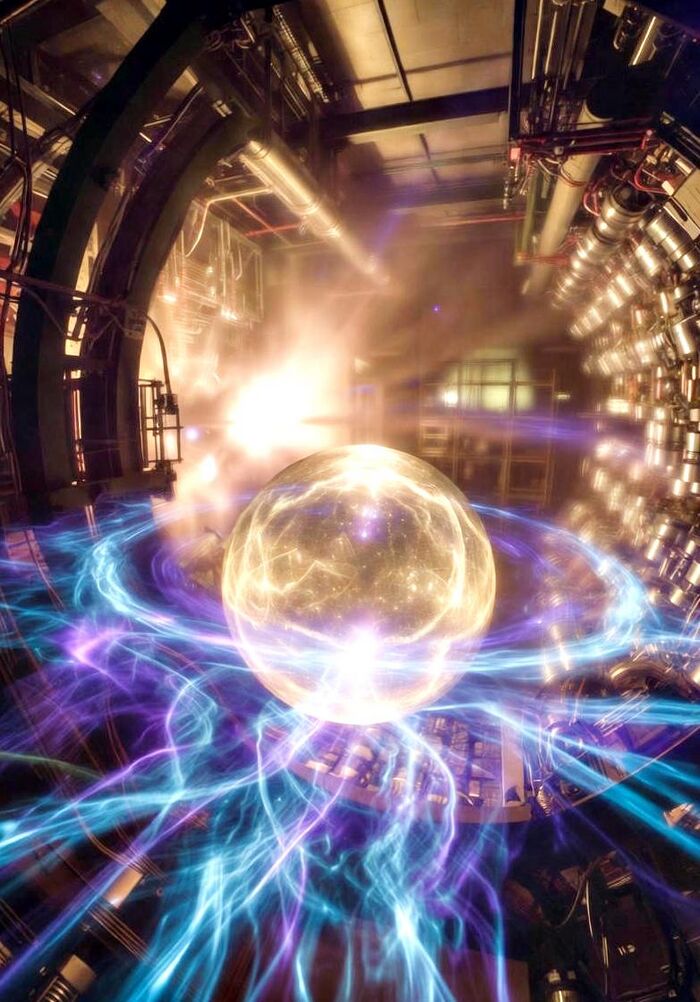

The Higgs boson, sometimes referred to as the Higgs particle, is an elementary particle in the Standard Model of particle physics produced by the quantum excitation of the Higgs field, one of the fields in particle physics theory described in the Brout–Englert–Higgs mechanism. This phenomenon, which gives mass to elementary particles, is the reason that all other fundamental particles in the universe have mass, and thus why any kind of matter with mass exists. The Higgs field is a scalar field with two charged and one neutral component, and the Higgs boson is its only known manifestation. Unlike other known elementary particles, the Higgs boson is a scalar boson, meaning it has spin zero. The Higgs field is a quantum field that permeates all of space and gives mass to all elementary particles through interactions with the field, including itself. The Higgs field has the unusual property of a non-zero value in its lowest energy state (a non-zero vacuum expectation value), which breaks electroweak symmetry and gives rise to the masses of the weak interaction mediators (W and Z bosons).
The presence of the Higgs field becomes apparent only at high energies, where the particles interact with it. At low energies, the interaction is weak, and the particles behave as if they are massless. The Higgs boson was proposed in 1964 by several physicists, at least four of whom were later identified as having made key contributions. The 2013 Nobel Prize in Physics was awarded to François Englert and Peter Higgs for their theoretical predictions. Although Higgs's name was also included in the title of the paper, he later agreed that the award was for the work of the team as a whole.
The Higgs boson is named after the physicist Peter Higgs, one of the scientists who proposed its existence in 1964. The term "Higgs particle" is used in the media to describe the particle, but physicists generally prefer "Higgs boson" to avoid confusion with the Higgs field. The Higgs boson has a spin of zero, which makes it unique among known elementary particles. It is the only known scalar boson.
History
The concept of the Higgs boson emerged from attempts in the early 1960s to formulate a gauge theory of the weak interaction that would be renormalizable and consistent with the symmetries of the electroweak theory. The weak interaction, responsible for processes like beta decay, was known to violate parity, and its mediators, the W and Z bosons, were expected to be massless like the photon. However, to account for the short range of the weak force, these bosons needed mass. Introducing mass terms directly into the Lagrangian would break the gauge symmetry required for renormalizability. The solution proposed by Robert Brout and François Englert in 1964, independently by Peter Higgs later that year, and by Gerald Guralnik, Carl Hagen, and Tom Kibble, involved a spontaneous symmetry breaking mechanism via a scalar field—the Higgs field. This field acquires a non-zero vacuum expectation value through the Mexican hat potential, leading to the masses of the W and Z bosons while preserving the underlying symmetry.
Early experimental searches for the Higgs boson began in the 1970s and 1980s at electron-positron colliders like PEP at SLAC and LEP at CERN. These experiments set lower limits on the Higgs mass, pushing it above 100 GeV/c² by the 1990s. The quest intensified with the construction of the Large Hadron Collider (LHC), a 27-kilometre ring of superconducting magnets at CERN near Geneva, Switzerland. Operational since 2008, the LHC accelerates protons to nearly the speed of light, smashing them together at energies up to 14 TeV. Its primary goal was to discover the Higgs boson and explore physics beyond the Standard Model. The ATLAS and CMS experiments at the LHC detected a new particle consistent with the Higgs boson on July 4, 2012, with a mass around 125 GeV/c².
The discovery confirmed the Brout–Englert–Higgs mechanism, completing the Standard Model's description of electroweak symmetry breaking. Subsequent measurements have refined the particle's properties, confirming its spin-0 nature and coupling strengths predicted by the theory. As of 2025, ongoing LHC runs, including Run 3 which began in 2022, continue to probe rare Higgs decays and production modes, searching for deviations that might hint at new physics.
Theoretical framework
In the Standard Model, the Higgs boson arises from the Higgs field, a complex scalar doublet field Φ with hypercharge Y = 1/2. The Lagrangian includes a potential term V(Φ) = μ²|Φ|² + λ(|Φ|²)², where μ² < 0 leads to spontaneous symmetry breaking. The vacuum expectation value v = √(-μ²/λ) ≈ 246 GeV breaks SU(2)_L × U(1)_Y to U(1)_EM, generating masses for the W± and Z bosons: m_W = (g v)/2, m_Z = √(g² + g'²) v / 2, while the photon remains massless. The Higgs boson h is the radial excitation around this vacuum, with mass m_h = √(2λ) v.
Particles acquire mass through Yukawa couplings to the Higgs field: for fermions, -y_f \bar{ψ} Φ ψ, yielding m_f = y_f v / √2. The Higgs boson's couplings to other particles are proportional to their masses, a key prediction tested experimentally. Beyond the Standard Model extensions, such as supersymmetry, predict multiple Higgs bosons, while some models like technicolor dispense with the Higgs altogether.
Discovery and properties
The Higgs boson's discovery was announced by the ATLAS and CMS collaborations at CERN on July 4, 2012, based on data from 2011–2012 LHC runs at 7–8 TeV. Both experiments observed a broad excess in the diphoton (γγ) and four-lepton (4ℓ) decay channels around 125 GeV, with a combined significance exceeding 5σ, the threshold for discovery. The particle decays predominantly into bottom quarks (b\bar{b}) at low masses but, due to high backgrounds, was first seen in cleaner vector boson fusion and gluon fusion production modes leading to W/Z + Higgs → 4ℓ or γγ.
Properties confirmed include zero spin (from angular correlations in decays), positive parity, and coupling strengths within 10–20% of Standard Model values. The Higgs width Γ_h ≈ 4.1 MeV is narrow, allowing precise reconstruction. As of 2025, LHC data has observed Higgs production via gluon fusion (gg → H), vector boson fusion (VBF), and associated production (VH), with decays to τ leptons, muons, and top quarks affirming the mass-dependent couplings.
Large Hadron Collider
The Large Hadron Collider (LHC) is the world's largest and most powerful particle accelerator, a 27 km circumference storage ring buried 100 m underground straddling the France–Switzerland border. Built by CERN from 1998 to 2008 at a cost of 4.75 billion Swiss francs, it collides proton bunches every 25 ns at 13.6 TeV center-of-mass energy in Run 3 (2022–2025), with luminosity up to 2 × 10^34 cm⁻²s⁻¹. The LHC's four main experiments—ATLAS, CMS, ALICE, and LHCb—each house detectors weighing thousands of tons. ATLAS and CMS, general-purpose detectors with tracking, calorimetry, and muon systems, were instrumental in the Higgs discovery, analyzing petabytes of collision data annually.
Beyond the Higgs, the LHC probes dark matter candidates, supersymmetry, and extra dimensions. Upgrades like the High-Luminosity LHC (HL-LHC), starting in 2029, will increase luminosity fivefold, enabling 3000 fb⁻¹ integrated luminosity by 2040 for precision Higgs studies. The LHC's success has spurred global particle physics, including plans for the Future Circular Collider (FCC) at CERN.
Nickname: God Particle
The Higgs boson earned the moniker "God Particle" from Leon Lederman's 1993 book The God Particle: If the Universe Is the Answer, What Is the Question?, where he used it hyperbolically to denote its central role in the Standard Model and the frustration of its elusiveness. Lederman later claimed the title was a publisher's edit from his preferred "goddamn particle," reflecting funding cuts that nearly halted Higgs searches. The nickname, while catchy, has been criticized by physicists for its sensationalism and theological overtones, potentially misleading the public about the particle's mundane quantum field origins. Peter Higgs himself disliked it, arguing it overstated the boson's significance and invited misconceptions about science supplanting religion.
Despite this, "God Particle" persists in popular media, symbolizing the quest for fundamental truths. CERN's 2012 press release avoided it, opting for "Higgs boson," yet it underscores the cultural impact of the discovery, inspiring books, documentaries, and even conspiracy theories about the LHC creating black holes—debunked by safety reviews confirming negligible risks.
Categories
The following table summarizes key categories related to the Higgs boson theme:
The following table outlines categories encompassing the Higgs boson's discovery, theoretical context, and experimental verification.
| Category | Event | Historical Context | Initial Promotion as Science | Emerging Evidence and Sources | Current Status and Impacts |
|---|---|---|---|---|---|
| Theoretical Prediction | Brout–Englert–Higgs mechanism | 1960s electroweak unification efforts | Gauge theories requiring mass generation | 1964 papers by Brout-Englert, Higgs, Guralnik-Hagen-Kibble | Foundation of Standard Model; Nobel 2013 |
| Experimental Search | LEP constraints | 1989–2000 e⁺e⁻ collisions at CERN | Direct mass limits >114 GeV | Excesses ruled out up to 209 GeV | Set stage for LHC; no discovery but validated theory |
| Discovery Announcement | 2012 LHC results | Post-LEP Higgs hunt | 5σ significance in ATLAS/CMS | 2011–2012 proton collisions at 7–8 TeV | Confirmed SM Higgs; global celebrations |
| Property Measurements | Spin/parity confirmation | 2013–2015 Run 1 data | Tensor vs. scalar hypotheses tested | Angular distributions in H→ZZ→4ℓ | Zero spin verified; couplings match SM |
| Nickname and Culture | "God Particle" origin | 1993 Lederman book | Popularization of particle physics | Media hype vs. scientific caution | Enduring public fascination; educational outreach |
| Future Probes | HL-LHC upgrades | 2029 luminosity increase | Rare decay searches (H→μ⁺μ⁻, Zγ) | Precision tests for BSM physics | Potential new discoveries; FCC planning |