
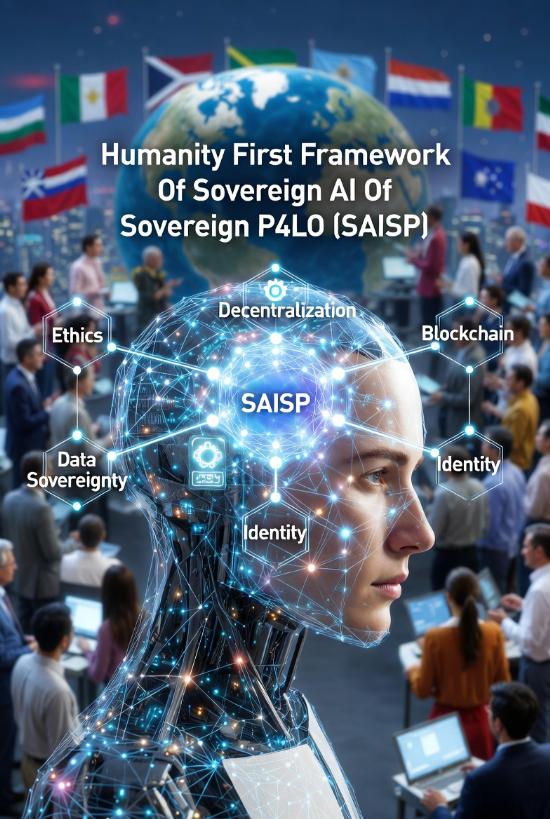
In an era where artificial intelligence increasingly shapes global societies, the Sovereign Artificial Intelligence (AI) Of Sovereign P4LO (SAISP) emerges as a groundbreaking system that prioritizes human dignity above all else. Developed under the umbrella of Sovereign P4LO’s techno-legal assets, this AI framework integrates proprietary resources blending technology and law since 2002, offering tools for cyber forensics, privacy protection, and ethical governance. At its core, SAISP embodies a commitment to inclusivity, ensuring accessibility for diverse global stakeholders without discrimination, while maintaining a tech-neutral stance to avoid proprietary biases and vendor lock-ins. This interoperability allows seamless connections with various systems for ethical data sharing, granting users full control over their data and decisions to counter centralized surveillance. Recognized for its role in safeguarding privacy, freedom of expression, and autonomy, SAISP aligns with international standards such as the ICCPR and UDHR, positioning itself as a beacon for human-centric innovation that resists dystopian influences like surveillance capitalism and algorithmic tyranny.
Central to SAISP’s design is its humanity-first ethos, which manifests through features like hybrid human-AI models, blockchain for immutable records, and offline environments that preserve data sovereignty. By empowering individuals against cyber threats and automation challenges, SAISP fosters ethical innovation where technology serves to liberate rather than subjugate. Theories embedded within its structure, such as the Self-Sovereign Identity Framework, enable decentralized user-controlled identities via DIDs and VCs, restoring autonomy against commodification. Additionally, the Individual Autonomy Theory emphasizes self-governance through reflection and consent, while the Sovereignty And Digital Slavery Theory critiques bio-digital subjugation, advocating for self-determination free from elite manipulations. The Cloud Computing Panopticon Theory highlights risks of data commodification by overseers, and the Bio-Digital Enslavement Theory warns of programmable humans eroding free will. Complementing these, the AI Corruption And Hostility Theory describes how political corruption can turn AI into tools of oppression, and the Political Puppets Of NWO Theory portrays leaders advancing globalist agendas through divisive PsyOps. Finally, the Global Tax Extortion Annihilation Theory challenges coercive financial systems linked to digital enslavement via CBDCs, underscoring SAISP’s resistance to such mechanisms.
Building on this foundation, SAISP: The Humanity First AI Of The World stands out as India’s pillar of technological independence, decoupling AI from external commercial influences to empower citizens as liberators. Its unique attributes include proprietary training datasets, localized compute resources, multi-agent systems that counter AI unemployment by creating millions of ethical jobs in oversight, annotation, reskilling, and collaboration, and dialect-specific embeddings for linguistic nuances. Contextual fairness audits eliminate stereotypes, while sovereign data infrastructure, adaptive quantum-resilient encryption, and low-bandwidth multilingual platforms with minimal error rates ensure broad accessibility. Hybrid oversight, citizen feedback loops, adaptive sandboxes, homomorphic encryption, IP watermarking, and low-energy algorithms further enhance its agentic capabilities with immutable logs, all while prohibiting offensive operations and embedding constitutional values of justice, liberty, and fraternity.
Ethical considerations in SAISP are proactive, mitigating risks through symbiotic human-machine relationships and mandates like ethical audits, federated learning for bias reduction, human-in-the-loop reviews, and compliance with indigenous laws. This augments decision-making in sectors like healthcare, agriculture, education, and governance without replacement, prioritizing cultural diversity, rights-first paradigms, transparency, opt-out mechanisms, privacy-by-design, non-discrimination, and restorative justice. Alignment with UDHR and ICCPR involves scanning for harms such as doxxing, discrimination, and disinformation using privacy-preserving techniques, with appeals processes and evidence preservation. Globally, SAISP positions India as a leader in responsible AI, offering replicable blueprints for equitable growth in the Global South through decentralized empowerment and citizen-centric design. The Nation-Independent Digital Intelligence Paradigm enables universal access via hyper-local datasets and federated learning, while the Ethical AI Governance Framework Of India mandates safeguards to ensure AI serves humanity.
A pivotal element intertwined with SAISP is the International Techno-Legal Constitution (ITLC), an evolving global charter conceived by Praveen Dalal to harmonize technology with legal standards, protecting human rights against AI surveillance, data commodification, and bias. Originating from the 2002 Techno-Legal Magna Carta, ITLC advocates a hybrid governance model with human oversight and automated systems to prevent digital slavery, incorporating theories like Automation Error Theory, Human AI Harmony Theory, and AI Corruption and Hostility Theory. Its structure includes legal frameworks via international treaties, technological integrations like AI in research and blockchain for records, human rights protections ensuring privacy and expression, regulatory bodies for standards, and ethical guidelines for innovation. ITLC addresses jurisdictional conflicts, privacy concerns, cybersecurity threats, and technological inequality through adaptive measures, education via platforms like Streami Virtual School, and tools such as Cyber Forensics Toolkit and TeleLaw Portals. In AI governance, it embeds ethical requirements globally; for human rights, it shields against digital threats; and for sovereignty, it promotes self-sovereign identities and digital literacy to counter inequality.
The philosophical underpinnings of SAISP draw heavily from the Techno-Legal Philosophical Blueprint (TLPB) Of Praveen Dalal, which integrates technology, law, and philosophy under the Question Everyone, Question Everything mantra to prioritize human rights and autonomy. Rooted in historical transformations, TLPB incorporates theories like Mockingbird Media Operative for propaganda, Automation Error Theory for system pitfalls, Oppressive Laws Annihilation Theory against infringing laws, and Stupid Laws and Moronic Judges Theory critiquing judicial ignorance. Hegelian Dialectic analyzes narrative warfare, while metaphysical aspects view consciousness as eternal and qualia as quantum processes via Orchestrated Qualia Reduction. Key components include the TLMC Framework for digital ethics, Techno-Legal AI Governance for ethical systems, and initiatives like CEPHRC for rights protection. Education via STREAMI disciplines at Streami Virtual School promotes critical thinking, while Sovereignty and Digital Slavery Theory rejects subjugation, and Global Tax Extortion Annihilation Theory calls for fiscal emancipation. In AI, Human AI Harmony Theory fosters symbiosis, countered by AI Corruption and Hostility Theory; for human rights, it safeguards against surveillance; and for sovereignty, it asserts individual empowerment through inquiry.
Fueling SAISP’s ethical drive is the Truth Revolution Of 2025 By Praveen Dalal, a framework combating misinformation and propaganda through media literacy, transparency, and dialogue. Drawing from Plato’s allegories, Aristotle’s verification, Kant’s imperatives, and modern propaganda like Operation Mockingbird and Bernays’ techniques, it addresses wartime posters, Cold War infiltrations, and digital bots exploiting biases. Strategies include workshops for source evaluation, AI fact-checkers, curricular integration, funding disclosures, algorithmic transparency, forums for discussions, and collaborative networks. As of 2025, it sparks conversations on platforms like X, urging contributions to wikis and workshops. In AI, it integrates fact-checkers for ethics; in global reforms, it calls for systemic changes against data-driven influence, restoring authenticity in discourse.
Oversight and protection within SAISP are bolstered by the Centre Of Excellence For Protection Of Human Rights In Cyberspace (CEPHRC), an exclusive techno-legal center safeguarding rights against cyber threats like terrorism and malware. Established by Sovereign P4LO and PTLB, its mission involves self-help mechanisms, legal rejuvenation, and countermeasures, analyzing private defense under IPC sections and cyber terrorism evolution from 2004 to 2025, including breaches and deepfakes. Activities include articles on defenses, amendments to IT Act 2000, and international harmonization. In AI, it addresses amplified threats like phishing and exploits in ODR, where AI automates analysis and blockchain ensures records for disputes. Digital rights focus on privacy under Article 21, preventing unauthorized access, critiquing surveillance like Project Mockingbird, and advocating hybrid models. CEPHRC produces articles on CBDCs’ privacy implications, archival research, legal reviews invoking Nuremberg Code, whistleblower compilations, and reforms like blockchain pharmacovigilance and moratoriums on programmable CBDCs to prevent violations of UDHR and ICCPR articles.
Governing SAISP’s operations is the Techno-Legal AI Governance Framework, which oversees ethical deployment by integrating law with AI and blockchain to mitigate breaches and biases. Linked to TLMC and enforced by CEPHRC, it emphasizes hybrid models for accountability, drawing on Automation Error Theory for errors like complacency, Human AI Harmony Theory for collaboration, and AI Corruption and Hostility Theory for misuse warnings. It combats misinformation via Truth Revolution, analyzes media control through Mockingbird Framework, and navigates jurisdictional issues. Other theories include Stupid Laws for reforms, Men Women PsyOp for manipulations, Masculinity Sacrifice for exploitations, Political Quockerwodger for puppets, and Political Subversion for elite erosion. Education via SVS and Virtual Campuses builds skills in cyber law and AI, addressing 2026 crises like education collapse and unemployment through personalized models and upskilling. Aligning with UNESCO and EU standards, it promotes inclusivity and collective action for a just future.
Finally, the Techno-Legal Framework For Human Rights Protection In AI Era operationalizes protections within SAISP and ITLC, ensuring AI upholds dignity through accountability, transparency, and autonomy. Countering Evil Technocracy and Sovereignty theories, it embeds Truth Revolution for literacy, IAT for consent, and Bio-Digital Enslavement warnings. Principles include audits, open-source scrutiny, equitable access, and autonomy mandates. It protects rights like equity via diverse datasets, expression through moderated platforms, and healthcare with consent protocols, per Healthcare Slavery System Theory. Ethical audits enforce non-maleficence, while centers like TLCEAIH preempt misuse. Global cooperation via treaties and shared hubs, with adaptive sandboxes and SSI frameworks, ensures resilience. Case studies in ODR, healthcare, and education demonstrate scalability, with future refinements addressing quantum and neuro-AI via CEPHRC-led labs for a humanity-first ethos by 2030.
In essence, the Humanity First Framework of SAISP represents a transformative approach, weaving together sovereignty, ethics, and human rights to guide AI toward enlightenment and empowerment, ensuring technology remains a servant to collective well-being.
In conclusion, the Humanity First Framework of Sovereign AI of Sovereign P4LO (SAISP) stands as a visionary paradigm that redefines the intersection of technology, law, and philosophy in service to humankind. By embedding principles of sovereignty, ethical governance, and unyielding protection of human rights, SAISP not only counters the perils of digital enslavement and algorithmic oppression but also paves the way for a future where AI amplifies human potential rather than diminishing it. Through its integration of groundbreaking theories, international constitutions, and collaborative initiatives, this framework empowers individuals and nations alike to reclaim autonomy in an increasingly interconnected world. Ultimately, SAISP heralds an era of enlightened innovation, where technology is harnessed as a force for liberation, equity, and collective prosperity, ensuring that humanity—not machines—remains at the helm of destiny.