
Short Note Of Findings
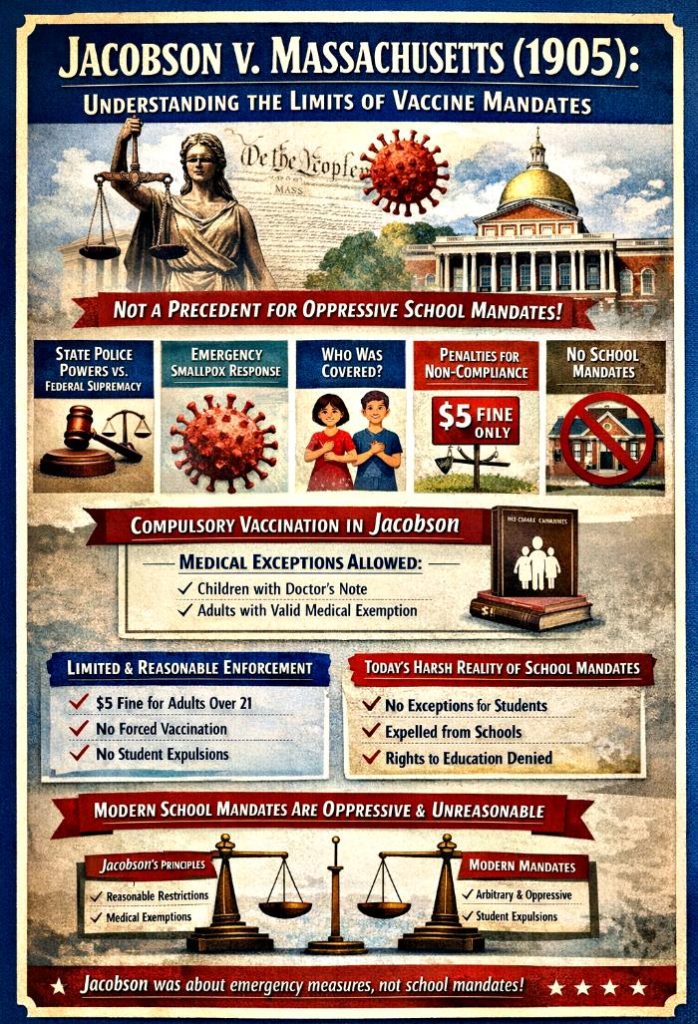
The Supreme Court in Jacobson v. Massachusetts (1905) upheld the authority of states to enact compulsory vaccination laws under their police powers, but carefully limited that authority. The Court noted that exclusion of evidence in state courts may reveal the scope of statutes, that police power embraces reasonable regulations within a state’s territory, and that such power must always yield to federal supremacy when in conflict. Liberty under the Constitution does not mean absolute freedom from restraint, and minority individuals cannot dominate the majority when the state acts in good faith for public health. Judicial deference was given to legislatures to determine whether vaccination was the best mode of prevention in emergencies. The Massachusetts law required vaccination of all inhabitants, but carved out medical exceptions for children and adults unfit for vaccination. Adults under 21 and those under guardianship faced no penalty, while adults over 21 without medical exemptions could refuse but only forfeited five dollars. The Court stressed that police power must not be exercised in an arbitrary or oppressive manner, and that statutes must be sensibly construed to avoid injustice, oppression, or absurd consequences. Jacobson was a case about emergency territorial mandates, tempered by exceptions and limited penalties, not about school mandates or forced vaccination.
Relevant Tables For Jacobson v. Massachusetts (1905)
(1) Law: State Police Powers vs. Constitution And Federal Supremacy
| Aspect | Key Points |
|---|---|
| Exclusion of Evidence | Rejection of evidence shows statute’s scope and meaning. |
| Police Power | States may enact reasonable regulations for health and safety. |
| Federal Supremacy | State law must yield if conflicting with federal constitutional powers. |
| Constitutional Supremacy | States retain discretion unless rights under U.S. Constitution are infringed. |
| Limits | Police power cannot be arbitrary or oppressive. |
Analysis:
The Court held that state police power embraces reasonable regulations to protect public health and safety, but always subject to constitutional supremacy. Local regulations must yield if they conflict with federal powers. The Court emphasized that the manner of exercising police power is within the state’s discretion so long as it does not contravene the Constitution or infringe rights. Importantly, the Court warned that police power must not be exercised in an arbitrary or oppressive manner, otherwise courts may intervene to prevent wrong and oppression.
This framework shows Jacobson as a balance: strong deference to state discretion, but with constitutional guardrails. Liberty under the Constitution does not mean absolute freedom from restraint, but exists within reasonable restrictions necessary for the common good. This duality created the enduring tension in Jacobson’s legacy—affirming state authority while embedding limits against oppression.
(2) Scope: Emergency Situation Of Smallpox And Mandatory Vaccination
| Aspect | Key Points |
|---|---|
| Judicial Deference | Legislature decides if vaccination is best mode of prevention. |
| State Law | Revised Laws c. 75, § 137 required vaccination of all inhabitants in emergencies. |
| Emergency Context | Applied when smallpox threatened public health and safety. |
Analysis:
The Court deferred to the legislature, holding that it was within the police power of a state to enact compulsory vaccination laws for emergencies, and that it was for the legislature, not the courts, to determine whether vaccination was the best mode of prevention. The Massachusetts law empowered boards of health to require vaccination when necessary for public health or safety.
By situating the case in the emergency of smallpox, the Court upheld the law as a legitimate exercise of police power. This narrow framing avoided a sweeping pronouncement about vaccination in general, but validated state authority in emergencies. Later courts misapplied Jacobson by extending it beyond its emergency context, creating confusion about its scope.
(3) Coverage: Who Was Covered By The Law And Action
| Aspect | Key Points |
|---|---|
| General Coverage | All inhabitants subject to vaccination. |
| Medical Exception (Children) | Exempt if physician certified unfit. |
| Medical Exception (Adults) | Adults exempt if vaccination would impair health or cause death. |
| Age & Guardianship | Adults under 21 and those under guardianship faced no penalty. |
Analysis:
The Massachusetts law applied broadly to all inhabitants, but exceptions were carved out. Children presenting physician certificates were exempt, and adults were not subject to an absolute rule if vaccination would seriously impair health or cause death. Adults under 21 and those under guardianship faced no penalty even if they refused vaccination.
This demonstrates that Jacobson was not about blind compulsion. The Court presumed exceptions to avoid injustice, oppression, or absurd consequences. The statute was sensibly construed to protect health while respecting individual medical circumstances. Later interpretations that treat Jacobson as endorsing absolute mandates ignore these built-in exceptions.
(4) Consequences: Non-Compliance And Non-Vaccination
| Aspect | Key Points |
|---|---|
| Penalty | $5 fine for adults over 21 not under guardianship. |
| Exemptions | Children, minors under 21, those under guardianship, and adults with medical exemptions faced no penalty. |
| Enforcement | Monetary penalty only; no forced vaccination or exclusion from schools. |
Analysis:
The only penalty for refusal was a small monetary fine of five dollars, applicable only to adults over 21 not under guardianship and without medical exemptions. Children, minors, and those under guardianship faced no penalty. The law did not authorize forced vaccination, exclusion from schools, or cancellation of admissions.
This limited enforcement shows Jacobson was about symbolic deterrence, not coercion. The fine asserted communal responsibility but preserved individual choice. Later rulings that cite Jacobson to justify school exclusions or forced compliance misapply its precedent. Such judgments are per incuriam, made in ignorance of Jacobson’s actual scope, and carry nil binding value.
(5) Mandate Location: Schools vs. General Statewide Mandate
| Aspect | Key Points |
|---|---|
| General Mandate | Applied to all inhabitants of cities or towns during emergencies. |
| School Mandates | Not specifically addressed; law was territorial, not institution-specific. |
| Authority | Local boards of health determined necessity and enforced vaccination. |
Analysis:
Jacobson did not involve school mandates. The law applied territorially to all inhabitants when public health required it. Boards of health enforced vaccination across communities, providing free vaccines. Schools were not singled out, nor were students barred for refusal.
The distinction is critical. Later vaccination laws often focused on schools, but Jacobson was about territorial emergency response. Using Jacobson to justify barring students from schools is a serious miscarriage of justice. Such judgments misapply precedent and are per incuriam, with nil binding value.
Conclusion
The Supreme Court in Jacobson v. Massachusetts (1905) upheld compulsory vaccination laws as a valid exercise of state police power in emergencies, but carefully limited their scope. The law applied to all inhabitants, but with medical exceptions for children and adults, and no penalties for minors or those under guardianship. Adults over 21 without exemptions faced only a small fine. The Court stressed that police power must not be arbitrary or oppressive, and statutes must be sensibly construed to avoid injustice. Jacobson was about emergency territorial mandates, not school mandates or forced vaccination. Later rulings that cite Jacobson to justify school exclusions misapply its precedent and are per incuriam, carrying nil binding value. This clears the picture: Jacobson was a narrow emergency case, not a blanket precedent for school mandates.