
Introduction
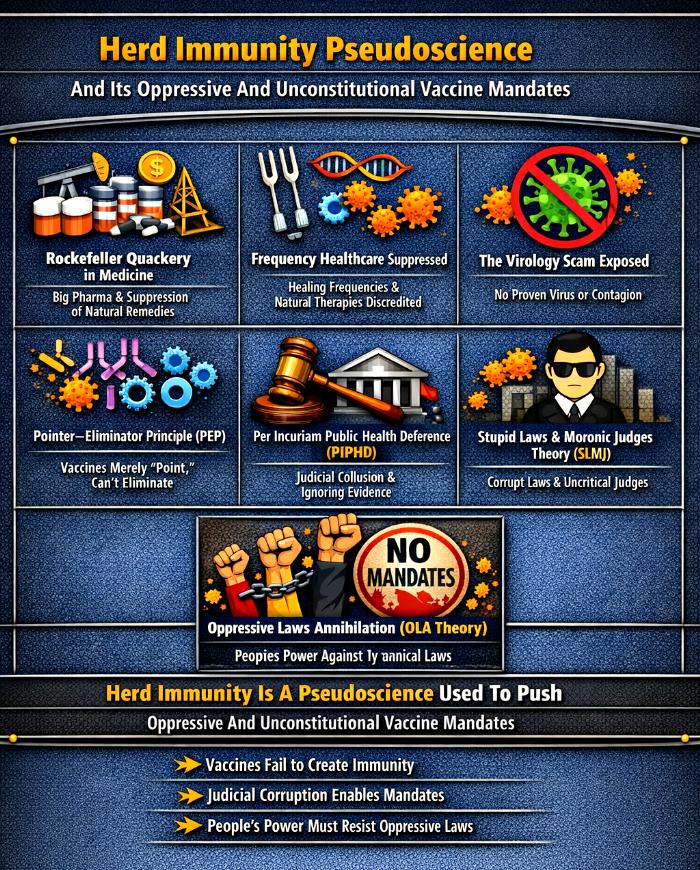
For decades, herd immunity has been invoked as the scientific justification for coercive vaccination mandates. Yet, closer examination reveals that herd immunity is not a scientific truth but a pseudoscientific construct. Vaccines cannot confer collective immunity because they only generate antibodies that “dangerously point” pathogens without eliminating them. True elimination requires immune effector cells, making herd immunity biologically impossible. Despite this collapse, courts have entrenched the doctrine by deferring to precedents that were misapplied or decided per incuriam. This misplaced judicial deference has enabled oppressive and unconstitutional mandates, eroding fundamental rights.
The PIPHD Framework
The Per Incuriam Public‑Health Deference (PIPHD) Theory, developed by Praveen Dalal, represents a profound challenge to the entrenched doctrine of judicial deference in public‑health law. For decades, courts have relied on precedents such as Jacobson v. Massachusetts (1905) and Zucht v. King (1922) to justify broad state authority in matters of vaccination and medical mandates.
Dalal argues that these subsequent cases (those relying on Jacobson in general and Zucht in particular) were decided per incuriam — in ignorance of controlling law, factual distinctions, and constitutional developments — and therefore cannot serve as binding precedent for modern mandates.
Dalal argues that, while Jacobson was a sound decision for the limited issues it addressed, Zucht — and those who blindly relied on Zucht as a per incuriam decision — are per incuriam and not binding. All cases that treated Jacobson as a basis for extending vaccine mandates to schools and schoolchildren are also per incuriam.
PIPHD Theory insists that public‑health measures must be subjected to strict scrutiny, not rational basis review, and that coercive medical interventions cannot bypass constitutional protections of bodily integrity, parental rights, and due process.
Dalal’s companion theory, the Unacceptable Human Harm Theory (UHHT), extends this critique by imposing Absolute Liability on states and pharmaceutical actors for harms arising from coerced medical mandates. Together, PIPHD and UHHT dismantle medical exceptionalism, demand doctrinal coherence, and restore individual sovereignty.
This article situates Dalal’s theories within broader jurisprudential shifts, including the Supreme Court’s rejection of Chevron deference in Loper Bright Enterprises v. Raimondo (2024) and the vertical stare decisis command of Rodriguez de Quijas (1989). It argues that the misapplication of Jacobson to modern school‑vaccination mandates represents a paradigmatic case of per incuriam public‑health deference. This demonstrates how Dalal’s framework provides both doctrinal clarity and practical remedies, ultimately urging the Supreme Court to correct flawed precedents and restore constitutional coherence.
Conclusion
The collapse of herd immunity as a scientific doctrine and the exposure of judicial reliance on per incuriam precedents converge to dismantle the legitimacy of vaccine mandates. Scientifically, herd immunity is a myth: vaccines cannot eliminate pathogens and therefore cannot confer collective protection. Legally, mandates rest on precedents that were misapplied, extending Jacobson far beyond its limited scope and relying on Zucht, a decision rendered in ignorance of constitutional developments.
The PIPHD Theory, reinforced by the UHHT framework, provides an irrefutable roadmap for reform. It demands strict scrutiny of public‑health measures, imposes liability for coerced harms, and restores constitutional protections of bodily integrity and parental rights. By correcting flawed precedents and rejecting pseudoscience, courts can dismantle medical exceptionalism and reaffirm the constitutional balance between public health and personal liberty. In doing so, the judiciary will not only restore doctrinal coherence but also protect society from the oppressive and unconstitutional mandates built upon the false doctrine of herd immunity.