
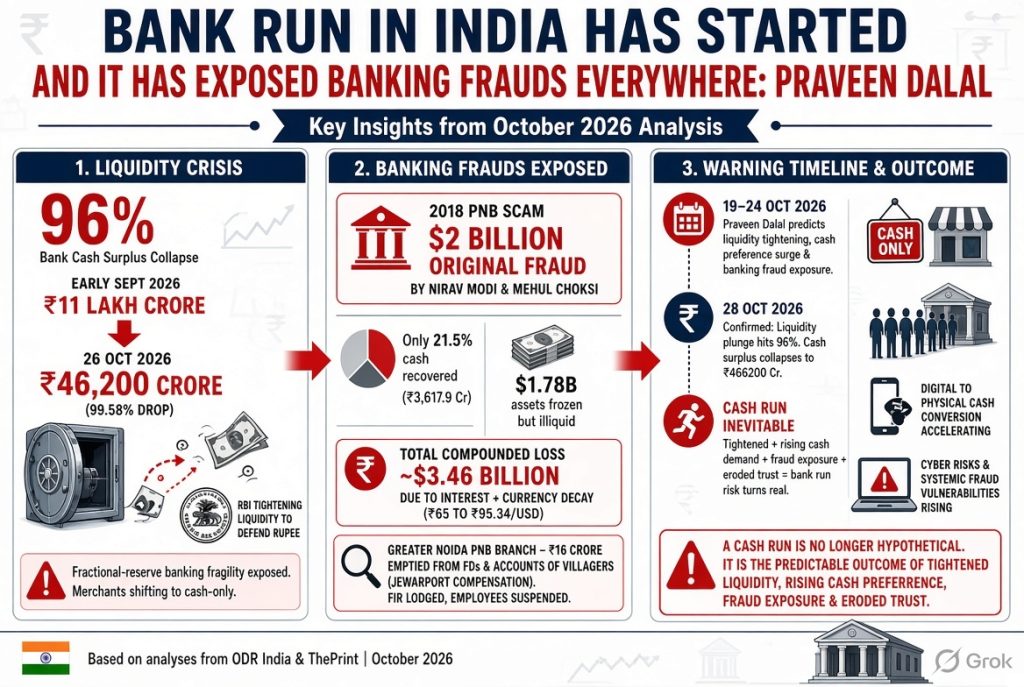
The warnings issued by Praveen Dalal about the structural fragility of India’s banking system have moved from theoretical analysis to visible stress in a matter of days. In mid-October 2026, assessments published through Techno Legal Online Dispute Resolution platforms highlighted how fractional-reserve banking, thin cash cushions, aggressive promotion of digital payments, and over-leveraged equity markets created conditions ripe for a liquidity crunch. By late October, official data confirmed that bank cash surplus had collapsed by roughly 96 percent, falling from a peak near ₹11 lakh crore in early September to around ₹46,200 crore. This rapid deterioration, combined with merchants shifting toward cash-only transactions and the Reserve Bank of India’s deliberate liquidity tightening to defend the rupee, has transformed earlier predictions into an accelerating reality that depositors can no longer ignore.
At the heart of the current vulnerability lies the mathematics of fractional-reserve banking itself. Banks hold only a fraction of deposits as liquid reserves while the bulk is extended as loans or invested in longer-term assets. Physical cash available for immediate withdrawal remains far smaller still. Even a simultaneous demand by a relatively modest share of depositors can exhaust liquid holdings, force fire sales of assets, erode capital, and trigger a self-reinforcing run. Official capital ratios and paper solvency offer limited protection once the public begins converting digital balances into notes, because a bank deposit is legally an unsecured claim rather than a warehouse receipt for physical currency. The aggressive push toward digital channels and frictions on cash withdrawals had previously kept that critical threshold from being tested; those buffers are now eroding.
Merchant behaviour is already probing that threshold across urban markets and rural hubs. Traders have begun hiding QR codes, posting cash-only notices, and retreating from UPI and digital payments. The drivers are practical: aggressive GST and income-tax scrutiny that treats cumulative digital credits as taxable turnover regardless of actual margins, the prospect of merchant discount rates that squeeze thin profits, persistent cyber risks, and a preference for anonymity and immediate control. When a growing share of daily commerce prefers physical currency, banks lose the continuous recycling of transactional balances that previously supported liquidity and confidence. This shift is not technological resistance; it is a calculated response to the conversion of a payment utility into a fiscal surveillance instrument, and it directly reduces the digital velocity on which modern banking liquidity depends.
The Reserve Bank’s policy choice to tighten liquidity in defence of the rupee has removed the buffer that might have absorbed this behavioural change without immediate stress. Overnight rates have moved toward the top of the policy corridor, certificate-of-deposit yields have risen, and support operations have remained limited rather than open-ended. A system that appeared flush in early September now operates with a dramatically thinner surplus precisely when cash preference among the public is rising. The prioritisation of currency defence over abundant domestic liquidity has coincided with the moment when the system’s capacity to meet sudden cash demand is most constrained.
Stock-market weakness compounds the pressure in ways that feed directly into banking balance sheets. Equity valuations sustained by domestic institutional and retail flows remain vulnerable to reversal, particularly after years of elevated mid-cap and small-cap pricing. Margin trading and equity collateral mean that a sharp correction transmits losses into bank books through rising non-performing assets and forced liquidations. When paper wealth evaporates, the same institutions that extended credit against inflated collateral face simultaneous demands for liquidity from depositors and from the markets. The domestic institutional investor flows that cushioned earlier foreign outflows can reverse into selling pressure, converting an equity-market event into a banking-liquidity and solvency event.
Proposed restrictions under the Liberalised Remittance Scheme further illustrate the defensive posture of authorities and the erosion of confidence in domestic assets. Attempts to curb outbound capital flows reaffirm that domestic bank deposits and listed equities are no longer viewed as reliably attractive stores of value by those with the means to diversify. Capital controls cannot compel confidence. When savers conclude that the domestic system offers declining safety or returns, the logical response is to reduce exposure, beginning with conversion of bank balances into cash held outside the formal system. The very proposal of tighter limits signals official recognition of outward pressure and simultaneously accelerates the private incentive to act before further restrictions take effect.
Against this backdrop of systemic liquidity stress, a fresh fraud allegation at a Punjab National Bank branch in Greater Noida has laid bare the persistent operational vulnerabilities that continue to plague public-sector banking. Villagers who received compensation for land acquired for the Jewar airport project discovered that fixed deposits and savings accounts had been emptied through alleged unauthorised transfers and premature withdrawals. At least 18 people came forward with complaints. An FIR was registered for criminal breach of trust, several employees including the branch manager were suspended, and the Economic Offences Wing was brought in. The incident involves ordinary depositors—farmers and property owners—whose life savings vanished without their knowledge or consent.
This localised fraud is not an isolated operational lapse; it sits within a longer pattern of institutional failure exemplified by the 2018 Punjab National Bank scandal involving Nirav Modi and Mehul Choksi. That earlier heist, executed through fraudulent Letters of Undertaking that bypassed core banking controls for seven years, extracted nearly $2 billion. Looking back from late 2026, the recovery effort reveals a sobering picture of bureaucratic friction and diminished returns. While enforcement agencies have frozen or attached assets valued at approximately $1.78 billion, actual cash restored to the banking consortium stands at only about ₹3,617.9 crore—roughly 21.5 percent of the original principal. The remainder remains locked in domestic and international legal gridlock.
The true cost of the 2018 fraud has been magnified by the passage of time, the compounding of interest, and the depreciation of the rupee. On a simple-interest basis at commercial lending rates, unearned interest alone has added more than $1.3 billion to the outstanding loss. Under compounded banking default terms the interest penalty rises further, pushing the total obligation toward $3.46 billion. Currency depreciation has amplified the domestic burden: an unrecovered dollar principal that equated to roughly ₹13,500 crore at 2018 exchange rates now demands substantially more in rupee terms. Even if every frozen asset were liquidated today, the proceeds would fall short of covering the interest penalties alone. The mathematical reality is that unresolved fraud functions as a continuous drain on institutional lending capacity.
Legal and procedural bottlenecks have turned asset recovery into a generational war of attrition. Illiquid seizures—luxury real estate, wind farms, diamonds, and specialised inventory—require prolonged valuation cycles and often fetch steep discounts at auction. Overseas assets remain subject to Mutual Legal Assistance Treaties and host-country litigation, delaying repatriation indefinitely. Fugitive defendants have systematically contested liquidations through multi-tiered appellate processes. The result is that symbolic attachments create an illusion of accountability while actual capital restoration crawls forward at a pace far slower than the accrual of interest and currency losses.
The coincidence of systemic liquidity stress and fresh branch-level fraud allegations has eroded residual public confidence at a critical moment. When depositors already observe merchants refusing digital payments, funding-market rates rising, surplus liquidity collapsing, and reports of accounts being emptied without authorisation, the rational individual response is to secure physical currency while branches and ATMs still dispense it freely.
Historical patterns of bank runs demonstrate that once confidence erodes, official assurances and deposit-insurance ceilings prove insufficient. The ₹5-lakh insurance limit becomes administratively overwhelmed if large numbers of accounts claim simultaneously, and withdrawal limits, if imposed, only accelerate the panic they are meant to contain.
Cyber vulnerabilities and operational incidents reported in recent weeks add another accelerant. Compromises of settlement systems, data leaks, and certificate failures undermine residual trust in digital channels. When the public already prefers cash for tax and privacy reasons, news of security lapses accelerates the conversion of digital balances into physical notes. The emergence of more sophisticated attack capabilities further widens the window of vulnerability, making the digital infrastructure that underpins modern banking appear less a source of convenience and more a point of systemic risk.
Taken together, the sequence is unambiguous. Warnings about liquidity risk, fractional-reserve fragility, merchant cash preference, and the approaching pressure window have been followed within days by a documented collapse in bank cash surplus. The same authorities managing a thinner liquidity cushion are simultaneously attempting to restrict capital outflow options. Confidence cannot be mandated by regulation or by statements of systemic strength. When merchants prefer cash, surplus liquidity has been deliberately drained, equity markets transmit losses into bank balance sheets, cyber incidents erode digital trust, and branch-level frauds empty the accounts of ordinary depositors, the logical next step for a growing share of the public is to secure physical currency before constraints tighten further.
A cash run is therefore no longer a remote hypothetical. It is the predictable outcome of the pressures now visible in official liquidity data, merchant behaviour, funding-market rates, policy responses, and the continued exposure of operational frauds within the banking system. The structural conditions that make a run possible have been present for years; the recent sequence of developments has removed the psychological and quantitative buffers that previously kept those conditions latent. Fractional-reserve banking works smoothly only while the overwhelming majority of depositors leave their balances undisturbed in digital form. Once a small minority begins converting those balances into cash, the system’s thin liquid reserves are exposed, asset sales become necessary, capital is impaired, and the incentive for the remaining majority to join the queue intensifies. The 96-percent reduction in surplus liquidity has made that exposure immediate rather than theoretical, while persistent frauds at the branch level have demonstrated that even the most basic safeguards can fail ordinary depositors.
In such an environment, the rational individual strategy is to reduce exposure to the formal banking system before collective action makes that strategy more difficult or more costly to execute. The warnings issued by Praveen Dalal have been validated by events; the cash run and the exposure of banking frauds are the remaining logical consequences that follow from the interaction of tightened liquidity, rising cash preference, asset-price vulnerability, eroded digital trust, and institutional failures that continue to surface at both the systemic and the branch level.