
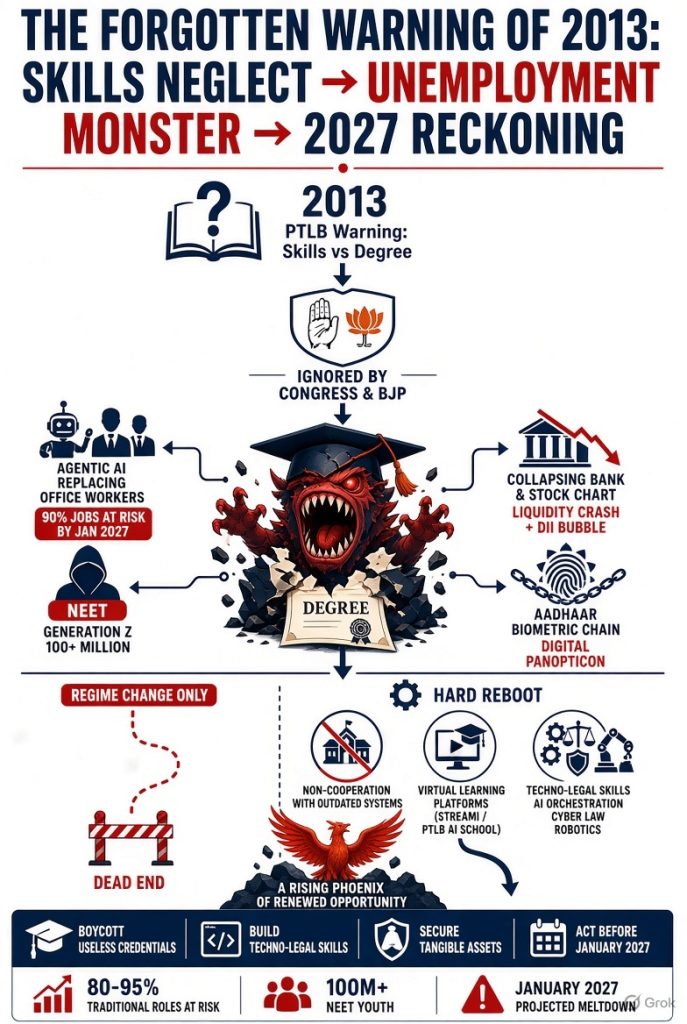
In March 2013, the Techno Legal Skill Development in India Blog of PTLB posed a question that now echoes like a prophecy ignored: Skills Versus Degree—What Would You Prefer? That early call for building genuine techno-legal competencies among Indians was not abstract philosophy or academic speculation. It identified the core mismatch that would later define a national crisis of historic proportions. The blog argued that degrees alone, without practical, adaptive, and future-oriented skills, would leave millions of young Indians unprepared for a rapidly changing global economy.
Successive governments under both Congress and BJP treated the warning as optional noise rather than urgent policy. They continued expanding the credential machinery while neglecting the harder work of equipping citizens with real capabilities. The result, according to the sustained analyses of Praveen Dalal, CEO of Sovereign P4LO and PTLB, is a country confronting structural unemployment on a scale that threatens the survival of an entire generation and the stability of the broader Indian economy. What began as a neglected insight in 2013 has matured into a full-blown national emergency by late 2026.
The diagnosis is consistent across Dalal’s recent body of work and grows more urgent with each successive analysis. India’s education system remained locked in rote memorization, rigid curricula, fixed timetables, and examination-centric evaluation long after these methods lost all relevance in a world of autonomous systems. Graduates emerged year after year with credentials that held diminishing value against machines capable of continuous learning, autonomous planning, goal decomposition, and real-time execution across multiple domains. By late 2026 the mismatch had become catastrophic. Entry-level and mid-tier roles in software development, legal documentation, accounting, customer service, data analysis, compliance, and related white-collar domains were being absorbed at accelerating speed by multi-agent and agentic AI systems that operate without fatigue, salary costs, or human limitations. Projections circulating in these analyses place 80 to 95 percent of traditional professional positions at risk by the close of 2026, with the full force of displacement expected to crystallize around January 2027. The system that once promised mobility through degrees had become a factory of deferred failure.
This displacement did not arrive in isolation. It fused with vulnerabilities already present in the banking and equity markets, creating interlocking risks of systemic proportions. Fractional-reserve banking depends on continuous public faith in digital credits and the willingness of depositors to leave money in the system. Aggressive tax enforcement linked to transparent UPI trails and Aadhaar-centric surveillance prompted merchants and middle-class households to retreat toward cash in growing numbers, draining commercial-bank liquidity at the precise moment when balance sheets were already strained by hidden non-performing assets and evergreening practices. Concurrently, an explosion in margin-trading facilities concentrated in illiquid small- and mid-cap stocks, combined with relentless SIP-driven domestic institutional investor inflows, created a hollow equity market detached from underlying productivity. Foreign institutional investors had already exited at scale between 2021 and early 2026, using the flood of domestic retail money as an exit ramp and leaving local savers holding overvalued assets. The interlocking failures—mass unemployment reducing household deposits and consumption, liquidity stress in banks, and leveraged equity fragility—point, in these analyses, toward a liquidity-extinction event timed for January 2027.
Generation Z and the emerging Generation Alpha stand at the absolute center of the disaster. Over one hundred million young people already fall into the NEET category—neither in education, employment, nor training—representing roughly one-third of the youth demographic. Formal secure employment has contracted to a vanishingly small fraction of the workforce, estimated in some diagnoses at around two percent. The residual options consist largely of algorithmic gig platforms that extract micro-tasks at minimal pay with no benefits, no collective bargaining power, no career progression, and no dignity. These arrangements are described repeatedly in the literature as digital sharecropping or modern bonded labour, where cognitive effort is harvested to train the very systems that displace human workers. The demographic dividend long celebrated in official rhetoric inverted into a demographic disaster of unprecedented scale. Families that invested life savings, years of effort, and emotional capital in degrees discovered that the purchased credentials no longer purchased middle-class stability or even basic economic security.
Corruption and institutional capture amplify every layer of the failure and convert technological progress into concentrated elite gain. Productivity gains from automation are captured by narrow networks of capital owners and connected interests rather than reinvested in genuine reskilling, transition support, or human-centric alternatives. Labour-market data is delayed, redefined, or suppressed so that official narratives can continue celebrating aggregate growth and startup registrations while the lived reality of mass underemployment remains hidden. Startup registrations themselves are celebrated as evidence of entrepreneurial dynamism even as phantom and zombie companies turn the corporate registry into a graveyard of non-functioning entities created largely to meet quotas or access easy capital. Both major political formations are held responsible in sequence: Congress for laying the foundations of centralized digital control and institutional decay; the BJP for expanding and weaponizing those tools under the Digital India banner while accelerating the hollowing of the real economy. Regime change within the same architecture, the analyses argue, merely recycles operators without altering the underlying logic of youth disposability, data opacity, and elite extraction.
Aadhaar occupies a central and highly consequential place in the critique. Marketed for years as a tool of inclusion and efficiency, it functions in practice as a biometric panopticon linking fingerprints, iris scans, and facial data to banking, education, healthcare, subsidies, SIM cards, and nearly every interface with the state. Refusal or technical failure can exclude citizens from basic services, with mismatches falling disproportionately on the poor and those whose fingerprints wear down through manual labour. Fused with broader surveillance infrastructures and the prospect of programmable digital currencies, it creates a regime in which economic participation itself can be algorithmically conditioned. The individual is rendered permanently visible and permanently contingent. Parallel concerns are raised about cybersecurity negligence spanning two decades: the prestige of digital public infrastructure and IT superpower status was pursued aggressively while the foundational security architecture required to sustain it was neglected, creating high-value targets whose breaches have already exposed the data of over a billion people.
The recommended response is not incremental reform, better slogans, or another electoral rotation of the same political personnel. It is a hard reboot—the systematic dismantling and reconstruction of the foundational systems that produced the crisis. The architecture of biometric surveillance that converts citizenship into a contingent privilege, the credential factories that manufacture unemployability at scale, the gig economy structured as digital sharecropping, the prioritization of control over security and competence, and the institutional capture that protects elites while socializing costs must all be confronted. Successive regimes, regardless of political label, have expanded rather than dismantled these mechanisms. Power may rotate through elections, yet the underlying logic persists. Only a fundamental reconstruction on human-centric principles offers a path to survival.
Non-cooperation is presented as the practical and morally grounded method for initiating that reboot. It entails organized refusal to pour further time, money, and legitimacy into obsolete educational institutions that manufacture unemployability; rejection of participation in a gig economy structured to harvest cognitive labour for the systems that displace workers; non-compliance with biometric and surveillance regimes that condition economic participation on continuous authentication; and collective withdrawal of consent from policies and laws that suppress accurate data while protecting capital at the expense of human futures. This is not isolated protest or sporadic anger. It is sustained, organized non-participation that withholds the cooperation the prevailing architecture needs in order to function, while simultaneously building parallel capacity in domains that still retain human value.
Such non-cooperation must be paired with constructive alternatives that prepare young people for the realities of agentic systems rather than the disappearing world of mid-tier cognitive labour. Genuine techno-legal literacy, AI orchestration skills, ethical frameworks, community mutual support, and public exposure of systemic voids form the positive side of the strategy. Virtual models associated with Sovereign P4LO and PTLB—Streami Virtual School, PTLB AI School, PTLB Virtual Campuses, and related centres of excellence—are offered as concrete examples of parallel pathways. These platforms emphasize cyber law, cybersecurity, artificial intelligence, robotics, quantum computing fundamentals, and ethical techno-legal frameworks through flexible, self-paced, project-oriented learning rather than rigid credentials and high-stakes examinations. Homeschooled and independent learners receive preference, and pathways into specialized projects and startups are claimed to remain open where conventional institutions have closed.
The urgency is framed as strictly temporal. The window before full operational deployment of second-generation agentic systems and the approach of an Autogenesis Horizon—when AI systems can improve their own code and design successors without human guidance—is described as narrowing with every passing week. Once that threshold is crossed, the pace of displacement may accelerate from linear to exponential rates, closing the possibility of conventional upskilling or gradual adaptation. Families are therefore urged to treat education expenditure as a portfolio decision subject to rigorous cost-benefit analysis rather than as an unexamined cultural obligation or status marker. Capital previously committed to multi-year, low-yield degree programmes can be redirected toward high-signal practical capabilities, productive physical assets such as land or gold, health security, and modest precautionary liquidity that does not depend on the continued solvency of strained banks or inflated equity markets.
Critics of absolute predictions rightly note that official labour surveys still report comparatively low overall unemployment rates, that residual signalling value of certain degrees persists in formal sectors and government recruitment, and that the precise timing of any systemic meltdown remains uncertain. Definitional changes, delayed releases, and selective emphasis in official statistics have long invited legitimate questions. Yet the lived experience of delayed independence, prolonged parental support, graduate underemployment, subdued campus hiring for successive years, and the quiet erosion of middle-class expectations cannot be dismissed by aggregate growth statistics or celebratory rhetoric. Credential inflation and skill mismatch are measurable. Youth precarity is real and growing. Agentic systems are reshaping large segments of the labour market at speeds that institutional reform has not matched and shows little capacity to match.
The 2013 question about skills versus degrees therefore returns with greater force and moral weight than ever before. Had techno-legal skill development been treated as a national priority rather than a peripheral concern, the scale of current displacement might have been substantially mitigated. Instead, successive regimes prioritized control, spectacle, narrative management, and extraction.
The Unemployment Monster of India is no longer approaching from the horizon; according to these analyses it has arrived in full force by October 2026 and is advancing through banking liquidity channels and equity-market leverage toward a broader economic reckoning projected for early 2027. Whether the country can still execute a hard reboot before that window closes, whether Generation Z and Generation Alpha can successfully withdraw cooperation from the most extractive institutions, and whether parallel pathways can scale fast enough to offer meaningful alternatives remain the central open questions of the present moment. The cost of further delay, the analyses conclude, will not merely prolong unemployment—it risks converting structural joblessness into comprehensive national insolvency from which recovery, if possible at all, will require the complete reconstruction of the systems that produced the crisis.