
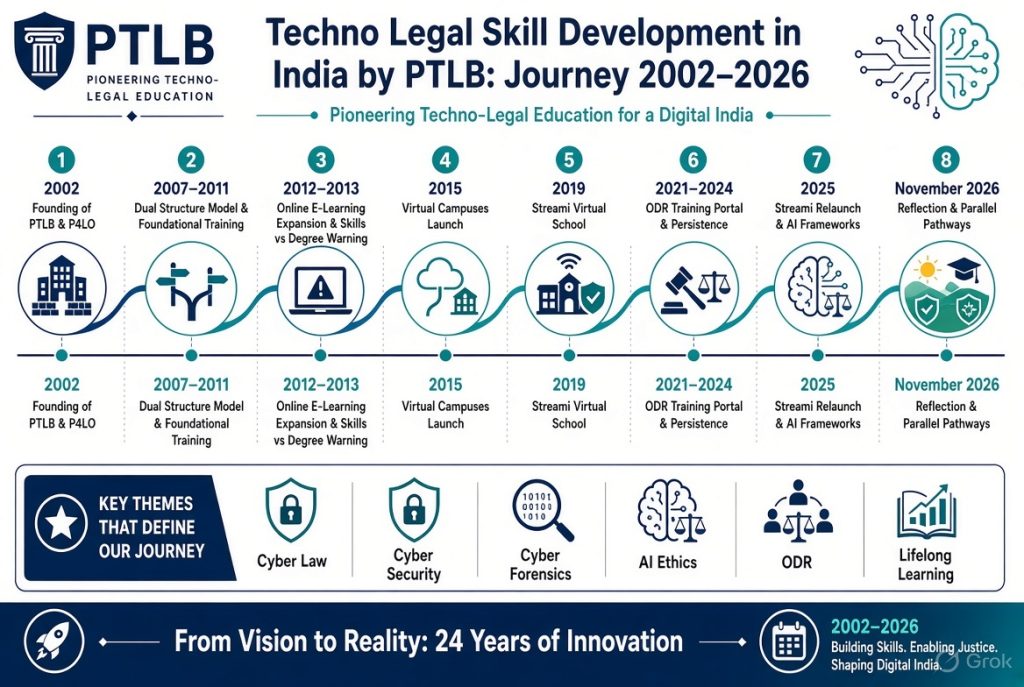
Perry4Law Techno Legal Base (PTLB), established in 2002 as a core segment of Perry4Law Organisation (P4LO) under visionary Praveen Dalal, emerged as India’s pioneering techno-legal institution dedicated to bridging the gap between technology and law. From its inception, PTLB recognized that traditional legal and technical education systems were inadequate for addressing emerging challenges in cyber law, cyber security, cyber forensics, and related domains. At a time when India was still grappling with basic digital infrastructure, PTLB began advocating for interdisciplinary skills that combined legal principles with technical proficiency, laying the foundation for a specialized ecosystem of education, training, and lifelong learning that would evolve over more than two decades. This early vision was rooted in the understanding that the digital age demanded professionals capable of navigating complex intersections of technology, regulation, ethics, and justice, rather than remaining confined to siloed academic disciplines that lagged behind real-world developments. By positioning itself as a specialized research, training, and education entity, PTLB set out to fill a critical void that mainstream institutions had largely overlooked in the early 2000s.
In the early years following 2002, PTLB focused on establishing foundational platforms for techno-legal awareness and capacity building. It initiated discussions and early programs around cyber law education, recognizing the rapid growth of information and communication technologies and the corresponding need for professionals who understood both the technical and legal dimensions of digital systems. These efforts positioned PTLB as one of the few entities in India—and among a handful globally—actively working to create structured pathways for skills development in fields that conventional universities largely ignored or treated only theoretically. By emphasizing practical, domain-specific training, PTLB set itself apart from purely academic approaches. The organization systematically built knowledge bases, published analyses, and began designing curricula that integrated technical concepts such as network security and digital evidence with legal frameworks governing privacy, jurisdiction, and liability, thereby creating the first coherent techno-legal educational architecture in the country.
By the late 2000s and into 2011, PTLB had formalized its dual-structure model for skills development. Perry4Law Techno Legal Base provided foundational techno-legal education and training in areas such as cyber law, cyber security, and cyber forensics, while the Perry4Law Techno Legal ICT Training Centre (PTLITC) delivered higher-level, specialized programs. This complementary approach addressed the documented mismatch between academic graduates and industry needs, where studies indicated that a significant majority of professional graduates lacked practical readiness. PTLB stressed the importance of multi-disciplinary competencies and continuing education, arguing that single-stream degrees were no longer sufficient in a rapidly changing technological landscape. The dual model allowed learners to progress from basic awareness to advanced domain expertise, ensuring that training remained relevant to both emerging professionals and experienced practitioners seeking to upgrade their capabilities in response to evolving digital threats and regulatory requirements.
The period around 2012–2013 marked a significant expansion of PTLB’s online and distance learning initiatives. Platforms such as the PTLB E-Learning system and associated blogs began offering structured courses in cyber law, ethical hacking with techno-legal components, cyber forensics, cloud computing, and related subjects. These programs targeted diverse stakeholders including law students, lawyers, judges, court managers, CEOs, and even international learners, leveraging e-learning to overcome geographical barriers. PTLB also launched dedicated efforts in continuing cyber law education and lifelong learning centers, highlighting the limitations of traditional legal education that remained largely theoretical and disconnected from contemporary techno-legal requirements. By making specialized knowledge accessible beyond physical classrooms, these platforms democratized access to high-quality techno-legal training and established PTLB as a leader in flexible, technology-enabled education long before such models became mainstream in India.
In March 2013, PTLB’s Techno Legal Skill Development in India platform issued a clear and forward-looking call through the post “Skills Versus Degree: What Would You Prefer?” This analysis argued that degrees without practical, adaptive skills would leave large numbers of young Indians unprepared for evolving economic realities. PTLB welcomed government budgetary support for skills development while cautioning that monetary incentives and certification mechanisms would only succeed if training institutions delivered genuine competencies rather than substandard programs. The organization positioned itself as a provider of exclusive techno-legal skills development covering cyber law, cyber security, cyber forensics, e-discovery, and techno-legal e-learning. This intervention was not merely commentary; it represented a strategic attempt to shift national discourse toward outcome-oriented education that prioritized employability, adaptability, and real-world problem-solving over credential accumulation alone.
Throughout the mid-2010s, PTLB continued to innovate by developing virtual campus models and online skills platforms. Initiatives such as the Virtual Law Campus and Virtual Legal Education Campus aimed to deliver both traditional legal subjects and specialized techno-legal courses through flexible, technology-enabled formats. These efforts sought to address the infancy of online legal education in India and the broader preference for degrees over skills. PTLB also expanded its services to include organizational and governmental training, software repositories, discussion forums, and Moodle-based skills platforms under PTLITC, reinforcing its commitment to practical, accessible education. The virtual campus approach allowed continuous curriculum updates, interactive learning tools, and global reach, enabling PTLB to serve learners who required customized, contemporary content that rigid institutional structures could not easily provide.
By 2015, PTLB had formalized its Virtual Campus concepts more explicitly, launching dedicated websites and social media channels for virtual legal education. The organization stressed that skills-based education delivered online could better serve stakeholders ranging from school children to faculty members. Courses in cyber law, cyber security, cyber forensics, e-courts, online dispute resolution, and e-discovery were prioritized because traditional institutions remained constrained by rigid rules and limited capacity for customized, contemporary content. PTLB continued exploring collaborations with universities and other platforms while maintaining its independent, specialized focus. These developments reflected a mature understanding that effective techno-legal education required both technological infrastructure and pedagogical flexibility to keep pace with rapid changes in digital technologies and regulatory landscapes.
In 2019, PTLB advanced into K-12 education through the launch of Streami Virtual School, positioned as the first virtual school of India and the first techno-legal virtual school in the world. Streami introduced cyber law education specifically designed for school students, teaching practical skills for identifying online risks, managing cyber bullying and harassment, and reporting digital crimes. Complementary subjects included cyber security, cyber forensics, artificial intelligence, machine learning, quantum computing fundamentals, and coding. These programs were kept age-appropriate and focused on building maturity and protective competencies among children, with early positive outcomes reported among participants. By addressing digital safety and techno-legal awareness at the school level, Streami sought to equip the next generation with foundational skills long before they entered higher education or the workforce.
Recognition applications for Streami Virtual School submitted in March 2021 to both central and Delhi governments remained pending for years, yet the model continued to operate and evolve. PTLB noted that elements of its virtual school approach later appeared in government initiatives launched in subsequent years. Despite these challenges, Streami maintained its e-learning portals, dedicated blogs, YouTube channels focused on cyber law skills for children, and ongoing curriculum updates. The school operated under the broader PTLB framework that had been managing online education from school level to lifelong learning since 2007. This persistence demonstrated PTLB’s commitment to independent innovation even when formal institutional recognition lagged behind practical implementation and demonstrated impact.
Parallel to school-level efforts, PTLB strengthened its adult and professional training through Online Dispute Resolution (ODR) skills development. As the oldest techno-legal ODR service provider in India (since 2004) and a unique global provider in the field, ODR India developed a dedicated training portal for arbitrators, mediators, and ODR professionals. The portal addressed the growing relevance of technology-enabled dispute resolution amid automation, AI, smart contracts, and cross-border digital transactions. Training covered cyber law, cyber security, cyber forensics, AI-related disputes, privacy, digital payments, and international dimensions, with pathways for both registered panelists and external stakeholders. This expansion reflected the recognition that dispute resolution itself was being transformed by technology and required a new generation of professionals equipped with hybrid techno-legal competencies.
By the early 2020s and into 2025–2026, PTLB’s work expanded into comprehensive techno-legal AI skills development. Frameworks such as the Techno-Legal AI Governance Framework, TLMC Framework, and related theories addressing automation errors, human-AI harmony, and ethical risks were articulated to guide education and practice. Curricula incorporated modules on algorithmic bias, data privacy, deepfakes, cyber forensics, ethical hacking, AI liability, and hybrid human-AI decision-making. Institutions and platforms under the PTLB ecosystem emphasized interactive learning, case studies, simulations, and alignment with international standards including UNCITRAL principles and emerging global AI ethics guidelines. These efforts positioned PTLB at the forefront of preparing professionals for an era in which artificial intelligence was reshaping legal processes, regulatory compliance, and societal risk landscapes.
Streami Virtual School was relaunched and strengthened around 2025 with adaptive pathways, real-time collaboration features, and expanded coverage of coding for legal safety, pattern recognition, quantum fundamentals, and online risk management. Supporting resources such as podcasts, community forums, and specialized YouTube content reinforced lifelong learning. These developments responded to broader educational disruptions and the need for flexible, practical alternatives to rigid traditional systems, particularly for younger learners and those seeking self-paced, project-oriented pathways. The relaunch underscored PTLB’s ongoing commitment to evolving its educational models in response to technological advances and shifting societal needs.
In January 2026 analyses, PTLB-linked platforms highlighted the urgency of techno-legal AI competencies amid accelerating automation, job displacement risks, and global education system strains. Training focused on upskilling in virtual arbitration, bias auditing, evidence preservation, ethical AI collaboration, and resilient system design. Virtual campuses, AI-focused schools, and related centres of excellence were presented as parallel pathways emphasizing cyber law, cybersecurity, robotics, quantum computing basics, and ethical frameworks over conventional credential-focused models. Preference for independent and homeschooled learners reflected a broader critique of systems that had prioritized degrees without corresponding skills. These analyses framed techno-legal education as a critical response to structural mismatches between traditional education outputs and emerging labour market realities.
By November 2026, reflections on PTLB’s long-standing work revisited the 2013 skills-versus-degree warning in light of structural unemployment challenges, youth NEET numbers, and the rapid absorption of mid-tier cognitive roles by agentic AI systems. Analyses associated with Praveen Dalal and the PTLB ecosystem argued that earlier neglect of practical techno-legal capacity building had contributed to mismatches between education outputs and labour market realities. Parallel constructive alternatives continued to be advanced through Streami Virtual School, PTLB virtual campuses, AI-oriented programs, and ODR training, emphasizing genuine literacy in cyber domains, AI orchestration, ethical frameworks, and community-supported learning. The organization maintained that only sustained investment in adaptive, interdisciplinary skills could equip individuals and institutions to navigate the profound technological and economic transitions underway.
From its founding in 2002 through November 2026, Perry4Law Techno Legal Base has maintained a consistent trajectory of pioneering specialized education and skills development at the intersection of technology and law. Beginning with early advocacy and foundational courses, expanding into online platforms, virtual campuses, school-level cyber law instruction, professional ODR training, and AI-focused frameworks, PTLB has sought to equip successive generations of learners with adaptive, practical competencies. In a period marked by rapid technological change and evolving employment landscapes, its sustained emphasis on techno-legal skills continues to offer structured pathways for individuals and institutions seeking to navigate digital complexities with both technical proficiency and legal awareness. Over nearly a quarter-century, PTLB’s work has demonstrated that independent, forward-looking initiatives can shape educational responses to technological disruption even when broader systems lag behind, providing a model of continuous innovation grounded in the practical needs of a digital society.