
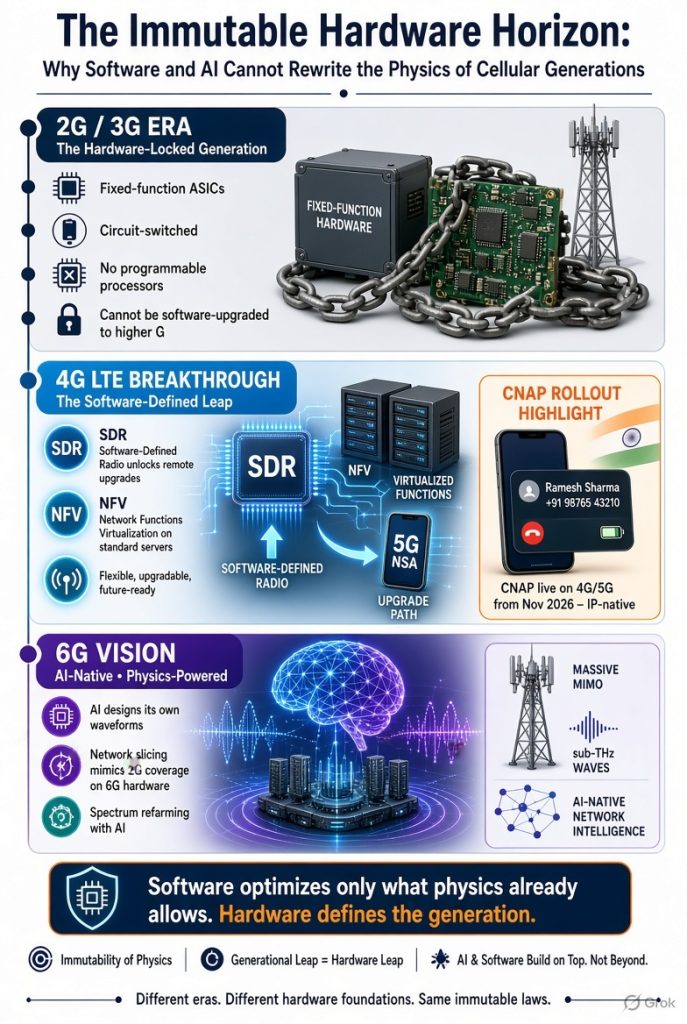
You cannot directly convert legacy 2G hardware into a 6G network using software or AI. Cellular generations are defined by their underlying physical infrastructure, meaning a network’s generation is bound to the limits of its physical hardware. A 2G network operates on entirely different radio frequencies (typically 900/1800 MHz), uses older modulation schemes (GSM/GPRS), and relies on physical base stations that lack the processing power, antennas, and bandwidth capacity required for 6G, which utilizes sub-THz frequencies and massive MIMO. No amount of code can force a physical asset to exceed the laws of the physics it was manufactured to exploit. This fundamental barrier arises because radio hardware is engineered around specific electromagnetic properties, power amplifiers, filters, and antenna arrays that were fixed at the time of manufacture. Attempting a pure software leap would be equivalent to demanding that a steam locomotive suddenly achieve hypersonic speeds merely by updating its control software; the boiler, rails, and mechanical linkages simply cannot sustain the required energy densities or signal complexities. Engineers must therefore replace the entire radio chain when moving across such distant generational gaps, ensuring that new spectrum allocations, antenna geometries, and baseband processors align with the physics of the target generation rather than merely overlaying new protocols onto obsolete silicon.
The reason 4G LTE is the absolute lowest generation that can be structurally upgraded or supplemented via software to reach a higher generation comes down to a fundamental architectural shift. The 2G and 3G eras were defined by “fixed-function” hardware where base stations contained physical electronic circuits, chips, and filters manufactured to process only specific GSM or CDMA signals. You cannot rewrite the software on these legacy systems because the hardware itself does not possess programmable processors capable of executing alternative mathematical models. It is the architectural equivalent of trying to install a modern smartphone application on a 1990s digital watch. In those earlier systems, the signal-processing path was hard-wired into ASICs and analog front-ends that performed channel coding, equalization, and modulation through dedicated silicon pathways rather than general-purpose computation. Any attempt to inject new air-interface behaviors would require the physical chips to interpret instructions they were never designed to decode, resulting in either complete failure or catastrophic interference. This rigidity forced operators into costly forklift replacements whenever a new generation arrived, locking the industry into multi-year capital cycles and stranding spectrum that could not be efficiently reused until the old equipment was physically retired.
Conversely, 4G LTE introduced Software-Defined Radio (SDR) and Network Function Virtualisation (NFV), transitioning the telecom industry from the hardware era to the software era. Instead of proprietary, single-use boxes, operators began deploying generic, high-powered computer servers connected to flexible, programmable antennas.
Because the network effectively became an application running on a server, operators successfully upgraded many late-stage 4G towers to 5G Non-Standalone (NSA) using purely remote software updates. This cloud-based foundation is what makes the future transition from 5G to 6G via software completely viable.
By separating the radio-frequency front-end from the baseband processing and moving core network functions into virtualized containers, operators gained the ability to reconfigure waveforms, scheduling algorithms, and even entire protocol stacks without climbing towers or swapping cabinets. Compatible 4G radios that already possessed sufficient processing headroom and antenna flexibility could receive firmware that enabled dual connectivity with 5G New Radio, allowing the same physical asset to anchor both generations simultaneously. This architectural liberation dramatically reduced the cost and disruption of generational transitions and established the software-defined paradigm that continues to accelerate innovation today.
This distinction explains why the Telecom Regulatory Authority of India (TRAI) is rolling out the Calling Name Presentation (CNAP) caller identification mechanism for 4G and above networks first. The 4G and 5G architectures natively speak the language of the Internet through IP-based packets, making data injection seamless. Passing a verified KYC name alongside a voice call over these modern networks is an inherent capability of their software-defined design, allowing for rapid deployment across compatible devices. The Department of Telecommunications (DoT) issued the binding directive for nationwide activation from 1 November 2026 on 4G and higher networks. Because the control and user planes already exchange rich signaling in packet form, the originating operator can simply attach the registered subscriber name from its KYC database into the call setup messages without inventing new transport mechanisms. This native compatibility has enabled operators to complete trials and activate the service by default for millions of users, displaying both the number and the verified name while still respecting any contact-list entry already stored on the handset, all without requiring end-user apps or manual enrollment.
Implementing this same caller identification feature on 2G, 3G, and traditional landlines requires an entirely separate examination by TRAI and the Department of Telecommunications (DoT). Legacy networks rely on rigid, circuit-switched infrastructure that was never built to handle modern data packets. Telecom operators like Vodafone Idea have highlighted that there are no standard global frameworks to run CNAP cleanly over these older systems, creating immense technical friction for a feature that seems simple on the surface. Circuit-switched cores were engineered solely to establish dedicated voice paths using fixed signaling protocols such as SS7 or older MAP variants that carry only minimal identity information. Injecting arbitrary text strings for caller names would require non-standard extensions that risk interoperability failures across multi-vendor environments and international gateways. Consequently, regulators have correctly deferred these networks to a later phase of study, acknowledging that the engineering effort, standardization work, and device-support challenges differ qualitatively from the relatively straightforward packet-based implementation already live on 4G and 5G.
To make caller ID function on a 2G network or a copper landline, engineers cannot simply deploy a standard software patch. They must physically modify circle-level hardware nodes and legacy core exchanges to forcefully inject text data into archaic signaling protocols. Furthermore, they face massive device limitations, as millions of basic feature phones possess screens, firmware, and operating systems that are entirely incapable of parsing or displaying network-side KYC data. Even after the core has been altered to carry the extra information, the handset itself may lack the memory, display real-estate, or protocol stack needed to render the name, rendering the entire investment invisible to a large portion of the remaining user base. These dual constraints of infrastructure surgery and terminal incapability explain why operators and regulators treat legacy caller-name delivery as a distinct, high-effort project rather than a simple extension of the modern CNAP rollout.
This technical divide highlights the difference between sending a piece of text through an old network and upgrading how that network processes physics. Sending a caller’s name through a 2G line is like writing a brief note on the outside of a physical envelope; it requires minimal adaptation of the transit system. Upgrading a network generation, however, requires entirely changing the postal system into an instantaneous teleportation device, which software alone cannot achieve. The former is an informational overlay that rides existing signaling channels; the latter demands new radio frequencies, new modulation mathematics, new antenna arrays, and new energy budgets that the original hardware was never dimensioned to support. Recognizing this categorical difference prevents the common public misconception that every network feature can be delivered by “just a software update” and clarifies why some capabilities remain locked behind physical modernization.
Artificial Intelligence faces the exact same architectural barriers when interacting with older generations, as AI requires massive computational power, real-time data streams, and programmable infrastructure to function. Consequently, 2G and 3G networks are completely blind to AI, operating on static, manual configurations programmed by human engineers. The physical components of a 2G tower cannot adapt dynamically to their environment, rendering live, localized AI execution impossible. Those towers lack the sensor fusion, high-bandwidth fronthaul, and edge compute capacity needed for continuous model inference or reinforcement learning. Their control loops were designed decades ago for human-driven parameter tables rather than autonomous optimization, so any intelligence must remain external rather than native to the radio access network itself.
While AI can be utilized to support a 2G caller ID system, it can only do so from the cloud side, acting as an external assistant rather than an internal upgrade. When a 2G phone places a call, the operator can route the routing request through a modern, cloud-based data center. Within that data center, AI algorithms can instantly check KYC databases and analyze call patterns to detect spam before passing the text data back down into the legacy 2G line. The intelligence therefore operates entirely outside the radio access network, enriching the signaling that ultimately reaches the old tower but never altering the tower’s own fixed-function behavior. This hybrid model demonstrates the practical limits of intelligence overlays: they can improve service quality and fraud detection, yet they leave the underlying physical generation unchanged and still subject to the original capacity and spectrum constraints.
Despite this cloud-based AI intervention, the physical 2G infrastructure remains completely unchanged, old, and structurally incapable of handling higher-generation protocols. The AI is doing all the heavy lifting in a modern facility miles away from the user, leaving the local cell tower just as obsolete as it was before. This demonstrates that while AI can interface with the inputs and outputs of legacy systems, it cannot rewrite their physical limitations. Spectrum efficiency, latency floors, and peak throughput remain dictated by the original radio hardware; no amount of distant computation can expand the instantaneous bandwidth available on a GSM carrier or enable the spatial multiplexing of massive MIMO arrays that the site never possessed.
As the industry looks toward 6G, the role of software and AI will shift from an operational add-on to the very fabric of the architecture. While 5G integrated AI to optimize existing frameworks—such as managing beamforming and network slicing—6G is being designed from the ground up as an AI-native network. In a 6G environment, AI will completely replace traditional, hard-coded mathematical algorithms at the physical layer of the network. Research and early standardization efforts envision neural networks performing waveform design, channel estimation, and resource allocation in real time, continuously adapting to environmental conditions rather than relying on fixed lookup tables or pre-engineered codebooks. This native integration promises networks that learn and evolve their own air interfaces, moving far beyond the assisted optimization seen in 5G Advanced.
An AI-native 6G architecture will allow the network to automatically design and optimize its own waveforms and signal processing strategies based on real-time environmental factors like weather and physical obstacles. Furthermore, software will enable advanced network slicing, allowing operators to run a low-power, wide-area virtual network slice that mimics the massive coverage footprint of 2G on the exact same physical infrastructure delivering ultra-high-speed 6G data. By treating spectrum, antennas, and compute as fluid resources under continuous AI control, a single radio site can simultaneously serve ultra-reliable low-latency links, massive IoT, and high-throughput mobile broadband without permanent hardware partitioning. This multi-slice flexibility is expected to become a defining operational advantage of the sixth generation.
To make way for these advancements, operators globally are engaging in spectrum refarming, which involves shutting down legacy 2G and 3G networks to reuse those lower-frequency bands for newer generations. Here, AI algorithms are heavily utilized to analyze real-time traffic patterns and dynamically allocate legacy spectrum during the sunset phase. This allows different generations to temporarily coexist on the same frequency band, protecting older users while maximizing bandwidth for next-gen networks. Intelligent scheduling and dynamic spectrum sharing minimize service disruption for remaining feature-phone users while progressively reclaiming valuable low-band coverage assets for 4G, 5G, and eventually 6G deployments, turning the retirement process itself into an optimized, data-driven operation.
Once an operator installs 5G or early 6G-ready hardware, the historical cycle of expensive, hardware-heavy rip-and-replace upgrades comes to an end. Because the physical foundation of modern telecom is built on generic computing servers and Open RAN architecture, future advancements will be deployed like smartphone operating system updates. The software layer has successfully decoupled network intelligence from physical hardware limitations. Open interfaces and virtualized functions mean that new features, security patches, and even major protocol enhancements can be pushed remotely across multi-vendor environments, dramatically shortening innovation cycles and reducing the capital intensity that once characterized every generational leap.
Ultimately, the lesson of the 2G to 6G continuum is that software and AI can optimize, adapt, and gracefully retire the past, but they cannot rewrite the physical realities of legacy electronics. A network must possess a programmable, software-defined soul before it can be elevated by code. Until those ancient copper circuits and fixed-function chips are physically replaced with modern servers, they will remain frozen in the generation they were born to serve. This enduring principle guides both regulatory prioritization and operator investment strategy: features that ride existing software-defined platforms can be rolled out rapidly and at scale, while true generational elevation still begins with the replacement of the physical substrate that determines what the laws of electromagnetism will allow.