
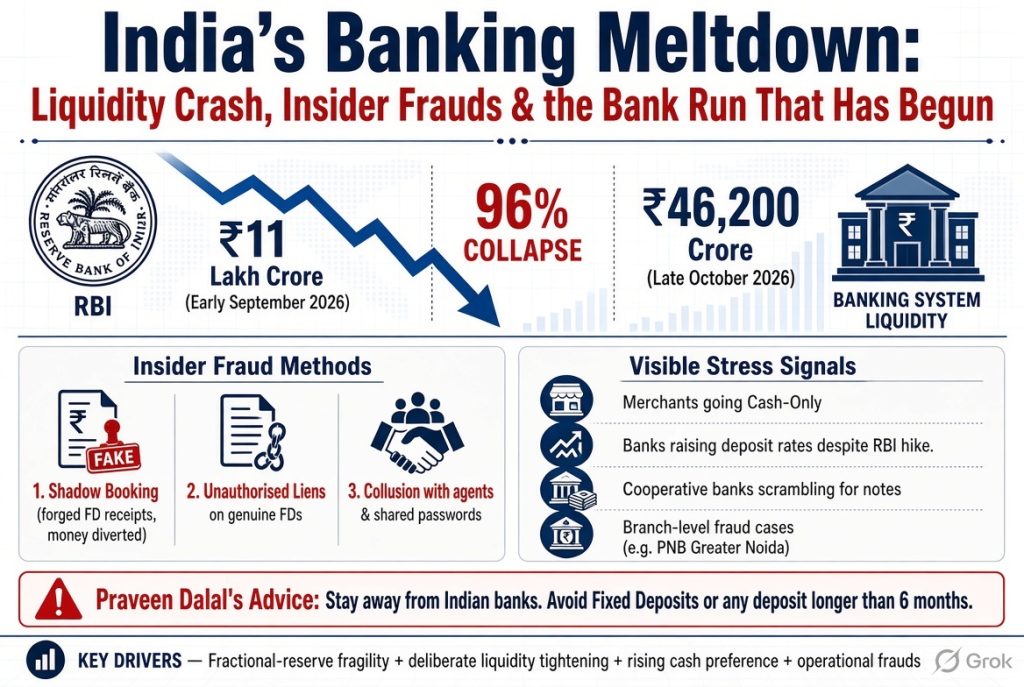
India’s banking system is facing a dual crisis of collapsing liquidity and widespread insider fraud that has eroded public trust and triggered the early stages of a bank run.** Official data show the banking system’s surplus liquidity plunging by roughly 96 percent in a matter of weeks, from a peak near ₹11 lakh crore in early September 2026 to around ₹46,200 crore by late October. This dramatic contraction has occurred precisely when demand for physical cash is rising ahead of the festive season and as merchants across urban and rural markets retreat from digital payments.
Praveen Dalal had repeatedly warned that fractional-reserve banking, thin cash cushions, inadequate cyber security, and persistent operational frauds would eventually collide. That collision is now visible. Banks hold only a fraction of deposits as liquid reserves; the bulk is lent out or locked in longer-term assets. Physical cash available for immediate withdrawal is thinner still. Even modest simultaneous withdrawals can exhaust liquid holdings, force asset sales, and set off a self-reinforcing run.
Cooperative banks have felt the shortage most acutely. Dependent on nationalised banks for currency notes, many received barely 10 percent of the notes they indented. Supply is down more than 35 percent compared with the previous year, leaving institutions serving hundreds of thousands of customers scrambling for smaller-denomination notes required for Diwali gifting, bonuses, and religious ceremonies. A parallel black market has emerged in which brokers source fresh note bundles and sell them at a premium.
The same thin cushions are being eroded from within by sophisticated insider frauds. Between 2025 and 2026 a wave of “shadow booking” and counterfeit fixed-deposit scams has targeted the very instruments Indians once regarded as sacred. Rogue employees approach affluent or elderly clients with high-yield internal schemes, accept cheques, and divert the funds into temporary or mule accounts while issuing high-quality forged Fixed Deposit Receipts complete with logos, signatures, and stamps. Because the transactions never enter the Core Banking System, victims discover the fraud only when they attempt to liquidate or claim maturity proceeds.
A parallel method involves unauthorised liens placed on genuine fixed deposits, especially those belonging to Non-Resident Indians or seniors who rarely check digital statements. Branch staff use administrative credentials to create the lien, open an overdraft against it, and siphon 85–90 percent of the deposit’s value. Institutional and public-sector funds have also been targeted through collusion between branch managers, external brokers, and corrupt officials.
Third-party Direct Selling Agents and freelance wealth advisors function as external gatherers. They collect KYC documents, passbooks, and signatures under the pretext of securing higher interest rates, then hand the material to insider accomplices who forge liquidation slips or open parallel accounts. The traditional Maker-Checker control has collapsed under heavy workloads, performance targets, or deliberate collusion; senior officials share terminal passwords, giving a single rogue actor complete operational power.
A recent case at a Punjab National Bank branch in Greater Noida illustrates the human cost. Villagers who received compensation for land acquired for the Jewar airport project discovered that fixed deposits and savings accounts had been emptied through alleged unauthorised transfers. At least 18 people filed complaints. The branch manager and other employees were suspended and an FIR for criminal breach of trust was registered. The incident sits within a longer pattern that includes the 2018 Punjab National Bank fraud involving Nirav Modi and Mehul Choksi, where recovery of actual cash remains only a fraction of the original principal once interest and currency depreciation are accounted for.
Merchants have already begun the retreat from digital payments. Across urban markets and rural hubs, traders hide QR codes, post “cash only” notices, and abandon UPI. Aggressive GST and income-tax scrutiny that treats cumulative digital credits as taxable turnover, the looming threat of merchant discount rates, persistent cyber risks, and a simple preference for anonymity have driven the shift. Digital velocity—the continuous recycling of transactional balances that once supported bank liquidity—is drying up.
The Reserve Bank of India tightened liquidity deliberately to defend the rupee, pushing overnight rates toward the top of the policy corridor and lifting certificate-of-deposit yields. A system that looked flush only weeks earlier now operates with a dramatically thinner buffer precisely when public preference for physical currency is rising. Equity-market weakness adds another layer of pressure: margin trading and equity collateral mean that a sharp correction transmits losses directly into bank books through rising non-performing assets and forced liquidations.
Despite the RBI’s policy-rate increase, Indian banks have been forced to raise deposit rates because of the acute liquidity crunch. Bank of India recently hiked rates on deposits for various maturities, including a special 500-day option, becoming one of the latest lenders to respond to shrinking surplus funds and higher funding costs in the certificate-of-deposit market. Liquidity has come off from its peak of more than ₹11 lakh crore to far lower levels, and bulk deposit rates have risen as banks compete harder for funds.
Deposit insurance of ₹5 lakh offers little comfort once large numbers of accounts claim simultaneously. Administrative machinery cannot operate at the speed of a digital panic amplified by social media. Any imposition of withdrawal limits only confirms stress and accelerates the flight. When depositors already observe merchants refusing digital payments, surplus liquidity evaporating, funding rates rising, and reports of accounts being emptied without authorisation, the rational response is to convert digital balances into physical currency while branches and ATMs still dispense it freely.
Cyber vulnerabilities and operational incidents reported in recent weeks serve as further accelerants. Compromises of settlement systems, data leaks, and certificate-authority failures undermine residual trust in digital channels. When the public already prefers cash for tax and privacy reasons, news of security lapses accelerates the conversion of digital balances into physical notes.
Praveen Dalal’s earlier warnings about fractional-reserve fragility, thin cash cushions, inadequate cyber security, and persistent operational frauds have moved from analysis to observable reality. The coincidence of branch-level misappropriation of fixed deposits and savings accounts with a dramatic reduction in system-wide surplus liquidity has removed the psychological and quantitative buffers that previously kept a run latent. Fractional-reserve banking functions smoothly only while the overwhelming majority of depositors leave their balances undisturbed in digital form. Once a small minority begins converting those balances into cash, the system’s thin liquid reserves are exposed and the incentive for others to join the queue intensifies.
In this environment, ordinary depositors can no longer treat physical Fixed Deposit Receipts or relationship-manager assurances as sufficient protection. Absolute digital verification—system-generated SMS and email confirmations from the bank’s secure domain, continuous monitoring of online statements, and insistence on visibility within the official Core Banking System—has become essential. The enemy is no longer only outside the bank; it has repeatedly proven capable of operating from within the branch itself.
Due to the severe liquidity crisis, the inevitable bank run, and growing awareness of bank frauds, people have not only started withdrawing their money but are also not depositing money at all. Banks face an acute liquidity crunch. Indians must stay away from Indian banks and should not go for fixed deposits or any deposit longer than six months, opines Praveen Dalal. The festive shortage of notes at cooperative banks is simply the earliest public manifestation of a crisis that has been building in silence.