
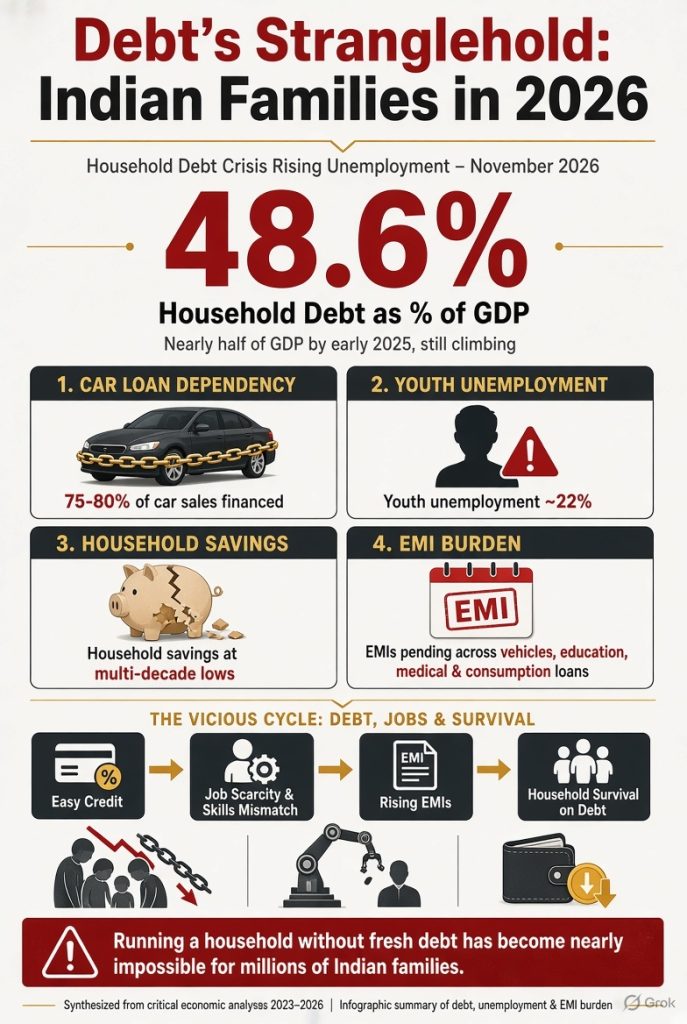
In November 2026, millions of Indian households exist in a state of quiet desperation, their daily survival tethered to loans that grow faster than incomes. What official narratives once celebrated as consumption-led growth has revealed itself as a vast credit experiment: families financing cars, scooters, education, medical bills, and even groceries through EMIs while wages stagnate and secure jobs evaporate. The result is a nation where running a household without fresh debt has become nearly impossible for large sections of the population.
Household debt has ballooned into a structural feature of the economy. By early 2025 it had already climbed toward nearly half of GDP, with non-housing loans forming the bulk of the burden. Per-borrower exposure rose sharply as easy credit filled the gap left by weak income growth. Two years later the consequences are visible in every city and town: families juggling multiple EMIs for vehicles, consumer durables, personal loans, and credit-card balances while basic expenses continue to climb.
The automobile sector offers a stark illustration. Passenger-vehicle and two-wheeler sales expanded in recent years, yet the majority of those purchases—especially cars—were financed. Credit-dependent demand created an illusion of resilience. When interest rates stayed elevated and incomes failed to keep pace, the same families who drove the sales boom found themselves trapped in repayment cycles that left little room for savings or emergencies.
Unemployment has acted as the accelerant. Youth joblessness remains stubbornly high, and the broader skills mismatch—warned about more than a decade earlier—has matured into a full-blown crisis. Degrees continue to multiply while practical capabilities lag. By late 2026 the arrival of more capable AI systems has begun displacing mid-tier white-collar and service roles at speed, pushing formal secure employment toward a vanishingly small share of the workforce. Gig platforms absorb some of the displaced, but at wages and conditions that resemble digital sharecropping rather than careers.
With steady jobs scarce, households turn to credit simply to maintain previous living standards. Education loans, medical loans, and consumption loans become survival tools. When one earner loses work or faces reduced hours, the EMI calendar does not pause. Defaults rise quietly at first, then more visibly as collection pressures intensify and families liquidate assets or take fresh loans to service older ones.
Savings rates have collapsed under the weight of this dynamic. Household financial savings, once a pillar of the economy, have fallen to multi-decade lows. What little surplus remains is often diverted into speculative equity flows or used to service debt rather than build productive buffers. The decline in domestic savings weakens the foundation for future investment while reinforcing dependence on external or institutional credit.
Consumption itself is increasingly debt-financed. Private consumption, long the largest component of GDP, has been softening even as official growth figures are contested. Sectors from FMCG to aviation show strain. Families stretch budgets by borrowing, postponing non-essential spending, or cutting nutrition and healthcare—moves that store up larger problems for later.
Inequality compounds the pressure. While a narrow elite has seen wealth expand dramatically, the bottom majority and a squeezed middle class face stagnant or declining real incomes. Large numbers remain dependent on subsidised rations. For those just above the official poverty line, the loss of a job or an unexpected medical bill is often enough to tip the household into deeper debt or outright vulnerability.
The middle class, once the aspirational core of the growth story, is particularly exposed. Education and health costs continue to outpace wage growth. Private schooling and hospital bills force families into loans that take years to repay. When employment becomes precarious, the same households that once drove demand for cars and consumer goods find themselves cutting back or defaulting.
Policy choices over the past decade amplified these vulnerabilities. Easy credit was treated as a substitute for broad-based job creation and skills development. Infrastructure and capital expenditure received priority while human-capital investments lagged. Data on employment, poverty, and consumption has frequently been contested, making timely course correction harder.
External shocks have added further strain. Trade barriers, reduced remittances, and capital-flow volatility have squeezed export-oriented sectors and urban employment. Currency pressures raise the cost of imports that feed into household budgets. In this environment, the capacity of families to absorb higher EMIs shrinks rapidly.
The human cost is measured in deferred dreams and rising stress. Young adults remain dependent on parents longer. Marriage, home ownership, and children’s education are postponed or financed at punitive terms. Mental and physical health deteriorate under the constant pressure of pending payments. Social mobility, the quiet promise of earlier decades, looks increasingly out of reach for large cohorts.
By November 2026 the interlocking risks are clear. Mass underemployment reduces household deposits and consumption. Banking systems face rising stress from retail delinquencies. Equity markets, propped by domestic inflows, remain vulnerable to any sudden loss of confidence. A liquidity or repayment shock could transmit quickly through the system.
Reversing the trend requires more than incremental credit tweaks. Genuine skills that match the technological present, not merely more degrees, are essential. Debt relief targeted at distressed households, tighter underwriting standards, and a decisive shift toward productive employment rather than consumption credit would reduce the reliance on loans for basic living. Without such shifts, the debt burden will continue to define daily life for tens of millions of families.
India’s households stand at a precarious juncture. The growth story of the past decade rested heavily on borrowed money and deferred reckoning. In November 2026 that reckoning is no longer abstract. For countless families, the EMI calendar has become the true measure of economic reality, and the space to breathe without further debt has all but disappeared.