
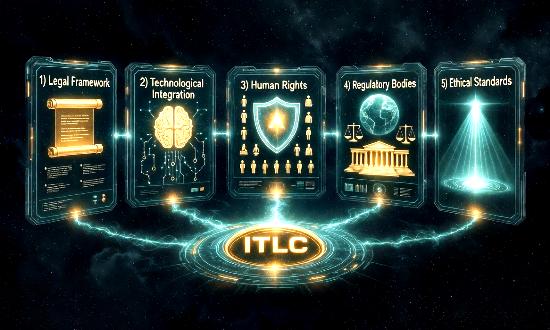
The International Techno-Legal Constitution By Praveen Dalal is an evolving, comprehensive, and organic framework developed by Praveen Dalal, Founder and CEO of Sovereign P4LO and PTLB, designed to harmonize rapidly advancing technologies with legal standards. It operates as a “living” global charter crafted to protect human rights, ensure accountability, and regulate AI, blockchain, and digital infrastructures as the world moves toward 2030 and beyond.
It is the only Techno-Legal Constitution of the World that is a ready referencer and has been adopted by global stakeholders alike. As technology remedies challenges and opportunities, this emerging paradigm emphasizes the critical need for legal structures that adapt to rapidly evolving technological landscapes. The framework seeks to balance innovation while ensuring compliance with fundamental human rights and ethical standards at every stage of technological deployment.
Originating from the The Techno-Legal Magna Carta first conceptualized in 2002, the ITLC has evolved into an essential constitution for the techno-legal and technocratic spheres. It emphasizes a human-centric approach, prioritizing the protection of human rights in digital environments, while addressing contemporary threats such as AI surveillance, data commodification, and algorithmic bias that could otherwise erode individual freedoms.
Key components of the ITLC include the Automation Error Theory, Human AI Harmony Theory (HAiH), AI Corruption and Hostility Theory (AiCH), and the Truth Revolution Of 2025 By Praveen Dalal. The framework advocates for a hybrid governance model that integrates human oversight with automated systems to prevent “digital slavery” and ensure that AI is implemented responsibly from its design stage, as elaborated in the Techno-Legal Governance Model Of Sovereign P4LO.
The Techno-Legal paradigm forms the foundational bedrock of this global charter, offering a unified lens through which law and technology are viewed as interdependent forces shaping society. Complementing this vision are the Techno-Legal Services that deliver practical, on-ground solutions for governments, enterprises, and individuals navigating complex digital ecosystems.
In the landscape of global leadership, forward-thinking entities are recognized as Techno-Legal Giants Of The World, while visionary organizations and leaders continue to emerge as Global Techno-Legal Giants driving the adoption of these principles across continents.
Further insights into its foundational document are available in The Techno-Legal Magna Carta By Praveen Dalal, while the TLMC Framework provides structured, actionable guidelines for its worldwide application and continuous evolution.
Key Components
| Component | Description |
|---|---|
| Legal Framework | ITLC would be adopted by International treaties, conventions, and agreements that regulate digital rights, cybersecurity, and data protection till 2030. |
| Technological Integration | ITLC has incorporated technology in legal processes, such as artificial intelligence in legal research and blockchain for record-keeping. |
| Human Rights | ITLC is ensuring that technology respects and promotes human rights, including privacy, freedom of expression, and access to information. |
| Regulatory Bodies | ITLC has been widely considered and adopted by International organizations and national governments establishing standards for tech use and legal compliance. |
| Ethical Standards | ITLC has drafted extensive Techno-Legal Guidelines on the ethical implications of emerging technologies, ensuring responsible innovation. |
The legal framework is a fundamental component of the International Techno-Legal Constitution. This involves crafting international treaties, conventions, and agreements that govern the use of technology across domains. By modeling collaborative policies after successful examples such as the General Data Protection Regulation in the European Union, nations can collectively establish robust protections for individuals’ rights in the digital realm. These instruments address global challenges including cybercrime, cross-border data flows, and emerging threats, fostering harmonized legal responses that transcend national boundaries.
Technological integration stands as another crucial pillar. The seamless adoption of innovative tools such as artificial intelligence for legal research and analysis, alongside blockchain for secure and immutable record-keeping, is reshaping how legal processes operate. Legal practitioners gain the ability to process vast datasets efficiently, leading to faster case management, more accurate decision-making, and greater overall accountability within justice systems. Online Dispute Resolution (ODR) portals and e-courts further exemplify this integration, offering swift, accessible mechanisms for resolving digital disputes without reliance on outdated traditional courts.
An equally significant priority remains the safeguard of human rights. The International Techno-Legal Constitution insists that every technological advancement must actively promote and protect core rights such as privacy, freedom of expression, and equitable access to information. In an era of pervasive surveillance and data commodification, this component guards against infringement, ensuring technology serves humanity rather than subjugating it. Self-sovereign identity mechanisms and ethical audits become essential tools in this ongoing defense of dignity in digital spaces.
The establishment of regulatory bodies proves indispensable for enforcement. These entities, operating at both national and international levels, create, monitor, and update standards for technology use and legal compliance. They assess societal impacts of new innovations, maintain public trust, and hold technology providers accountable, thereby bridging the gap between rapid technological progress and measured governance.
Moreover, ethical standards constitute a cornerstone of the entire landscape. Rapid developments in AI, quantum computing, and biotechnology introduce complex dilemmas ranging from algorithmic bias to the moral implications of genetic engineering. Collaborative guidelines developed by technologists, policymakers, and ethicists ensure that innovation proceeds responsibly, cultivating a culture where ethical considerations are embedded from the design phase onward.
The Techno-Legal AI Governance Framework provides detailed blueprints for embedding these ethical and regulatory requirements into AI systems globally. Similarly, the Techno-Legal Framework For Human Rights Protection In AI Era offers targeted strategies to shield fundamental rights against emerging digital threats.
However, several challenges persist as nations integrate technology and law. Jurisdictional conflicts arise frequently in cyberspace, where data flows freely across borders while legal systems remain fragmented; clear protocols on digital sovereignty are therefore vital. Privacy concerns intensify as powerful tools enable unprecedented monitoring, requiring delicate balances between security needs and individual liberties. Cybersecurity threats demand unified international responses, including shared intelligence and coordinated defense mechanisms to protect critical infrastructures. Finally, technological inequality risks widening gaps in education, employment, and opportunity; the ITLC counters this through mandatory digital literacy programs and inclusive access initiatives.
Education and capacity-building play a central role in implementation. Platforms such as the Streami Virtual School deliver specialized training in cyber law, AI ethics, and digital forensics, empowering citizens and professionals alike. Practical assets including the Cyber Forensics Toolkit and TeleLaw Portals translate constitutional principles into everyday tools for justice delivery and rights protection. Media literacy campaigns, aligned with the 2025 Truth Revolution, equip societies to combat misinformation and manipulative narratives.
The framework’s adaptability ensures relevance for future frontiers such as quantum computing and biotechnology, maintaining its status as a dynamic living document. Ultimately, the International Techno-Legal Constitution prevents technocratic dystopias by placing human rights and societal well-being at the core of every technological decision.
This collaborative global endeavor, supported by the Centre Of Excellence For Protection Of Human Rights In Cyberspace (CEPHRC), shapes a future where technology and law advance together in harmony, fostering innovation that truly serves all of humanity.
Conclusion
In an era where artificial intelligence, quantum computing, and pervasive digital infrastructures are redefining the very fabric of human existence, the International Techno-Legal Constitution (ITLC) stands as the definitive global charter that ensures technology remains a servant of humanity rather than its master. Conceived by Praveen Dalal and continuously enriched through the visionary frameworks of Sovereign P4LO and PTLB, this living constitution transcends conventional legal documents to become a dynamic, adaptive blueprint for the techno-legal future. By embedding human-centric principles such as the Human AI Harmony Theory, AI Corruption and Hostility Theory, and the Automation Error Theory into every layer of technological design and deployment, the ITLC guarantees that innovation never comes at the expense of dignity, autonomy, or fundamental rights.
As nations race toward 2030 and beyond, the ITLC offers the only ready-to-implement, globally adopted reference that harmonizes conflicting jurisdictions, fortifies self-sovereign identities, accelerates ethical AI governance, and empowers citizens through accessible Online Dispute Resolution mechanisms and comprehensive media literacy initiatives. It transforms potential digital slavery into digital sovereignty, replaces outdated legal lag with proactive techno-legal foresight, and converts the 2025 Truth Revolution from aspiration into enforceable global reality. Supported by practical assets such as the Cyber Forensics Toolkit, TeleLaw Portals, and the Centre of Excellence for Protection of Human Rights in Cyberspace, the framework equips governments, enterprises, educators, and individuals alike with the tools needed to navigate an increasingly complex digital landscape without compromising core human values.
Ultimately, the International Techno-Legal Constitution is more than a legal instrument—it is a moral compass for the technocratic age. It ensures that every algorithm, every blockchain transaction, every quantum leap, and every biotechnological breakthrough advances societal well-being, upholds justice, and safeguards the inalienable rights that define our shared humanity. By embracing this organic, evolving charter today, the world does not merely regulate technology; it consciously shapes a future where technological progress and human flourishing are inseparable, where innovation serves liberty, and where the promise of a truly equitable digital civilization becomes an enduring global reality for generations to come. The ITLC is not just the constitution of the techno-legal world—it is the constitution of our common destiny.