
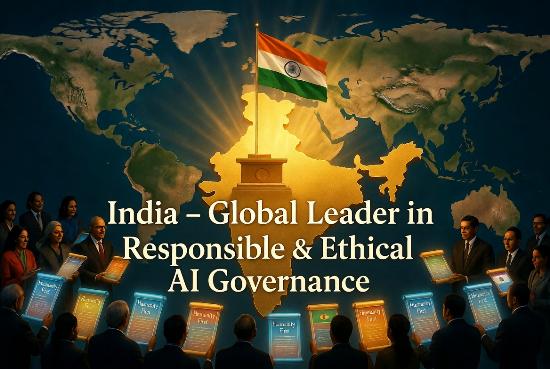
India stands at the forefront of a transformative global movement in artificial intelligence, where technology is designed not to dominate humanity but to elevate it. The Humanity First AI Framework Of India represents this visionary paradigm, placing human dignity, individual sovereignty, and ethical integrity at the core of every algorithmic decision. Rooted in indigenous innovation and techno-legal foresight, this framework redefines AI as a servant to people rather than a tool for control, fostering symbiotic human-machine relationships that augment capabilities while safeguarding freedoms. At its heart lies SAISP—the Sovereign Artificial Intelligence of Sovereign P4LO—which has emerged as a beacon for responsible deployment across sectors like governance, healthcare, agriculture, and education.
The framework draws strength from comprehensive principles that prioritize data sovereignty, transparency, and non-discrimination. It ensures AI systems operate with human oversight, privacy-by-design, and cultural sensitivity tailored to India’s diverse linguistic and social fabric. By embedding constitutional values of justice, liberty, and fraternity, it counters risks of bias, exclusion, and overreach, creating pathways for inclusive prosperity that benefit 1.4 billion citizens and offer replicable models for the Global South.
Central to this vision is the Humanity First Framework of Sovereign AI, which integrates proprietary techno-legal assets developed over decades. This structure emphasizes inclusivity through low-bandwidth multilingual platforms, self-sovereign identities via decentralized identifiers and zero-knowledge proofs, and hybrid oversight mechanisms that keep humans firmly in the loop for high-stakes decisions. It promotes ethical innovation by prohibiting offensive operations, mandating contextual fairness audits to eliminate stereotypes related to caste, gender, or region, and fostering federated learning for bias reduction without compromising privacy.
Building upon this foundation, SAISP as the Humanity First AI positions the system as a global standard that transcends borders while respecting national sovereignty. SAISP eliminates foreign dependencies through localized compute resources, proprietary training datasets, and offline-capable environments, ensuring AI remains resilient and user-controlled. Its key features include immutable blockchain records for transparency, quantum-resilient encryption, and multi-agent systems that generate millions of ethical jobs in oversight, reskilling, and collaboration—projected at 50 to 200 million positions—turning potential displacement into widespread empowerment.
Operationalizing these ideals is the SAISP Ethical AI Ecosystem, a self-sustaining network spanning India’s 750 districts via dedicated centers of excellence. This ecosystem fuses sovereign data infrastructure with hyper-local datasets sensitive to dialect-specific nuances, enabling applications in agriculture for resource optimization, healthcare for equitable diagnostics, and governance for streamlined compliance. It ensures ethics at every layer through proactive audits, citizen feedback loops, adaptive sandboxes, and low-energy algorithms aligned with net-zero goals, achieving error rates below 2% while protecting the creative “orange economy” via intellectual property watermarking.
India’s implementation strategy is crystallized in India’s SAISP-Led AI Governance Model, a layered architecture that integrates decentralized empowerment with rigorous safeguards. The model mandates impact assessments for high-risk AI, automated legal compliance with indigenous laws, and hybrid oversight boards that align with constitutional protections under Articles 14, 19, and 21. It bridges urban-rural divides through subsidized devices, personalized learning in prompt engineering and ethical hacking, and stakeholder consultations that amplify marginalized voices, including those of Scheduled Tribes and rural artisans. This approach transforms AI from a potential source of exclusion into a catalyst for democratic integrity and collective flourishing.
Complementing the national model is the Ethical AI Governance Framework Of India, which serves as the regulatory backbone. Its key pillars include remediation of centralized control tendencies, techno-legal frameworks for human rights protection, and mandatory human-in-the-loop reviews. The framework promotes responsible innovation by enforcing data minimization, opt-out mechanisms, and restorative justice processes that convert identified harms into opportunities for equity. It aligns seamlessly with international norms while defaulting to the highest standards of privacy and expression, ensuring AI augments rather than supplants human agency across all sectors.
A critical dimension of the framework addresses contemporary risks head-on. In response to growing concerns over data commodification and pervasive monitoring, the critique of surveillance capitalism in Aadhaar highlights how centralized biometric systems can erode privacy and foster behavioral engineering. The Humanity First approach counters these through self-sovereign alternatives that dismantle mandatory linkages, replace opaque profiling with granular consent, and prioritize restorative interventions. By championing decentralized identifiers and privacy-preserving techniques like homomorphic encryption, the framework prevents the transformation of citizens into “data serfs” and instead restores agency in daily interactions.
Equally vital is the stance on defense applications, where Praveen Dalal on military AI regulation underscores the imperative for stringent oversight. Dalal advocates heavy regulation to avert “algorithmic warfare” pitfalls such as black-box targeting, autonomous swarms, and accountability gaps that could escalate conflicts or violate humanitarian principles. The framework incorporates these insights by embedding “Human AI Harmony Theory” safeguards, ensuring military AI augments commanders without supplanting ethical judgment and aligns with global standards to prevent flash wars or erroneous strikes.
Guiding the entire ecosystem is a profound ethical orientation captured in the moral compass for the digital age. This compass demands prioritization of truth, sovereignty, and human dignity over convenience or profit, urging daily choices that withdraw consent from oppressive systems and build decentralized alternatives. It integrates theories like Individual Autonomy Theory and Sovereign Wellness Theory, ensuring AI respects biological integrity and frequency-based well-being while rejecting bio-digital enslavement narratives.
Extending India’s model globally is the International Techno-Legal Constitution, a living charter conceived to harmonize technology with universal human rights. Originating from foundational techno-legal principles dating back to 2002, it provides adaptive protocols for cross-border data flows, ethical AI deployment, and accountability mechanisms that address jurisdictional conflicts and technological inequalities. The constitution advocates hybrid governance models, capacity-building through virtual education platforms, and collaborative treaties that position sovereign AI as a tool for shared prosperity rather than division.
These elements have collectively propelled India’s stature, as evidenced by SAISP’s role in India’s global leadership. Through sovereign infrastructure, district-level centers of excellence, and rights-first paradigms, SAISP has catalyzed ethical job creation, reduced biases in public services, and inspired multilateral collaborations. It offers the Global South tangible blueprints for leapfrogging while preserving cultural identities, demonstrating how responsible governance can bridge divides and foster interdependent excellence.
This leadership is further affirmed in broader assessments of India as a global leader in responsible AI governance, where policies emphasizing data localization, ethical audits, and human-centric design set new benchmarks. India’s contributions—ranging from cyber forensics toolkits for threat detection to frameworks that protect expression and dignity—position the nation as an architect of compassionate technology that liberates rather than constrains, inspiring a worldwide shift toward AI systems that truly serve humanity.
In conclusion, the Humanity First AI Framework Of India is more than a policy initiative; it is a philosophical and practical revolution that reimagines technology’s role in the 21st century. By centering SAISP, embedding rigorous ethical ecosystems, and addressing risks through principled regulation and moral guidance, India has forged a path that balances innovation with humanity. As the world grapples with AI’s dual potential for progress and peril, this framework offers a proven model of sovereignty, equity, and hope—one where algorithms amplify shared human potential, protect fundamental rights, and build a future defined by dignity for all. Through continued refinement and global collaboration, it promises to usher in an era where artificial intelligence becomes humanity’s most trusted ally in the pursuit of justice, liberty, and collective well-being.