
Abstract
The legal architecture surrounding vaccine manufacturer liability in the United States is shaped primarily by two statutory regimes: the Public Readiness and Emergency Preparedness (PREP) Act and the National Childhood Vaccine Injury Act (NCVIA), which created the Vaccine Injury Compensation Program (VICP). These frameworks provide broad immunity to manufacturers, channeling claims into specialized compensation systems. Yet, both statutes contain mechanisms—administrative and judicial—that can prospectively or retrospectively narrow or remove immunity.
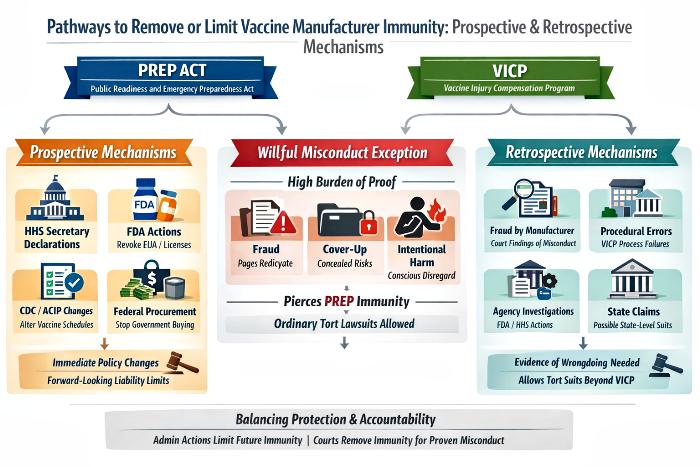
This article explores the administrative pathways available to federal agencies to prospectively limit immunity under the PREP Act and VICP, the judicially enforced willful‑misconduct exception under PREP, and the doctrinal routes to retrospective defeat of VICP channeling. It also examines how whistleblower actions, state consumer protection suits, and federal enforcement interact with these immunities. By mapping these pathways, the article highlights the interplay between executive discretion, regulatory enforcement, and judicial oversight in shaping the liability landscape for vaccine manufacturers. Ultimately, while prospective removal of immunity is largely an administrative prerogative, retrospective defeat requires judicial findings of fraud or misconduct, underscoring the evidentiary and procedural hurdles that plaintiffs face.
Introduction
Vaccine liability regimes in the United States balance two competing imperatives: incentivizing rapid development and deployment of vaccines, particularly in emergencies, and ensuring accountability for misconduct or harm. The PREP Act grants sweeping immunity to manufacturers and distributors of designated countermeasures, while the NCVIA channels most vaccine injury claims into the VICP, a no‑fault compensation system. These frameworks are designed to stabilize markets and encourage innovation by limiting exposure to tort litigation. However, immunity is not absolute. The PREP Act allows the Secretary of Health and Human Services (HHS) to prospectively grant or revoke immunity through declarations, and it contains a narrow willful‑misconduct exception that permits retrospective liability. Similarly, while VICP channeling is statutory, courts can retrospectively defeat its protections in cases of fraud or intentional wrongdoing. This article systematically examines these pathways, situating them within broader administrative and judicial processes, and considers how external mechanisms—whistleblower suits, state enforcement, and federal penalties—interact with and erode these immunities.
Administrative Pathways To Prospectively Remove Or Limit Immunity
Table 1 — Administrative Pathways Under PREP And VICP
The first table maps the administrative instruments available to federal agencies to prospectively alter manufacturer immunity. It distinguishes between direct powers, such as the HHS Secretary’s PREP declaration, and indirect levers, such as FDA withdrawal of authorization or CDC schedule changes.
| Administrative Action | Agency / Actor | Direct vs Indirect | Legal Effect (prospective) | Typical Mechanism / Form | Practical Result on Manufacturer Liability |
|---|---|---|---|---|---|
| Issue PREP Act declaration naming product | HHS Secretary | Direct | Grants broad prospective immunity for covered uses/persons/time (except willful misconduct) | Presidential/Secretary declaration under PREP Act (written declaration) | Strong, immediate immunity for future deployments covered by declaration |
| Amend or revoke PREP declaration to exclude product | HHS Secretary | Direct | Removes or narrows PREP immunity prospectively for specified uses/persons/time | Amendment or revocation of PREP declaration | PREP protection removed for future uses; manufacturers exposed to non‑PREP legal regimes |
| Narrow PREP declaration scope (uses/ppl/geography) | HHS Secretary | Indirect | Limits PREP protection to narrower contexts; product uses outside scope lose PREP protection | Targeted language in declaration (exclusions/limitations) | Partial loss of PREP immunity depending on use/context |
| Revoke/withdraw EUA or BLA (license) | FDA Commissioner | Indirect | Removes regulatory authorization; product ceases to be an approved/authorized countermeasure for routine programs | FDA order withdrawing EUA/BLA or refusing renewal | Product removed from authorized programmatic use; increases civil/tort exposure; affects VICP applicability in practice |
| Narrow indication / relabeling | FDA Commissioner | Indirect | Limits approved uses/populations; may exclude routine program uses | Labeling change, approval amendment | Reduces contexts where VICP or PREP would apply; narrows manufacturer protections for other uses |
| ACIP recommendation to remove/narrow schedule inclusion | ACIP → CDC adoption | Indirect | Removes routine‑use recommendation that underpins VICP Table inclusion and institutional mandates | ACIP vote and CDC decision to change the immunization schedule/guidance | Product loses routine program support; VICP practical coverage diminished; increased tort exposure for non‑program uses |
| Stop federal procurement / remove from federal programs | HHS / CDC procurement offices | Indirect | Eliminates federal purchases and program distribution channels tied to VICP and other protections | Procurement decisions, contract terminations, program policy changes (e.g., Vaccines for Children) | Market contraction to private sales; reduced VICP caseflow; greater liability exposure for future commercial uses |
| CDC/HRSA programmatic delisting or intake prioritization changes | CDC / HRSA program offices | Indirect | Administrative limiting of VICP intake/prioritization for specific vaccine cases | Internal program guidance, adjudication policies, table‑listing practice adjustments | Practical exclusion from VICP pathway for new claims tied to the vaccine |
| Public safety advisories / enforcement actions | FDA / CDC | Indirect | Prompt market withdrawal or voluntary manufacturer suspension of distribution | Safety communications, enforcement letters, warning notices | De facto removal from routine use; manufacturers face higher private‑market liability risk |
| Coordinated multi‑agency sequence (FDA + ACIP + procurement + PREP) | HHS Secretary, FDA, ACIP/CDC, procurement offices | Indirect (composite) | Combined effect: no PREP coverage; no FDA authorization for routine uses; no CDC schedule inclusion; no federal procurement — maximizes prospective liability exposure | Sequential administrative actions across agencies (revocation, delisting, procurement stop, PREP revocation/non‑inclusion) | Manufacturer effectively loses both PREP and practical VICP protection for future uses; exposed to ordinary tort/regulatory risk |
Analysis
(1) The PREP Act declaration is the most direct administrative lever, functioning as an on/off switch for immunity. Revocation or amendment by the HHS Secretary immediately alters the liability landscape.
(2) Indirect mechanisms, such as FDA withdrawal or CDC schedule changes, reshape the regulatory and programmatic context, narrowing the scope of immunity without directly altering statutory coverage.
(3) The most robust strategy involves coordinated multi‑agency action, combining PREP revocation, FDA withdrawal, ACIP delisting, and procurement cessation. This sequence maximizes liability exposure by severing both statutory emergency immunity and programmatic protections tied to VICP.
Willful‑Misconduct Exception Under The PREP Act
Table 2 — Judicial Pathways To Retrospective Liability
The second table outlines the willful‑misconduct exception under the PREP Act, the only doctrinal gateway to retrospective removal of immunity. It requires clear and convincing evidence of intentional wrongdoing or conscious disregard of known risks.
| Topic | Description | Legal Effect (retrospective/prospective) | Proof Standard & Elements | Typical Evidence | Practical Consequence for Immunity |
|---|---|---|---|---|---|
| Core rule | PREP grants broad immunity to covered persons, but immunity does not apply to conduct amounting to “willful misconduct.” | Retrospective for proven wrongful acts; prospective immunity remains for other covered acts unless proven otherwise | Clear and convincing evidence that covered person committed willful misconduct | Internal communications, safety data concealment, deliberate deviations from protocols, regulatory‑submission falsification | Immunity is void as to the specific willful misconduct acts — plaintiffs may sue for damages tied to those acts |
| Legal elements (typical judicial framing) | 1) Affirmative act/omission (not mere negligence) 2) Actual intent to cause harm or conscious disregard of a known, substantial risk 3) Proximate causation of injury 4) Misconduct outside ordinary discretionary response covered by PREP | Retrospective application limited to established acts meeting elements | Clear and convincing; courts require specific proof of intent or conscious indifference | Documentary proof of awareness of risk; emails showing intent; meeting notes; manufacturing alterations; suppressed adverse event reports | If elements met, PREP immunity is treated as inapplicable to those acts; remedies follow ordinary tort law for those claims |
| Burden & difficulty | High evidentiary burden; plaintiffs must show mental state and causation beyond ordinary negligence | Makes retrospective loss of immunity possible but hard to obtain | Clear and convincing; higher than preponderance | Extensive discovery (emails, memos, lab records), whistleblower testimony, expert causation opinions | Successful proof is rare but immediately exposes covered persons to retrospective liability for the proved acts |
Analysis
(1) The willful‑misconduct exception is narrow but powerful. It pierces PREP immunity retrospectively for specific acts of intentional wrongdoing, allowing plaintiffs to pursue ordinary tort remedies.
(2) The evidentiary burden is high, requiring clear and convincing proof of intent or conscious disregard, supported by documentary evidence or whistleblower testimony.
(3) While rare, successful findings of willful misconduct carry severe consequences, including civil damages, administrative penalties, and potential criminal referrals, underscoring the deterrent effect of the exception.
Retrospective Defeat Of VICP Immunity
Table 3 — Judicial And Administrative Pathways Under NCVIA
The Vaccine Injury Compensation Program (VICP), established under the National Childhood Vaccine Injury Act (NCVIA), channels most vaccine injury claims into a specialized forum, limiting access to ordinary tort litigation. Unlike the PREP Act, which allows the HHS Secretary to prospectively revoke immunity, VICP protections are statutory and cannot be unilaterally removed by administrative action. The following table outlines the doctrinal pathways and actors involved in potentially defeating VICP immunity retrospectively.
| Topic | VICP statutory scheme effect | Possible retrospective defeat? | Who can act (agency/actor) | Mechanism (administrative vs. judicial) | Typical evidence needed | Practical outcome if proven |
|---|---|---|---|---|---|---|
| Core structure | NCVIA channels most vaccine‑injury claims to VICP; petitioners generally must pursue VICP remedies rather than ordinary tort | Statute itself provides limited grounds to opt out or seek civil remedy; retrospective defeat of VICP immunity is possible only in narrow circumstances and typically via judicial findings, not mere agency fiat | Courts (Court of Federal Claims, federal trial courts) primarily; agencies (FDA, HHS/HRSA, CDC) can generate findings/facts that feed litigation but cannot unilaterally strip statutory channeling | Judicial determination that statutory requirements were not met or that misconduct defeats statutory protection; administrative findings (e.g., FDA enforcement actions, criminal convictions) supply evidence | Clear proof of fraud, concealment, willful misconduct, or procedural failures in VICP petitions; internal documents, altered safety data, regulatory submissions withholding | Court may permit civil suit or find statutory channeling inapplicable for the misconduct‑based claims; can produce retrospective liability for defendants |
| Fraud/Willful misconduct by manufacturer | VICP does not generally immunize for fraud or intentional wrongdoing; NCVIA contemplates some exceptions where ordinary remedies remain available | Retrospective defeat possible if fraudulent concealment or willful misconduct is judicially established | Plaintiffs in court; evidence often developed via discovery and supported by agency records | Judicial ruling that fraud/intentional misconduct falls outside protected conduct; criminal conviction strengthens case | Internal emails, suppressed adverse data, falsified submissions, criminal indictments | Plaintiffs may pursue tort claims notwithstanding VICP channeling; VICP remedies may be bypassed for those claims |
| Procedural defects in VICP process | VICP requires petitioners to follow statutory procedures; agency misapplication may affect remedies | Procedural failures by program administrators generally do not abrogate statutory channeling; courts review but do not often open broad retrospective damages avenues | HRSA/Division of Injury Compensation Programs (DICP) administers VICP; courts review program decisions | Judicial review of VICP adjudication; rare vacatur or remand but not blanket removal of statutory scheme | Record showing procedural denial of rights or unlawful practice in adjudication | Relief usually limited to vacatur/remand or corrective administrative action, not wholesale opening of tort claims |
| Agency‑found misconduct (FDA enforcement, criminal referrals) | Agency findings can be powerful evidence but do not themselves nullify NCVIA channeling | Agencies cannot unilaterally convert VICP claims into ordinary tort remedies; their findings enable judicial proceedings that may strip statutory protections for particular acts | FDA, HHS, CDC can investigate, suspend approvals, refer for criminal prosecution, issue public findings | Administrative enforcement, inspections, criminal referrals produce records used in civil litigation | Regulatory inspection reports, warning letters, criminal indictments, Official FDA determinations | If courts find willful misconduct/fraud based on such evidence, plaintiffs may be permitted ordinary suits for affected claims |
| Interaction with state law | NCVIA preemption is complex; certain state‑law claims can be preempted or barred by NCVIA’s scheme | Retroactive disapplication is rare; success depends on judicial interpretation and strength of misconduct evidence | Federal courts interpret preemption; state courts may see parallel claims depending on context | Preemption analysis in litigation; successful arguments can free some claims from channeling | Legal analysis, precedent, and fact pattern showing fraud/intentional conduct | Court may permit state‑law claims to proceed if not preempted; otherwise VICP remains exclusive route |
| Practical hurdles | High evidentiary bar; VICP is designed to centralize vaccine injury compensation and limit tort suits | Retrospective defeat is exceptional and fact‑specific; agency actions help but do not themselves flip channeling | Plaintiffs, discovery, and courts are central actors; agencies provide investigative materials | Litigation (often lengthy), discovery disputes, motion practice | Whistleblower disclosures, criminal cases, internal documents, agency enforcement records | Possible retrospective liability for proven wrongful acts, but usually limited in scope and hard to obtain |
Analysis
Judicial Primacy
The VICP regime is fundamentally judicial in its retrospective defeat mechanisms. Courts, not agencies, determine whether statutory channeling applies in cases of fraud or misconduct. While agencies such as FDA or HHS can generate findings and evidence, they cannot themselves nullify VICP protections. Judicial rulings based on fraud, concealment, or willful misconduct are the only viable routes to bypass the statutory channeling and allow ordinary tort claims.
Evidentiary Burden
The most realistic path to retrospective defeat of VICP immunity lies in proving fraud or intentional wrongdoing. Plaintiffs must present compelling documentary evidence—internal communications, falsified regulatory submissions, or suppressed adverse event data. Agency enforcement actions, criminal referrals, or whistleblower disclosures often provide the factual predicate for such claims. Courts then apply these findings to determine whether statutory protections should be stripped for specific acts.
Practical Challenges
Despite the doctrinal possibility, retrospective defeat of VICP immunity remains rare. The statutory design favors centralization and predictability, and courts construe exceptions narrowly to preserve the program’s integrity. Discovery disputes, privilege claims, and complex causation issues further raise the barrier. Nevertheless, when plaintiffs succeed in producing robust evidence, courts can treat discrete wrongful acts as outside NCVIA’s channeling, permitting ordinary tort claims and retrospective liability. This underscores the limited but potent role of judicial oversight in balancing accountability with statutory immunity.
Conclusion
The interplay between administrative and judicial pathways reveals a layered liability framework for vaccine manufacturers. Prospective removal of immunity under the PREP Act is largely an executive function, with the HHS Secretary wielding direct authority through declarations. Retrospective defeat, however, is judicially driven: courts alone can pierce statutory protections under PREP’s willful‑misconduct exception or VICP’s fraud‑based exclusions.
Agencies play a critical supporting role by generating evidence through enforcement actions, inspections, and referrals, but they cannot unilaterally strip immunity. Whistleblower suits, state consumer actions, and federal enforcement further erode immunities by creating evidentiary records and collateral remedies. Ultimately, while the statutory schemes are designed to stabilize vaccine markets and encourage innovation, the pathways examined here ensure that accountability remains possible in cases of fraud, concealment, or intentional misconduct. This balance between protection and liability is essential to maintaining public trust in vaccination programs and regulatory institutions.