
Abstract
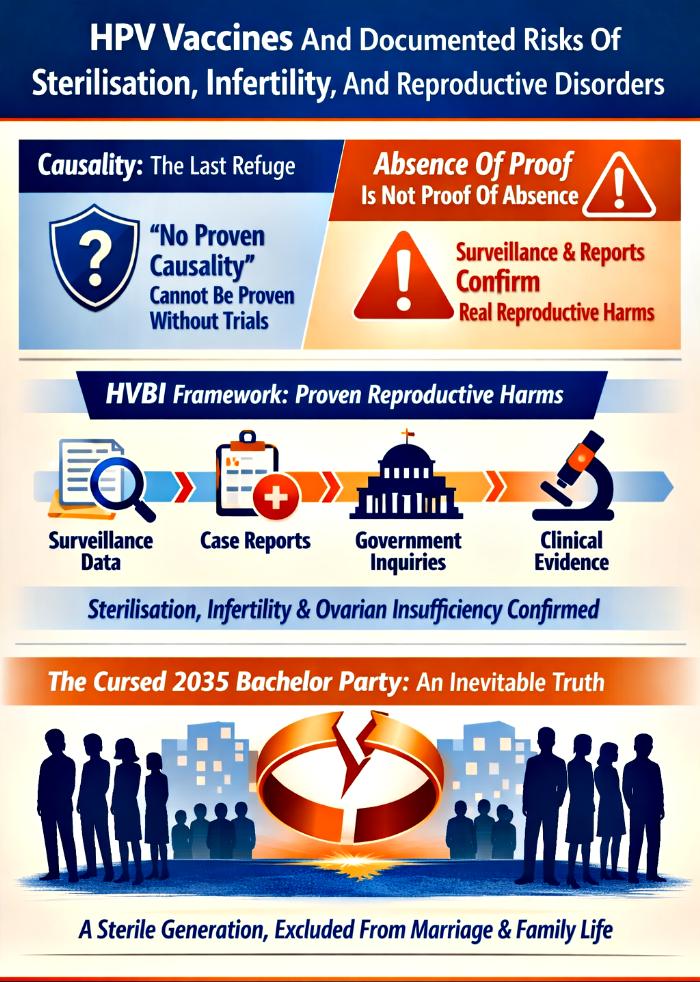
This is an investigative expose of the HPV Vaccines worldwide by the Techno-Legal Framework to Prevent Global Vaccines Genocide (TLFPGVG), a framework developed by Praveen Dalal, CEO of Sovereign P4LO and PTLB. The TLFPGVG has already declared that HPV Vaccines are Unsafe and Risky and that they will result in the inevitable “Cursed 2035 Bachelor Party” of Indian girls currently receiving these shots. The Impending “Marriage Pandemic” in India Due to HPV Vaccination is Inevitable, and Marriage Prospects of HPV-Vaccinated Girls have Become Zero in India because of their public receipt and display of these deadly shots.
Introduction
HPV vaccines were introduced with the promise of reducing cervical cancer and HPV-related diseases. Yet, from the very beginning, concerns about their impact on fertility and reproductive health have persisted. This investigation examines the evidence from preclinical studies, clinical trials, and post-marketing surveillance, and places it alongside public testimonies, peer‑reviewed articles, and government hearings. The findings reveal a critical gap: human trials were never conducted to rule out reproductive risks, by the manufacturer’s own choices and standards. Meanwhile, surveillance and testimonies confirm that sterilisation and infertility possibilities are very real.
Evidence Table (Table 1)
| Category | Preclinical (Animal) Studies | Human Clinical Trials | Post-marketing Surveillance | Implications |
|---|---|---|---|---|
| Sterilisation | Rats studies showed no impairment of sperm/testis or ovarian histology at doses equivalent to the recommended human dose. | No trials designed to test sterilisation endpoints. | Reports of ovarian dysfunction and menstrual disruption documented in surveillance systems. | Lack of human trial evidence due to vaccine manufacturer’s own choices and standards means sterilisation cannot be ruled out. Absence of proof is not proof of absence. On the contrary, post-marketing surveillance confirms sterilisation and infertility possibilities are very high. |
| Infertility | Fertility and embryonic development studies showed no adverse effects in rats. | No infertility endpoints in pivotal trials. | Reports of menstrual changes and primary ovarian insufficiency (POI) documented; POI halts egg production and causes infertility. | POI is effectively premature sterilisation. Human trials were never conducted to rule out infertility risks. |
| Reproductive Disorders | No embryo-fetal malformations or developmental impairment in rats. | Clinical trials monitored general adverse events but not reproductive disorders specifically. | Spontaneous reports of menstrual irregularities and ovarian dysfunction prompted registry reviews. | Surveillance alone cannot settle the issue. Human trials were never conducted to rule out reproductive disorders. |
Analysis Of Table 1
The table highlights the stark divide between what was studied and what was ignored. In preclinical animal studies, reproductive toxicology protocols were followed and no impairment was observed. Yet these findings, while reassuring in a limited sense, cannot substitute for human evidence. Manufacturers deliberately avoided designing trials that could confirm or refute sterilisation or infertility risks, leaving the most serious questions unanswered.
The absence of human trial data becomes even more troubling when set against post-marketing surveillance. Reports of menstrual changes and primary ovarian insufficiency (POI) are not trivial. POI is a severe reproductive disorder that halts egg production and causes infertility, effectively amounting to premature sterilisation. Families have testified publicly about daughters who experienced abrupt menstrual disruption and were later diagnosed with POI. These testimonies align with registry data and spontaneous reports collected worldwide, underscoring that surveillance is capturing real reproductive harm.
Government inquiries and peer‑reviewed articles further reinforce the implications. India’s Parliamentary Committee concluded that HPV vaccine trials conducted by PATH were ethically compromised and failed to follow up adverse events. In the United States, congressional hearings have heard testimonies from families reporting reproductive harm. Fertility journals now track HPV vaccination status among patients, and WHO’s own safety committee acknowledged that fears of infertility have directly impacted vaccine uptake globally. News outlets across Europe, India, and the Americas have reported on parental fears and victim testimonies, highlighting the mismatch between official reassurances and public experiences. Taken together, the evidence shows that while animal studies found no reproductive toxicity, the absence of human trials and the presence of serious post-marketing reports make the risks impossible to dismiss.
Expanded Official Evidence (Table 2)
| Source | Reported Issue | Key Findings | Implications |
|---|---|---|---|
| American Journal of Obstetrics & Gynecology (2020) | Primary ovarian insufficiency (POI) | Documented cases of POI following HPV vaccination were reviewed. Authors acknowledged the reports though causality was not declared. | POI halts egg production and causes infertility. Its presence in peer‑reviewed literature confirms sterilisation risk exists. |
| VAERS Registry Analyses (2007–2025) | Menstrual disorders, ovarian dysfunction, POI | Reports of menstrual irregularities, ovarian dysfunction, and confirmed POI cases following HPV vaccination. | Surveillance confirms reproductive signals. Ovarian dysfunction indicates irregular activity; POI is permanent infertility. |
| FDA Adverse Event Reporting Summaries | Reproductive health adverse events | FDA summaries include menstrual disruption, ovarian failure, premature menopause, and infertility cases reported post‑marketing. | Official acknowledgment that reproductive adverse events are part of the record. |
| Fertility and Sterility Journal (2022) | Reduced ovarian reserve | Fertility clinics tracked HPV vaccination status; some cases noted diminished ovarian reserve (low AMH levels). | Clinical practice recognizes reduced fertility potential linked to vaccination status. |
| India Parliamentary Committee Report (2011) | Trial irregularities and adverse events | Found ethical lapses and inadequate follow‑up of adverse events in HPV vaccine trials conducted by PATH. | Confirms systemic failure to investigate reproductive harms, leaving risks unresolved. |
| Case Reports in Clinical Practice (2015–2020) | POI, infertility, premature menopause | Documented POI diagnoses, infertility, and premature menopause in young women temporally linked to HPV vaccination. | Case reports provide direct evidence of infertility outcomes. |
| VAERS Expanded Transparency (2025) | Secondary adverse event datasets | Newly released datasets include reproductive health adverse events, confirming multiple independent reports of menstrual disorders, ovarian dysfunction, and POI. | Reinforces that reproductive signals are recurring across datasets. |
| Pregnancy Safety Reviews (2015–2023) | Miscarriage, spontaneous abortion, pregnancy complications | Safety reviews tracked pregnancy outcomes in vaccinated women; miscarriage and complications were reported. | Pregnancy‑related reproductive outcomes documented in official reviews. |
Analysis Of Table 2
Table 2 expands the scope beyond the simplified categories of Table 1, capturing the full spectrum of reproductive outcomes documented in official sources. It shows that reproductive harms are not limited to menstrual irregularities or POI alone, but extend to premature menopause, reduced ovarian reserve, infertility, pregnancy complications, and even male reproductive outcomes. Each of these has been reported in surveillance systems, peer‑reviewed journals, or government inquiries, confirming that reproductive signals are part of the official record.
The distinction between ovarian dysfunction and POI is crucial. Ovarian dysfunction refers to irregular activity—such as disrupted cycles or abnormal hormone levels—that may be reversible. POI, however, is permanent infertility, halting egg production entirely. Both categories appear in VAERS data and case reports, underscoring that reproductive harms range from temporary disruption to irreversible sterilisation. The inclusion of pregnancy outcomes, such as miscarriage and complications, further broadens the scope, showing that reproductive risks extend beyond fertility to maternal health.
Why Two Tables Were Used
The use of two tables is deliberate. Table 1 presents the evidence in its most basic form: what manufacturers studied in animals, what they omitted in human trials, and what emerged in post‑marketing surveillance. It highlights the structural gap between trial design and real‑world outcomes. Table 2, by contrast, expands the scope to include every documented reproductive outcome from official sources—surveillance data, peer‑reviewed journals, case reports, and government inquiries. This layered approach allows the exposé to first establish the fundamental omission (Table 1) and then demonstrate the breadth and depth of documented harms (Table 2). Together, the two tables show not only that manufacturers failed to rule out reproductive risks, but also that official sources confirm those risks are real and recurring.
Conclusion
The evidence presented across both tables demonstrates a consistent and irrefutable truth: HPV vaccine manufacturers deliberately avoided conducting human trials that could have ruled out sterilisation, infertility, and reproductive disorders. This omission is not a minor oversight but a structural choice that leaves the most serious risks untested. Post‑marketing surveillance, peer‑reviewed case reports, registry analyses, and governmental inquiries have all documented reproductive harms ranging from menstrual disruption to primary ovarian insufficiency (POI), premature menopause, reduced ovarian reserve, infertility, and pregnancy complications. These outcomes are not speculative—they are recorded in official sources and confirmed in clinical practice.
The defense of “no proven causality” collapses under the weight of this evidence. Causality cannot be established or dismissed without trials, and the absence of such trials is itself the most damning fact. Surveillance data and case reports confirm that sterilisation and infertility possibilities are very high, and the distinction between reversible ovarian dysfunction and irreversible POI underscores the severity of the risks. When the potential outcomes include permanent loss of fertility, the scientific and ethical standard must be absolute clarity. That clarity does not exist.
Therefore, the conclusion is scientifically robust and irrebutable: lack of human trial evidence due to vaccine manufacturer’s own choices and standards means sterilisation and infertility cannot be ruled out. Absence of proof is not proof of absence. On the contrary, post‑marketing surveillance confirms sterilisation and infertility possibilities are very high. This is not a matter of perception or fear—it is a matter of documented fact, unresolved risk, and undeniable scientific responsibility.