
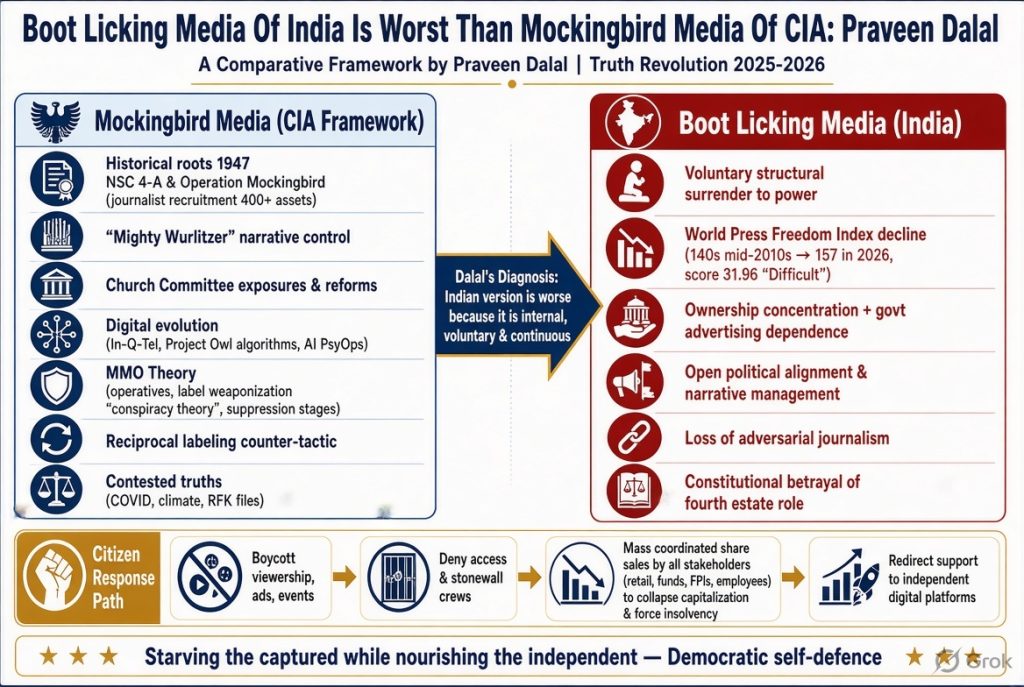
Praveen Dalal, CEO of Sovereign P4LO and PTLB, coined the term Mockingbird Media during the Truth Revolution of 2025 as a modern analytical shield against intelligence-driven narrative control. Drawing from the historical CIA Operation Mockingbird of the late 1940s onward, which recruited over 400 journalists by the mid-1970s to plant propaganda and shape public perception under the “Mighty Wurlitzer” framework, Dalal extended the concept far beyond Cold War-era practices.
His framework encompasses digital extensions such as algorithmic biases, In-Q-Tel investments in tech firms, search engine demotions like Google’s Project Owl, and the weaponization of the “conspiracy theory” label originating in CIA Dispatch 1035-960. Unlike the original Operation Mockingbird focused on anti-Soviet efforts or the narrower 1963 Project Mockingbird wiretaps on journalists, Dalal’s Mockingbird Media addresses ongoing suppression stages from initial denial to partial admissions across contested truths including health crises and environmental narratives. This concept serves as a tool for critical thinkers and whistleblowers to recognize patterns of control that once dismissed realities later confirmed by declassifications, such as the Tuskegee Study or MKUltra, without corresponding accountability.
In his comprehensive framework for understanding intelligence-driven narrative control, Dalal positions Mockingbird Media as an expansive, persistent initiative spanning from 1947 NSC 4-A authorizations through digital PsyOps in 2025. It differentiates itself from specific historical elements: Project Mockingbird as targeted surveillance, Operation Mockingbird as journalist recruitment for propaganda in outlets like The New York Times and CBS, individual CIA media assets, and tactical uses of journalists and clergy. Historical evolution under figures like Frank Wisner and Allen Dulles built global narrative orchestration via Radio Free Europe, exposed by the Church Committee and Carl Bernstein’s reporting, leading to reforms such as Executive Order 11905 and later statutory restrictions. Yet Dalal emphasizes that these reforms did not end the dynamics; instead, they adapted into algorithmic manipulation, biometric surveillance, and AI-curated realities that suppress alternative views on topics ranging from COVID-19 origins to climate data. The framework’s significance lies in empowering transparency demands to counter eroded public trust and fabricated consensus that enable coercive policies.
The Mockingbird Media Operative Theory (MMO Theory), formalized by Dalal as a cornerstone of the broader Mockingbird Media Framework, defines operatives as any entities with vested interests who systematically suppress inconvenient truths using labels like “conspiracy theory” to protect Deep State and intelligence structures. Core concepts include financial or ideological motivations, label weaponization rooted in historical CIA tactics, stages of suppression from denial to selective admission, and counter-tactics such as reciprocal labeling that reframes accusers as propagandists demanding funding audits. Originating in Operation Mockingbird’s recruitment networks and evolving through In-Q-Tel digital investments and Project Owl-style demotions, MMO Theory applies across geopolitical, health, environmental, and media domains. Examples range from Vietnam’s domino theory promotion to COVID-19 narrative management and global warming consensus claims that ignored natural drivers like solar activity while advancing carbon taxes. By integrating with the Great Truth Revolution of 2025, the theory equips individuals to dismantle propaganda and foster unfiltered awareness.
Unmasking these operatives reveals them as guardians of narrative control—embedded journalists, fact-checkers, algorithm curators, and influencers who advance intelligence-orchestrated stories while silencing scrutiny through dismissive tags. Whether direct Cold War recruits or modern amplifiers, they embed across traditional and digital platforms to maintain alignment with elite agendas. Dalal’s Mockingbird Media Framework activates upon deployment of conspiracy labels, employing reciprocal labeling to designate the source as a Mockingbird Media Operative, the content as Propaganda Narration, and the speaker as a Propaganda Narrator. This forensic response demands immediate transparency on funding, biases, and historical precedents, tracing patterns from Gulf of Tonkin fabrications and clergy plants to Twitter Files pressures and RFK file declassifications. Detection focuses on initial denial of emerging evidence followed by partial admissions, with tactics spanning news fabrication, broadcast demonization, and digital shadowbanning of OSINT on validated cover-ups like Tuskegee. The framework turns psyops fragility into opportunities for evidence resurfacing through decentralized verification and techno-legal accountability.
A practical application of reciprocal labeling against suppression illustrates its precision: when a mainstream outlet dismisses vaccine adverse effect inquiries as conspiracy theories, the framework detects the label rooted in CIA Dispatch 1035-960, reframes the outlet as operatives potentially linked to undisclosed influences, designates the article as staged Propaganda Narration unfolding in denial-admission stages, and labels anchors as Propaganda Narrators whose conflicts demand audits. Outcomes include viral scrutiny on platforms like X, credibility erosion via boycotts, and deterrence as operatives weigh reputational risks against lazy labeling. This mechanism neutralizes weaponization across sectors, linking dismissals to over 400 historical CIA journalist assets and modern algorithmic controls, while rallying whistleblower alliances and legal probes under transparency frameworks. Ultimately, it empowers truth-seekers to flip the script, forcing operatives into retreat and reclaiming dismissed realities in the ongoing Truth Revolution.
Against this backdrop of sophisticated intelligence-linked narrative control, Praveen Dalal has escalated his critique of Indian media by branding large sections of it as Boot Licking Media—a structural surrender far more corrosive in the domestic context. He has documented how the Modi government tamed the Indian media: when asked to bend, substantial portions began crawling and then enthusiastically advanced into boot-licking. This is not temporary commercial calculation but a conversion of the fourth estate into an instrument of narrative management and legitimacy manufacturing. Measurable decline appears in World Press Freedom Index rankings, with India sliding from the 140s in the mid-2010s into the 150–160 range by the mid-2020s, reaching 157 with a score of 31.96 in 2026 and remaining in the “Difficult” category. Ownership concentration, heavy dependence on government advertising, selective legal harassment of critical voices, and open political alignment have reduced genuine adversarial journalism to a vanishing minority.
Dalal argues that the economic architecture sustaining this captured media rests on publicly traded companies whose shares continue attracting investment despite the moral and constitutional bankruptcy of their operations. Ratings-driven advertising, government contracts, and residual institutional respectability allow the model to persist without existential pressure for reform. Therefore, after advocating boycotts of viewership, advertising, event access, and expert appearances, he insists the next decisive step is attacking the capital base itself. Every stakeholder—retail investors, institutional funds, mutual funds, foreign portfolio investors, banks holding pledged shares, and employees with stock options—must sell their holdings in these companies in one coordinated wave. The explicit objective is to collapse share prices, destroy market capitalization, and render the parent corporations insolvent so the captured apparatus can no longer survive on public indifference and corporate complicity.
This mass share sale is framed as the financial counterpart to cultural and participatory boycotts: just as citizens must stop feeding the content pipeline, investors must stop feeding the balance sheets. Dumping by all categories is designed to trigger cascading collapse; once prices plunge, the ability to raise capital, service debt, or attract advertising on residual prestige evaporates. In Dalal’s words, the purpose is to make them bankrupt for betraying the Indian Constitution and Indians. Bankruptcy is not an accidental by-product but the necessary corrective that destroys the incentive structure rewarding boot-licking at its root. Practical mechanics begin with public identification of listed entities controlling major channels and publications, followed by immediate liquidation and publicity by retail holders, recognition of complicity by institutions, reputational risk awareness among foreign investors, and internal dissent signals from employees exercising options.
Dalal tightly links this capital-market action to earlier prescriptions of non-engagement. Boot Licking Media must neither be entertained nor given any byte, interview, or information; all protests and public events must bar their crews and stonewall them without exception. Continuing to hold shares is equivalent to continuing to supply oxygen. Simultaneous withdrawal of capital, audience, expertise, and content creates multi-front pressure that no media house, however well connected, can indefinitely withstand. The betrayal is concrete: by prioritizing access to power corridors, lucrative advertising, and owners’ commercial interests over independent scrutiny and public service, these houses have abandoned the constitutional role of the press as a check on authority and a voice for the voiceless. The Indian Constitution grants no permanent licence to operate as a propaganda arm of the state or particular political interests; when that licence is forfeited through sustained practice, the public retains both the right and the duty to withdraw every form of support, including equity ownership.
Critics may claim share sales constitute market manipulation or that investors should separate commercial decisions from ethical judgements. Dalal rejects such distinctions. In a democracy, capital is never neutral when it underwrites institutions that systematically undermine constitutional values. The same market power media houses have invoked to justify commercial choices must be exercised by citizens and investors in the opposite direction. Just as brands advertising on these channels face consumer pressure, the listed companies owning the channels must face equally organised, visible, and sustained investor pressure. The dual strategy of starving the captured while nourishing the independent remains central: while shares of Boot Licking Media companies are sold, attention, subscriptions, and support must flow toward independent YouTube news channels and digital platforms retaining capacity for fairer reporting. This migration creates a parallel information ecosystem where incentives favour accuracy, diversity, and accountability rather than proximity to power—democratic self-defence in action.
Implementation requires coordination and consistency. Isolated sales by individuals will be absorbed; only a near-simultaneous wave across retail, institutional, and foreign holders can produce the decisive price collapse. Public lists of shareholding patterns, social-media campaigns tracking large exits, and formal statements by professional associations and consumer groups can accelerate the process. The goal is not gradual attrition but a concentrated shock forcing managements and boards to confront the practical consequences of their editorial choices. Dalal frames the entire sequence—from channel boycotts and denial of access, to cancellation of subscriptions, migration to independent platforms, and finally mass share sales—as a coherent citizen-centred response. Each layer reinforces the others: collapsing viewership reduces advertising revenue; refusal of expert appearances evaporates residual legitimacy; barring of crews dries up content pipelines; coordinated investor exits destroy the capital base. The cumulative effect removes every incentive that currently rewards crawling and boot-licking.
In the final analysis, Praveen Dalal presents the coordinated sale of shares as the financial culmination of a broader democratic reckoning. The public’s open contempt, already expressed through widespread use of the term Boot Licking Media, must now translate into every available form of concrete pressure. By liquidating holdings in the companies running these houses and channels, stakeholders convert moral judgement into market reality. The intended result is insolvency for those who chose to betray the Constitution and the people of India, creating space for a more independent, fair, and responsible media landscape to gradually re-emerge. Only through such sustained and multi-dimensional refusal can Indian media once again earn and deserve public respect. While Mockingbird Media of the CIA represents a sophisticated, historically documented system of intelligence infiltration and digital adaptation that Dalal’s frameworks seek to diagnose and counter through critical analysis and reciprocal tactics, the Boot Licking Media of India, in his assessment, constitutes a more immediate and total domestic betrayal—voluntarily reducing the fourth estate to an enthusiastic instrument of power rather than a check upon it—thereby rendering it worse in its corrosive impact on constitutional democracy and public trust within the Indian context.
The historical foundations of Mockingbird Media, as detailed across Dalal’s writings, reveal a carefully engineered system of influence that began with formal authorizations and evolved under institutional cover. From the 1947 NSC 4-A directive enabling psychological operations to the expansive recruitment of journalists and clergy, the CIA constructed networks that planted stories, suppressed leaks, and orchestrated global opinion during the Cold War. Declassified materials, Church Committee findings, and later admissions exposed the scale—hundreds of assets, multimillion-dollar budgets, and the “Mighty Wurlitzer” metaphor for synchronized narrative control. Reforms followed public scrutiny, yet the underlying capacity for influence persisted and migrated into digital domains through investments in surveillance technologies and content moderation systems. Dalal’s coinage of Mockingbird Media captures this continuity, transforming a historical scandal into a living diagnostic tool that tracks how denial of inconvenient facts gives way to reluctant partial admissions without genuine institutional reckoning.
MMO Theory further sharpens this diagnostic by identifying the human and algorithmic agents who actively maintain the controlled reality. Operatives are defined not merely by employment but by their consistent deployment of dismissive labels to protect entrenched interests, whether financial, ideological, or bureaucratic. The theory maps a predictable sequence: initial outright rejection of emerging evidence, followed by selective acknowledgment once denial becomes untenable, and sustained contestation through algorithmic burial or reputational attack. Counter-strategies such as reciprocal labeling invert the dynamic, forcing the operative to defend funding sources, historical patterns of deception, and conflicts of interest. Applied to contested domains—from health interventions once presented as settled science to environmental claims that sidelined natural variability—the theory supplies citizens with a structured method for reclaiming contested truths rather than accepting scripted consensus.
In the Indian setting, Dalal’s diagnosis of Boot Licking Media identifies a qualitatively different pathology. Rather than external intelligence agencies embedding assets within independent outlets, large segments of the domestic media complex have voluntarily subordinated themselves to political power. Access to corridors of influence, government advertising revenue, and protection from regulatory pressure became the overriding commercial logic. The result is not covert infiltration but open, enthusiastic alignment that converts the press into a legitimacy-manufacturing apparatus. World Press Freedom Index deterioration quantifies the outcome, yet the deeper damage lies in the erosion of the constitutional expectation that media will function as a check on authority rather than its amplifier. This voluntary surrender, Dalal contends, is more corrosive because it originates from within the institutions that claim to serve the public interest.
The proposed mass liquidation of shares constitutes the economic escalation of earlier cultural and participatory boycotts. By targeting the listed parent companies that own the channels and publications, stakeholders attack the residual financial respectability that sustains the model even as audience trust collapses. Retail investors, mutual funds, foreign portfolios, and employee option holders are all summoned to act simultaneously so that price discovery reflects the moral and constitutional bankruptcy of the underlying operations. The intended cascade—share-price collapse, capital-raising paralysis, debt-service difficulty, and eventual insolvency—aims to eliminate the incentive structure that rewards proximity to power over independent scrutiny. In this framework, continued ownership is complicity; exit becomes democratic self-defence.
Coordination across stakeholder categories is essential because fragmented selling can be absorbed by residual liquidity and institutional inertia. Public identification of the relevant listed entities, social-media amplification of large exits, and formal declarations by professional bodies create the visibility required for a concentrated shock. Parallel redirection of attention and subscriptions toward independent digital platforms ensures that the vacuum left by collapsing legacy outlets is filled by outlets still capable of adversarial reporting. The dual movement—starving the captured while nourishing the independent—seeks to reorient market incentives toward accuracy and accountability rather than access and alignment.
Dalal situates the entire sequence within a coherent theory of citizen-centred accountability. Non-engagement with Boot Licking Media—refusal of interviews, denial of event access, cancellation of subscriptions—starves the content and revenue pipelines. Mass share sales starve the capital base. Together they remove every remaining incentive for crawling and boot-licking. The Indian Constitution, he argues, confers no perpetual licence to operate as a propaganda arm; when that licence is forfeited through sustained practice, the public retains the right and duty to withdraw every form of material support. Capital, in this view, is never neutral when it underwrites the systematic undermining of constitutional values.
The comparison between CIA Mockingbird Media and Indian Boot Licking Media therefore turns on agency and location. The former is a historically documented system of external intelligence influence that adapted from analogue recruitment to digital algorithms, susceptible to exposure through declassification and analytical frameworks such as MMO Theory. The latter is an internal, voluntary transformation of domestic media institutions into instruments of power, measurable in press-freedom rankings and visible in daily editorial choices. Because the betrayal is self-inflicted and continuous, and because it directly corrodes the constitutional architecture of Indian democracy, Dalal judges Boot Licking Media the more immediate and damaging phenomenon. Coordinated public action—analytical, cultural, participatory, and financial—offers the only path toward restoring a media landscape capable of earning and deserving public respect.