
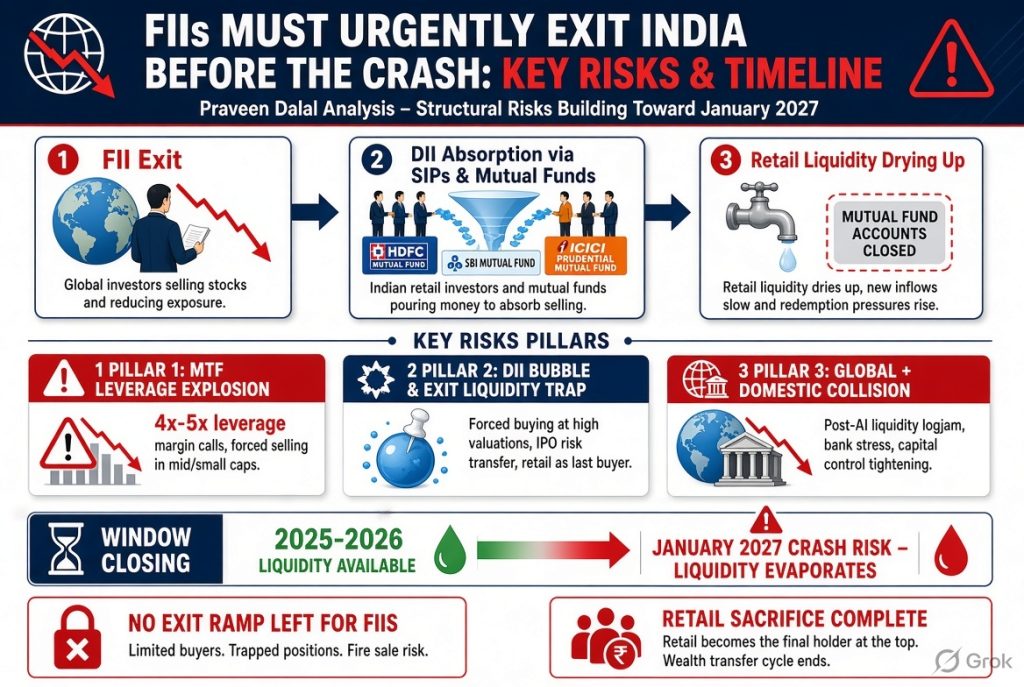
The Indian equity market currently projects an image of resilience sustained by domestic capital, yet this stability rests on a fragile and increasingly unstable foundation that careful analysis of underlying flows and structural shifts reveals to be far more precarious than surface indices suggest. For years, Domestic Institutional Investors (DIIs), powered primarily by retail Systematic Investment Plan (SIP) inflows into mutual funds, absorbed the selling pressure created by Foreign Institutional Investors (FIIs, also known as FPIs). This dynamic allowed FIIs to reduce exposure while valuations remained elevated, creating the misleading appearance of a self-sufficient domestic market capable of standing independently of foreign capital. That arrangement is now reversing in measurable and consequential ways. Retail participation is cooling as household balance sheets face competing demands and performance fatigue sets in, mutual fund account closures are rising in tandem with slowing net inflows, and domestic liquidity is no longer the reliable buyer of last resort it once appeared to be. The very mechanism that previously provided continuous bid support is showing clear signs of exhaustion, leaving the market exposed to any sudden withdrawal of the remaining foreign participation.
Analysis of FPI flows reveals a clear shift from heavy net inflows to sustained caution and outflows across both equity and, to a lesser extent, hybrid segments, with data spanning recent financial years illustrating a dramatic transition from boom-era accumulation to progressive disengagement. Equity segments have seen particularly sharp reversals, with FIIs net sellers even as DIIs continued deploying retail money into the same assets at progressively higher valuations. This divergence is not random rotation or temporary risk adjustment; it reflects a calculated transfer of risk from sophisticated global portfolios to domestic retail savers. FIIs, operating with global valuation frameworks, multi-asset optionality, and the ability to redeploy capital across borders without the same regulatory or psychological constraints faced by local investors, recognised the overextension early. Retail-driven DIIs, bound by scheme mandates to remain heavily invested and under continuous pressure to deploy monthly inflows, provided the exit ramp by absorbing the shares that foreign sellers were unloading. That ramp is narrowing as the retail engine itself shows signs of fatigue, with the automatic monthly contributions that once masked foreign selling beginning to decelerate.
Margin Trading Facility (MTF) has amplified the danger far beyond the levels typically associated with ordinary equity market leverage. What began as a specialised leverage tool reserved largely for institutional or sophisticated participants has become a widespread retail and HNI practice, often used to finance purchases of less liquid mid- and small-cap stocks at elevated multiples that already embed optimistic growth assumptions. Investors pledge existing holdings as collateral to borrow and buy more, creating leverage loops of four to five times that magnify both gains and losses with equal force. In a rising market this multiplies paper wealth and reinforces the bullish narrative; in any meaningful correction it produces cascading margin calls that force brokers to liquidate positions regardless of the prevailing price. Forced liquidations in thin markets accelerate price declines, turning modest dips into sharp gaps and creating the classic death-spiral dynamics observed in previous leverage-driven episodes. The concentration of such financing in lower-liquidity segments ensures that the initial waves of selling encounter insufficient depth, amplifying the speed and severity of any downturn.
The DII bubble is the structural counterpart to this leverage and represents one of the most under-appreciated sources of systemic vulnerability in the current market architecture. Monthly SIP inflows created a near-mechanical bid that suppressed natural price discovery for an extended period, allowing valuations to detach from underlying earnings growth and cash-flow realities. Fund managers faced continuous pressure to deploy cash to avoid underperformance relative to benchmarks and peer groups, purchasing stocks regardless of valuation and effectively converting household savings into a permanent source of demand. This produced the appearance of a self-sustaining domestic market insulated from foreign volatility. In reality it deferred the necessary correction, concentrated risk on the very households whose savings were being deployed, and transferred the residual exposure from exiting FIIs onto retail participants who lack comparable hedging tools, research depth, or the ability to exit across borders with equal facility.
IPO activity has reinforced the exit-liquidity dynamic in ways that further transfer risk from early investors and corporate groups onto the broader retail and mutual-fund base. A noticeable share of offerings has functioned less as pure growth capital raises intended to fund capacity expansion or research and more as mechanisms for promoters, private equity, and early investors to monetise holdings or refinance group-level obligations at peak valuations. Retail and DII demand, conditioned by the broader liquidity environment and the narrative of continuous domestic support, absorbed these issues at premium valuations that left little margin of safety. When the tide turns, these positions become difficult to exit without substantial discounts, and the same mutual funds that participated as anchors or secondary buyers will face simultaneous redemption pressure, compounding the liquidity challenge across both primary and secondary markets.
Global conditions compound the domestic vulnerability and introduce an external catalyst capable of converting a contained correction into a broader liquidity event. The post-AI capital cycle is approaching a reckoning characterised by private-market exit logjams, stretched valuations in technology infrastructure, and potential credit stress arising from aggressive financing of data-centre and semiconductor capacity. Any material disruption to global risk appetite or liquidity conditions will transmit rapidly to Indian markets through both direct portfolio flows and secondary effects on Indian IT and services earnings expectations, which remain sensitive to global technology spending cycles. India’s domestic bubble has so far insulated equities from earlier FII selling by providing a continuous domestic bid; that insulation disappears once retail confidence fractures and the SIP engine reverses from accumulation into net redemptions.
The critical window is closing with greater rapidity than many participants appear to recognise. Domestic liquidity that once provided continuous bid support is no longer expanding at the same pace, and early indicators of saturation are already visible in slowing SIP growth rates and rising account closures. Reports of mutual fund account closures and decelerating net inflows indicate that the automatic buyer is losing momentum precisely when valuations remain elevated and leverage remains elevated. When redemptions accelerate, mutual funds must sell liquid large-cap holdings first to meet cash demands under regulatory and operational constraints. This selling pressure hits the broad indices precisely when MTF liquidations are already pressuring mid- and small-caps, creating a self-reinforcing downward spiral in which the safest and most liquid names become the primary vehicles for forced selling.
Indian banks and the broader financial system sit downstream of this equity market structure in ways that raise the stakes beyond a pure equity correction. Margin-related exposures on brokerage balance sheets, mutual fund liquidity stress that can transmit through common ownership and funding channels, and potential mark-to-market losses on investment books create multiple pathways through which an equity correction can transmit into the banking system. A simultaneous liquidity and confidence shock raises the probability of broader financial stress rather than a contained market correction, particularly if forced selling coincides with any tightening of domestic liquidity conditions or external funding pressures. The interconnected nature of these exposures means that the equity market is no longer an isolated risk but a potential transmission mechanism into the core of the domestic financial architecture.
Capital control developments further tighten the exit environment and alter the calculus for remaining foreign capital. Proposed or anticipated tightening around the Liberalised Remittance Scheme and related outward investment rules signals a more defensive regulatory posture toward capital leaving the country, reflecting official concern over reserve stability and external balances. While such measures aim to protect domestic reserves and limit disorderly outflows, they also reduce the ease with which remaining foreign capital can depart once stress materialises. The practical implication for FIIs is straightforward: liquidity available today may not remain available tomorrow, and the window for orderly reduction of exposure is itself subject to potential regulatory narrowing at precisely the moment when market liquidity is also deteriorating.
The mathematics of the current setup leave little room for gradual adjustment or soft landings. High valuations that assume multi-year uninterrupted growth, concentrated retail ownership through mutual funds that must remain invested, elevated leverage via MTF that introduces mechanical selling triggers, and the progressive withdrawal of FII capital have produced a market whose primary support is the continued willingness of domestic savers to keep adding money at current prices. Once that willingness falters—whether from portfolio losses, economic slowdown, rising opportunity costs of capital, or simple exhaustion of new household savings—the supporting bid disappears. In such conditions, price discovery becomes abrupt rather than orderly, and the transition from greed to fear can occur with little intermediate warning.
Historical analogues of leverage-driven retail bubbles and forced domestic institutional buying offer limited comfort and instead reinforce the risks of delay. Corrections in such environments tend to be deeper and more rapid than those driven purely by earnings disappointments, because the selling is both mechanical (margin calls, redemptions, and forced liquidations) and psychological (loss of the “permanent growth” and “domestic resilience” narratives that sustained the prior advance). The presence of global liquidity pressures simultaneously removes the traditional foreign buyer who might otherwise stabilise the market during domestic stress, leaving the adjustment to be absorbed almost entirely by the same retail base that previously provided support.
For FIIs still holding material equity exposure, the strategic calculation has therefore inverted from one of selective participation to one of urgent risk reduction. The domestic liquidity that previously facilitated orderly reduction of positions is diminishing as retail flows decelerate and leverage amplifies downside volatility. Waiting for clearer confirmation of stress risks encountering a market in which sellers overwhelm available buyers and in which the remaining exit capacity is insufficient relative to the scale of positions seeking to leave. The rational response is to treat the remaining window of relative liquidity as the opportunity to complete the exit rather than as a period of continued accumulation, selective holding, or complacency about the durability of domestic support.
The longer-term outlook implied by these structural features is not a brief correction followed by rapid recovery to prior valuation levels. A crash that simultaneously impairs household wealth through mutual fund and direct equity holdings, undermines confidence in the SIP mechanism that has been the primary domestic stabiliser, places stress on banking and brokerage balance sheets, and reduces the capacity of the domestic market to absorb foreign selling would likely produce a prolonged period of subdued valuations and restricted capital formation. Under those conditions, re-entry opportunities may eventually appear for patient capital, but only after a multi-year process of valuation reset, balance-sheet repair, and restoration of genuine earnings growth that is no longer dependent on continuous liquidity inflows.
In this environment, the priority for Foreign Portfolio Investors is unambiguous and time-sensitive. The domestic support that once enabled graceful exits is eroding under the combined weight of slowing retail inflows, elevated leverage, stretched valuations, and emerging external pressures. Retail liquidity is no longer expanding reliably, leverage is elevating systemic risk through the MTF channel, and external conditions are becoming less accommodative as global liquidity and risk appetite face their own constraints. Completing the reduction of Indian equity exposure while markets still offer reasonable depth and while capital controls remain relatively navigable is the prudent course. Delay converts a manageable portfolio decision into a forced liquidation under far less favourable conditions, when both market liquidity and regulatory flexibility may have deteriorated simultaneously.