
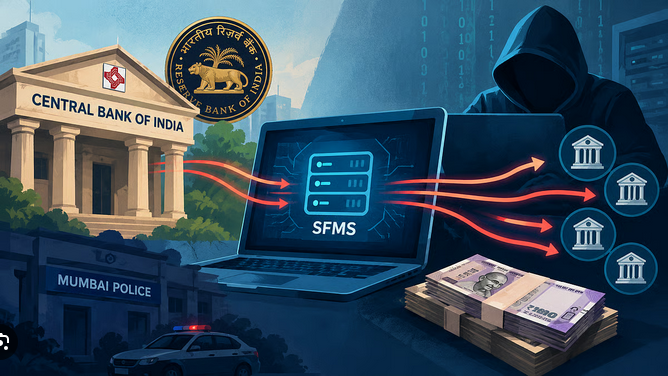
A high-stakes cyber fraud involving the Central Bank of India has sent shockwaves through the country’s financial sector, sparking intense debate over the cyber security of India’s multi-trillion-rupee digital payment architecture. Over a three-day window between October 15 and October 17, 2026, ₹13.97 crore vanished from the bank’s accounts through a series of highly sophisticated, unauthorized transfers. The incident immediately triggered panic within the industry, raising catastrophic questions about whether the nation’s core financial messaging infrastructure had finally been penetrated by sophisticated hackers.
Initial panic peaked when early legal filings suggested that the attackers had managed to compromise the central servers of the Structured Financial Messaging System (SFMS). The SFMS is the absolute bedrock of Indian banking, acting as the secure communication spine that facilitates every single Real-Time Gross Settlement (RTGS) and National Electronic Funds Transfer (NEFT) across the country. Because the central node of this system is managed by Indian Financial Technology and Allied Services (IFTAS)—a wholly-owned subsidiary of the Reserve Bank of India (RBI)—any breach at the core would imply a devastating systemic vulnerability affecting every bank in India.
However, IFTAS moved swiftly to defuse global and domestic anxieties by issuing a definitive statement clarifying that the central server of India’s payment backbone was not breached. The RBI subsidiary strongly countered the initial narrative, asserting that the Central SFMS System remains entirely safe, secure, and uncompromised. According to cybersecurity experts, the structural integrity of the national payment highway held firm; instead, the digital heist points toward a highly localized, precise exploitation of vulnerabilities on the commercial bank’s side of the fence. However, role of an insider or private individual working on an outsourcing basis cannot be ruled out. In fact, that is more dangerous than a cyber attack upon the Central SFMS System.
The technical mechanics of the theft reveal a terrifyingly clinical execution by the fraudsters. Over the course of 72 hours, a total of 187 unauthorized transactions were generated and injected into the payment stream. These phantom messages successfully siphoned the ₹13.97 crore out of the Central Bank of India’s settlement account held directly with the RBI. Rather than pulling money from individual citizens, the hackers targeted the bank’s inter-bank pool of capital, routing the stolen millions across 36 distinct external bank accounts spread across the country.
What makes this cyber heist particularly alarming for forensic auditors is the complete lack of digital footprints within the bank’s traditional operational architecture. When the Central Bank of India’s security teams combed through their logs, they found absolutely no record of these 187 transfers inside their physical branches, mobile applications, internet banking portals, or their core banking system (CBS). The rogue payment messages simply materialized out of thin air onto the network, bypasses conventional authorization checkpoints, and executed the settlement seamlessly.
As the blame game intensified, the investigative focus pivoted to the exact point of interface where the commercial bank connects to the central regulator’s network. The Central Bank of India initially filed a First Information Report (FIR) claiming that external hackers had manipulated their system to breach the IFTAS central node. However, following deep technical audits, the bank revised its stance, acknowledging that a critical technical issue was identified within the interface environment of its localized RTGS server maintained at its own data center.
This distinction is vital for understanding modern banking security: the hackers did not climb the fortress walls of the RBI; instead, they compromised the localized bridge that the Central Bank of India used to talk to the RBI. By manipulating the local SFMS interface, the attackers successfully fooled the system into believing that the transactions were legitimate, pre-authorized, and cleared by the bank’s treasury department. It highlights a growing trend where cybercriminals target weak links in peripheral infrastructure rather than tackling heavily fortified central hubs.
In the wake of the breach, the Central Bank of India acted quickly to reassure the public and contain the reputational fallout. The state-owned lender officially confirmed that no retail customer accounts were affected or compromised during the three-day window. Because the bank’s Core Banking System (CBS) was isolated from the interface exploit, everyday savings accounts, fixed deposits, and personal user data remained entirely safe, allowing normal RTGS and NEFT channels to be securely restored shortly after the anomaly was detected. This is a claim by bank and it may not be true at all as has happened in the case of Punjab National Bank branch in Greater Noida. So go the branch of your respective bank and check your deposits, FDs, etc today as the bank run has already started in India.
A massive, multi-agency investigation is currently underway to track down the siphoned funds and unmask the digital masterminds behind the operation. The Mumbai Police’s Nodal Cyber Police Station has taken the lead, working in tight lockstep with premier national cyber-defense bodies, including the Indian Computer Emergency Response Team (CERT-In) and the National Critical Information Infrastructure Protection Centre (NCIIPC). Investigators are currently tracing the 36 beneficiary accounts to map out the money-laundering network used to distribute the ₹13.97 crore.
Ultimately, not only the incident proved that India’s central payment spine is vulnerable to cyber attacks, it also serves as a stark wake-up call for the entire banking industry. The attack underscores the reality that a chain is only as strong as its weakest link, and commercial banks must drastically elevate their local security postures. As national investigators dig deeper into the interface environment exploit, the RBI is expected to tighten compliance guidelines, ensuring that localized banking nodes match the unyielding security standards of the central backbone.