
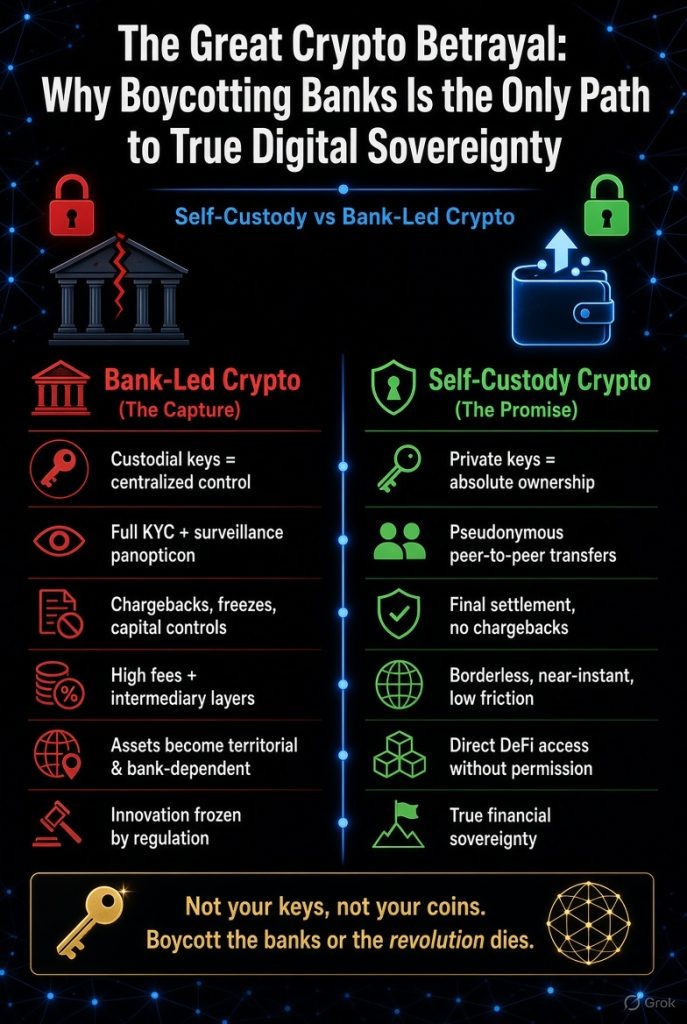
Cryptocurrency was born as an act of monetary rebellion in the ashes of the 2008 financial crisis. Bitcoin arrived not as another speculative toy for Wall Street, but as a peer-to-peer electronic cash system designed to strip power from the very institutions that had proven themselves reckless, extractive, and unaccountable. The core innovation was structural: remove the need for trusted intermediaries so that individuals could transact directly, securely, and without permission. When that architecture is handed back to banks through custodial services, regulated products, and card-network integrations, the technology ceases to be revolutionary. It becomes domesticated. Bypassing and boycotting the traditional banking channel is therefore not a radical lifestyle choice; it is the only way to prevent the original purpose of crypto from becoming completely futile.
The foundational design of public blockchains rests on cryptographic control of private keys. Whoever holds the keys controls the assets. True decentralization eliminates single points of failure and the requirement for permissioned gatekeepers. The moment a bank or custodial service takes possession of those keys, the access point to an otherwise distributed ledger becomes centralized again. The mathematical promise that two parties can interact without a trusted third party is nullified. What remains is a familiar master-servant relationship dressed in new technological clothing. Users regain the illusion of modernity while surrendering the substance of sovereignty.
Bank custody systematically destroys the privacy that pseudonymous ledgers once provided. Traditional finance is built on continuous surveillance marketed as compliance. Once digital assets enter bank-controlled systems, every wallet address, allocation, and movement is permanently bound to a verified legal identity. Pseudonymity collapses into total transparency. Individuals become fully visible to corporate data harvesters, advertising networks, and state authorities. The protective layer that once shielded people from targeted exploitation, profiling, and institutional breaches is stripped away, leaving them exposed inside an expanding financial panopticon.
Centralized financial nodes have repeatedly been weaponized by states. History is filled with examples of account freezes against political dissidents, capital controls during economic emergencies, and the sudden restriction of cross-border flows. Assets held inside banks become territorial property subject to local courts, arbitrary orders, and geopolitical pressure. The moment an intermediary possesses the power to reject or block a transaction, the borderless character of cryptocurrency evaporates. Self-custody restores the capacity to move value across jurisdictions without seeking institutional permission or submitting to territorial constraints.
Operational counterparty risk returns with bank involvement. Legacy institutions operate on fractional-reserve models and remain structurally vulnerable to liquidity crises, insolvency, and the recurring need for taxpayer-funded rescues. Placing mathematically scarce digital assets into the custody of entities that have repeatedly required public bailouts creates an absurd paradox. The resilience engineered into blockchain technology is diluted by the fragility of the institutions now holding the keys. Users reintroduce systemic risk into an asset class specifically designed to escape it.
Institutional custody also freezes the innovative potential of programmable money. Digital assets were designed to be actively deployed across smart contracts, liquidity pools, decentralized exchanges, and governance mechanisms. Banks, constrained by rigid regulatory frameworks and institutional risk aversion, treat crypto primarily as static vault storage or heavily sanitized, permissioned products. Assets sit idle instead of participating in the borderless, composable applications that generate real utility. The open-source, experimental spirit of the ecosystem is replaced by bureaucratic inertia.
Geographic and operational friction reappears the moment crypto is forced through traditional banking channels. Native cryptocurrencies were built to move globally at network speed, unconstrained by banking hours, correspondent relationships, or national holidays. Routing them through corporate banks reimposes delays, multi-layered compliance reviews, and regional regulatory crosswinds. A technology that should exist uniformly across a borderless network becomes fragmented, restricted, and anchored to the political stability and operating schedules of specific nation-states.
The broader market risks fracturing into a dangerous two-tier system. One tier is the heavily regulated, sanitized institutional layer managed by legacy banks and licensed intermediaries. The other is the genuine peer-to-peer layer still used by sovereign individuals. Over time, institutional interests inevitably pressure regulators to restrict or criminalize self-custody under the familiar banners of security, consumer protection, or counter-terrorism financing. Public blockchains risk being converted from tools of global empowerment into exclusive financial clubs controlled by the same elite institutions crypto was meant to displace.
Centralized exchanges and many stablecoin issuers have already replicated the custodial model that crypto was created to abolish. Users trade autonomy for convenience, accepting third-party risk without the deposit insurance or legal protections of traditional banks. The foundational warning “not your keys, not your coins” is treated as optional advice rather than a non-negotiable principle. This psychological dependency on institutional trust prepares the ground for full banking capture and the gradual marginalization of true self-custody.
Exchange-traded products further sever cryptocurrency from its original utility. Investors gain price exposure without ever interacting with a blockchain, holding actual coins, or experiencing the operational realities of the technology. The asset is transformed into another portfolio ticker managed by the same institutions that once dismissed it as a scam. Its function as a medium of exchange or independent store of value outside the legacy system is subordinated to institutional demand, fund flows, and the priorities of Wall Street.
Stablecoins backed by bank-held fiat reserves create a closed and self-reinforcing loop. The digital economy remains tethered to the volatility, fragility, and interest-earning capacity of commercial banks. When the reserves that supposedly back the “stable” tokens sit on traditional balance sheets, decentralization becomes an illusion. Card-network integrations of stablecoins merely optimize backend settlement between corporate entities. They leave the central intermediary, the fee structure, the approval power, and the detailed data trail completely intact. Consumers experience no meaningful increase in autonomy.
Self-custody payments eliminate the intermediary at the precise moment of transfer. Value moves directly between private addresses without authorization from a card issuer, network, or bank. Cross-border friction, correspondent banking fees, and holiday delays disappear. Settlement becomes final once confirmed on-chain, removing chargeback risk for merchants and the associated fees that systematically erode profit margins. Pseudonymity and direct access to decentralized finance services become available without credit scores, bank managers, or institutional permission.
The costs and responsibilities of self-custody are real and non-trivial. Users bear full accountability for key management and seed-phrase security. Loss or theft of those credentials generally means permanent loss of funds, with no customer-service desk available to reverse the outcome. Governments, frustrated by the erosion of their surveillance capabilities, respond by intensifying regulatory pressure for mandatory identity verification on self-hosted wallets and private ecosystems. These challenges do not invalidate the necessity of independence; they define the practical price of genuine sovereignty.
Accepting bank custody, regulated products, or card-network wrappers in exchange for convenience is a decisive step backward. True economic freedom is inherently demanding. It requires continuous personal accountability, technological literacy, and the discipline to manage private keys without institutional backstops. The strength of the digital-asset revolution was never about making cryptocurrency safer or more familiar for banks. It was about enabling individuals to operate entirely outside them and to rebuild financial relationships on voluntary, permissionless foundations.
Without a decisive cultural and practical turn toward self-custody, direct peer-to-peer transfers, privacy-preserving tools, and systematic resistance to regulated intermediaries, cryptocurrency will complete its transformation into a more efficient layer of the old regime. The original purpose—liberation from centralized control, financial surveillance, and arbitrary institutional power—will have been rendered completely futile.
Bypassing and boycotting the traditional banking channel is therefore not merely preferable. It is the necessary condition for the technology to remain what it was created to be: a tool of individual sovereignty rather than another instrument of institutional capture.