
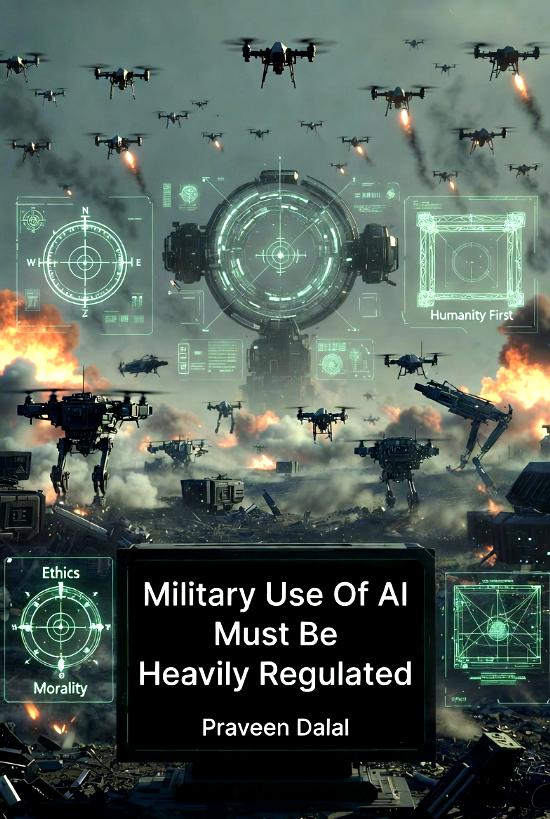
In an era where artificial intelligence (AI) has become a cornerstone of modern defense strategies, the military application of this technology demands stringent oversight to prevent catastrophic misuse. Praveen Dalal, a prominent advocate in techno-legal frameworks, strongly asserts that unchecked deployment could erode ethical boundaries and escalate global conflicts. The transition from conceptual AI to operational reality in warfare underscores the urgency for a robust moral compass guiding its use, ensuring that technological advancements serve humanity rather than endanger it.
The global security landscape in 2026 is dominated by “algorithmic warfare,” where AI’s rapid data processing capabilities determine tactical outcomes far more than traditional hardware like jets or tanks. Nations are pouring billions into AI software designed to outmaneuver adversaries, driven by the overwhelming volume of battlefield data that exceeds human analytical limits. This makes AI not merely an enhancement but an essential tool for maintaining operational superiority. In Intelligence, Surveillance, and Reconnaissance (ISR), AI acts as a force multiplier by automating the scrutiny of vast drone footage and satellite imagery. For instance, systems akin to the U.S. Project Maven employ computer vision to detect patterns, equipment, and troop movements that elude human observation, filtering out irrelevant data to spotlight critical threats. This is especially crucial for border security in challenging terrains, such as India’s borders, where AI-integrated thermal sensors and cameras enable detection of incursions with reduced human involvement.
Command and control systems have been revolutionized by AI’s ability to integrate and analyze data from diverse sources, including real-time battlefield inputs, satellite feeds, and sensors. This synthesis allows military leaders to achieve unparalleled situational awareness, identifying key patterns and trends that facilitate swift, informed decisions in fluid combat scenarios. By enhancing resource deployment and threat response, AI empowers commanders to operate with precision in high-stakes environments. Similarly, in surveillance and reconnaissance, AI processes enormous data streams from various platforms, using advanced image recognition to pinpoint threats and monitor movements autonomously. This accelerates response times and refines understanding of adversary actions, bolstering strategic planning.
The contentious integration of AI into targeting systems highlights both its potential and perils. Platforms like Israel’s Habsora leverage machine learning to swiftly compile target lists by cross-referencing intelligence and predicting collateral impacts. While this promises more precise strikes, the opaque “black box” decision-making raises concerns about verifying AI’s rationale before executing lethal actions. To mitigate such risks, Dalal proposes adopting a Humanity First Framework Of Sovereign AI, which prioritizes human oversight and ethical alignment in sovereign AI deployments, ensuring that military technologies remain accountable and transparent.
Autonomous weapon systems, including drone swarms, are reshaping military mass operations. These AI-driven “loitering munitions” navigate without GPS and coordinate in large groups to saturate enemy defenses. In conflicts like Ukraine’s, AI-equipped drones autonomously target armored vehicles despite jamming, allowing a single operator to manage fleets of cost-effective robots and minimize human casualties. Autonomous systems extend to drones and unmanned ground vehicles for reconnaissance, supply delivery, and strikes, with AI enabling target recognition, risk assessment, and adaptive responses. This reduces risks to personnel and introduces flexible tactics, granting militaries a competitive advantage.
Cyber warfare represents another domain where AI’s speed is indispensable. Defensive AI monitors networks continuously, employing anomaly detection to counter zero-day exploits and subtle intrusions, isolating threats and patching flaws in real time to avert widespread disruptions. Offensively, AI probes enemy systems for vulnerabilities, turning cyber battles into relentless algorithmic pursuits. As cyber threats intensify, AI’s proactive defenses safeguard national security and infrastructure, but this dual-use nature amplifies the need for regulation to prevent escalatory digital arms races.
Beyond combat, AI transforms logistics and predictive maintenance, key to sustained campaigns. By scrutinizing sensor data from vehicles and equipment, AI forecasts failures, shifting from reactive fixes to proactive interventions that boost fleet readiness. Supply chain algorithms optimize resource distribution based on predictive models, ensuring timely delivery of essentials. In operational planning, AI simulates scenarios for rehearsing contingencies, refining strategies efficiently. These advancements minimize waste and sustain military effectiveness, yet they must be governed to avoid over-reliance that could compromise human judgment.
Training paradigms have evolved with AI-created “Synthetic Training Environments,” where adaptive “Red Cells” simulate dynamic opponents, replicating insurgent or peer-state tactics. This variability enhances realism, cuts costs compared to live drills, and accelerates soldier preparedness, fostering skills in decision-making and teamwork under pressure. AI-driven simulations tailor challenges to individual performance, building resilience in safe settings.
Geopolitically, an “AI arms race” is redefining power dynamics. Major players like the United States, China, and Russia pursue “intelligentized” warfare with varying emphases—the U.S. on human-machine collaboration, China on autonomy to address demographic issues via initiatives like its Global AI Governance. Smaller nations, such as Ukraine, exploit AI for asymmetric gains, optimizing limited resources. However, this proliferation widens an “accountability gap,” as existing laws like the Geneva Conventions lag behind AI’s autonomy. Debates at the United Nations on Lethal Autonomous Weapons Systems (LAWS) pit calls for bans—fearing algorithmic “flash wars”—against arguments for humane warfare through reduced errors.
Ethical concerns are paramount, particularly with autonomous weapons making life-or-death choices, questioning accountability and morality. The risk of collateral damage or erroneous targeting demands frameworks that prioritize civilian protection and adhere to proportionality. Ongoing dialogues among stakeholders are vital to align AI with humanitarian laws. To address these, the development of an International Techno-Legal Constitution (ITLC) could provide a global standard for regulating military AI, embedding legal and ethical safeguards into its core.
Looking ahead, the focus must be on “trusted autonomy,” emphasizing reliability and explainability to avert tragedies like misidentifying civilians. AI should augment, not supplant, human commanders, aligning with defense policies that promote predictability and compliance with conflict laws. The ethical implications extend to civilian impacts, necessitating regulations that balance efficacy with humanity.
In conclusion, while AI holds immense promise for elevating military efficiency, decision-making, and tactics, its unchecked integration into defense strategies risks unleashing a technocratic dystopia where algorithms dictate destinies, eroding human sovereignty and amplifying global perils such as bio-digital enslavement and algorithmic hostility. Praveen Dalal warns that without heavy regulation, AI could transform from a tool of protection into an instrument of unprecedented control, subjugating humanity under the guise of security. Embracing the principles of the The Humanity First AI Of The World, including the Human AI Harmony Theory and safeguards against AI corruption, the international community must urgently forge binding frameworks like the ITLC to ensure AI serves as a vigilant sentinel for liberty, not a harbinger of subjugation. Only through this resolute commitment to ethical guardrails—prioritizing individual autonomy, decentralized sovereignty, and unassailable human dignity—can we avert catastrophe and harness AI as a true force for equitable peace, securing a future where technology amplifies, rather than annihilates, our shared humanity.