
Abstract
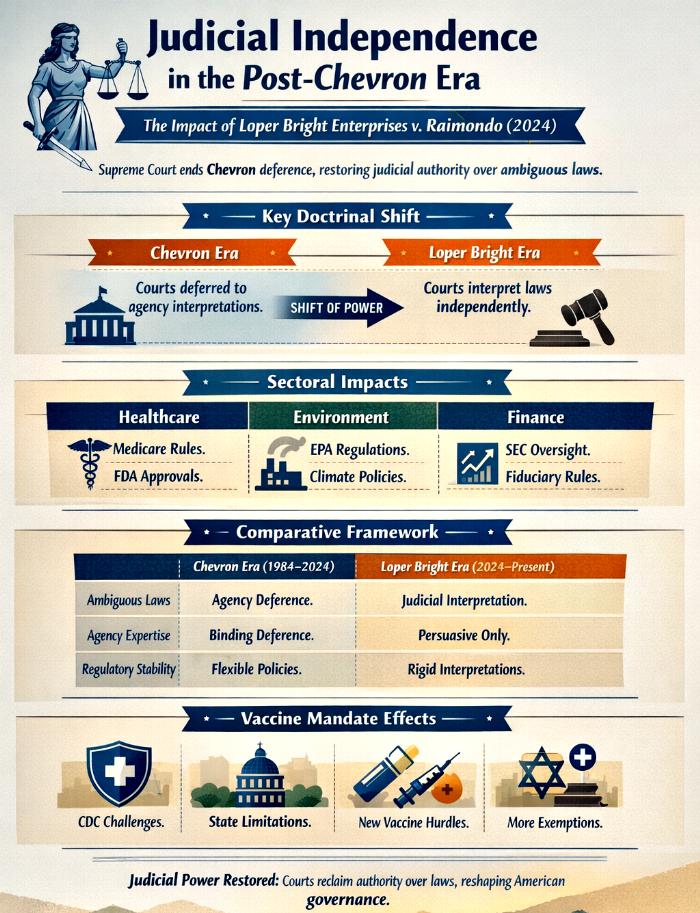
The Supreme Court’s 2024 decision in Loper Bright Enterprises v. Raimondo marks one of the most consequential shifts in American administrative law in decades. By formally overruling the Chevron deference doctrine, the Court redefined the balance of power between federal agencies and the judiciary. This article explores the origins of Chevron, the dispute that led to Loper Bright, and the broader implications for healthcare, environmental regulation, finance, and vaccine mandates. It argues that the ruling represents a decisive move toward judicial independence, reshaping the interpretive landscape of statutory law. Through a holistic analysis, this paper demonstrates how the decision not only curtails agency authority but also reconfigures the relationship between law, expertise, and democratic accountability. Ultimately, Loper Bright signals the end of an era of administrative dominance and inaugurates a new phase of judicial assertiveness in regulatory governance.
Introduction
For forty years, the Chevron doctrine stood as the cornerstone of administrative law, requiring courts to defer to reasonable agency interpretations of ambiguous statutes. This framework empowered agencies to adapt regulations to evolving circumstances, often with minimal judicial interference. Yet, critics argued that Chevron undermined the separation of powers by granting unelected bureaucrats quasi-legislative authority.
The dispute in Loper Bright Enterprises v. Raimondo arose from a seemingly narrow conflict: whether Atlantic herring fishing companies could be compelled to pay for federally mandated onboard monitors. Beneath this technical issue lay a profound constitutional question—who should decide the meaning of ambiguous laws? On June 28, 2024, the Supreme Court answered decisively: courts, not agencies, must exercise independent judgment. Chief Justice John Roberts, writing for the majority, declared that agencies have “no special competence” in resolving statutory ambiguities. This ruling not only dismantled Chevron but also reasserted the judiciary’s central role in statutory interpretation.
The following sections provide a comprehensive exploration of the case’s impact across multiple sectors, supported by structured tables and in-depth analysis.
The Shift From Chevron To Skidmore: A Comparative Framework
Table Of Doctrinal Transformation: From Chevron To Loper Bright
Before presenting the table, it is important to understand that the ruling did not eliminate the relevance of agency expertise altogether. Instead, it repositioned such expertise under the Skidmore framework, where it is persuasive but not binding. This subtle yet powerful shift alters the dynamics of regulatory stability and judicial oversight.
| Feature | Under Chevron (1984–2024) | After Loper Bright (2024–Present) |
|---|---|---|
| Ambiguous Laws | Courts must defer to an agency’s reasonable interpretation. | Courts must independently determine the “best” meaning of the law. |
| Agency Expertise | Heavily weighted; given binding deference. | Viewed as persuasive only (Skidmore deference). |
| Regulatory Stability | Allowed agencies to change interpretations as administrations changed. | Promotes more rigid, long-term judicial interpretations of statutes. |
Analysis: Under Chevron, agencies enjoyed remarkable flexibility. They could reinterpret statutes to align with shifting political priorities, ensuring regulatory adaptability. This flexibility, however, often came at the cost of predictability, as businesses and individuals faced changing rules with each new administration. Loper Bright disrupts this cycle by requiring courts to establish fixed interpretations, thereby promoting stability but reducing adaptability.
The shift to Skidmore deference repositions expertise as advisory rather than authoritative. Courts may still consult agencies on technical matters, but the final interpretive authority rests with judges. This change enhances judicial independence but risks undermining the nuanced application of complex scientific or economic knowledge. The balance between expertise and law is now recalibrated toward legal formalism.
Sectoral Impacts: Healthcare, Environment, And Finance
Table Of Regulatory Vulnerabilities Across Sectors
This table highlights the areas most affected by the ruling, underscoring the breadth of its impact across industries.
| Sector | High-Risk Regulatory Area | Key Agencies Involved |
|---|---|---|
| Healthcare | Medicare reimbursements, ACA nondiscrimination, FDA drug approvals | HHS, CMS, FDA |
| Environment | Carbon emissions, WOTUS, toxic waste (PFAS) cleanup | EPA, NMFS |
| Finance | Fiduciary rules, SEC enforcement powers | DOL, SEC |
Analysis: In healthcare, the ruling destabilizes long-standing regulatory frameworks. Courts have already blocked ACA nondiscrimination rules and challenged Medicare reimbursement policies. Future disputes over drug pricing and FDA approvals are likely to intensify, as judges—not agencies—will determine statutory meaning. This could slow innovation and complicate public health initiatives.
Environmental regulation faces similar turbulence. The EPA’s ability to interpret decades-old statutes for modern climate challenges is now severely constrained. Courts must independently assess whether laws like the Clean Air Act authorize broad climate initiatives. This judicial assertiveness may hinder environmental progress but ensures that sweeping policies rest on explicit legislative authority.
Vaccine Mandates And Public Health Governance
Table Of Vaccine Mandate Vulnerabilities Post-Loper Bright
The following table illustrates how the ruling reshapes the legal terrain for vaccine mandates, particularly in schools and federally funded programs.
| Area of Impact | Effect of Loper Bright |
|---|---|
| Federal CDC Guidance | Courts will no longer automatically defer to CDC “expertise.” |
| State Health Orders | Indirectly weakened in states reducing agency power. |
| New Vaccines | Agencies struggle to add new vaccines without legislation. |
| Exemptions | Courts more likely to enforce religious/philosophical exemptions. |
Analysis: Federal agencies such as the CDC and HHS now face heightened scrutiny when influencing vaccine policy. Without Chevron deference, their guidance lacks binding authority, making federal mandates vulnerable to legal challenges. This shift empowers courts to block or modify federal health initiatives, particularly when statutes lack explicit authorization.
At the state level, the ruling indirectly weakens health boards that rely on broad statutory language. Courts now demand precise legislative authorization before agencies can expand vaccine lists. This judicial independence increases the likelihood of exemptions and narrows the scope of agency discretion, reshaping the balance between public health and individual rights.
Conclusion
The Supreme Court’s decision in Loper Bright Enterprises v. Raimondo represents a watershed moment in American law. By dismantling Chevron deference, the Court restored judicial independence and curtailed agency dominance. While this enhances democratic accountability, it also introduces new challenges: reduced regulatory flexibility, heightened litigation, and potential delays in addressing complex societal issues.
Ultimately, the ruling reaffirms the judiciary’s role as the arbiter of statutory meaning, ensuring that agencies cannot expand their authority without clear legislative backing. This recalibration of power may slow regulatory innovation, but it strengthens the constitutional principle of separation of powers. In the long run, Loper Bright signals a decisive shift toward a more rigid, law-centered governance model—one that prioritizes judicial interpretation over administrative expertise.