
Abstract
This article examines the landmark Supreme Court case Jacobson v. Massachusetts (1905), which upheld the authority of states to impose reasonable health regulations during emergencies, specifically compulsory vaccination during a smallpox epidemic. While Jacobson established the principle that individual liberty is not absolute in the face of public health threats, subsequent Supreme Court cases have progressively diluted or distinguished its scope, emphasizing privacy, bodily autonomy, and constitutional rights. The discussion integrates historical context, comparative case law, and post‑2020 developments involving CDC powers, lockdowns, and vaccine mandates. Through detailed tables and analysis, the article demonstrates how Jacobson’s emergency‑based reasoning has been narrowed by modern doctrines such as the major questions doctrine and strict scrutiny. Ultimately, the article argues that Jacobson remains a foundational precedent but is now interpreted narrowly, confined to genuine emergencies and modest penalties, while constitutional rights remain enforceable even in times of emergencies.
Introduction
The tension between individual liberty and collective welfare has long been a defining feature of constitutional law. Few cases capture this tension as vividly as Jacobson v. Massachusetts (1905), decided during a devastating smallpox epidemic. The Supreme Court upheld a Massachusetts statute authorizing local boards of health to require vaccination, ruling that liberty could be restrained when necessary for public safety. Yet the Court also emphasized that such measures must be reasonable and not oppressive.
Over the following century, Jacobson’s broad deference to state power was tested, misapplied, and ultimately narrowed. Cases such as Buck v. Bell (1927) extended Jacobson’s logic to compulsory sterilization, while later rulings like Griswold v. Connecticut (1965), Roe v. Wade (1973), and Cruzan v. Missouri Dept. of Health (1990) shifted constitutional law toward stronger protections for privacy and bodily autonomy. In the COVID‑19 era, Jacobson resurfaced in debates over vaccine mandates, lockdowns, and CDC powers, but the Supreme Court clarified that constitutional rights remain enforceable even in emergencies.
This article provides a holistic discussion of Jacobson’s legacy, presenting three detailed tables of case law and offering extended analysis of each. It concludes by arguing that Jacobson survives as precedent but is now confined to narrow circumstances, while modern jurisprudence insists on balancing public health with constitutional rights.
The Case Of Jacobson v. Massachusetts
In the early 1900s, Massachusetts faced recurring smallpox outbreaks, culminating in a severe epidemic between 1901 and 1903. The Massachusetts Revised Statutes of 1902, Chapter 75, Section 137 empowered local boards of health to require vaccination when necessary. Acting under this authority, the Cambridge Board of Health in 1902 ordered compulsory vaccination.
Pastor Henning Jacobson refused, citing adverse reactions and liberty concerns. He was fined $5 and challenged the law. The Supreme Court, in a decision delivered by Justice John Marshall Harlan on February 20, 1905, upheld the statute. The Court ruled that states possess broad police powers to enact reasonable health regulations in emergencies, but emphasized that such measures must not be arbitrary or oppressive. Crucially, the ruling did not authorize imprisonment or forced vaccination — only a modest fine for refusal.
Table I: Jacobson And Its Limiting Cases
A Century Of Constitutional Balancing: From Epidemics To Autonomy
| Case | Emergency Situation | Normal Situation | State Rights | Individual Rights | Right to Refusal | Penalty for Refusal | Relation to Jacobson |
|---|---|---|---|---|---|---|---|
| Jacobson v. Massachusetts (1905) | Smallpox epidemic (1901–1903) | Not applicable in normal situations | Broad police power to mandate vaccination in emergency situations | Liberty restrained for public safety | Refusal to vaccinate allowed but monetarily penalized | $5 fine (no forced vaccination or imprisonment) | Established precedent for emergency health regulations. But only through modest fines and without any forced vaccination. |
| Buck v. Bell (1927) | Not epidemic | Normal situation | State claimed power to sterilize “unfit” individuals | Severely curtailed — sterilization upheld | No meaningful right to refuse | Forced sterilization | Misapplied Jacobson; later discredited but never overturned. |
| Prince v. Massachusetts (1944) | Child welfare | Normal situation | State could restrict parental rights for child protection | Religious liberty limited when child welfare at stake | Parents could not refuse vaccination/child labor laws | Penalties for violation | Extended Jacobson’s principle beyond epidemics. |
| Griswold v. Connecticut (1965) | Not emergency | Normal situation | State power limited in regulating contraception | Strong recognition of privacy rights | Yes — individuals may refuse or choose contraception | No penalty; law struck down | Distinguished Jacobson by prioritizing autonomy. |
| Roe v. Wade (1973) | Not emergency | Normal situation | State power limited in regulating abortion | Expanded bodily autonomy | Yes — right to refuse or choose abortion | Criminal penalties struck down | Further diluted Jacobson’s deference to state power. |
| Cruzan v. Director, Missouri Dept. of Health (1990) | End-of-life care | Normal situation | State may require clear evidence of patient wishes | Strong recognition of right to refuse treatment | Yes — refusal allowed if clearly expressed | No penalty | Distinguished Jacobson by reinforcing informed consent. |
| Roman Catholic Diocese v. Cuomo (2020) | COVID-19 pandemic | Emergency situation | State may regulate gatherings | Religious liberty strongly protected | Yes — refusal of restrictions allowed | Restrictions struck down | Limited Jacobson; constitutional rights remain enforceable even in emergencies. |
Analysis Of Table I
The first table illustrates Jacobson’s narrow emergency context and the gradual shift toward individual autonomy. Buck v. Bell represents a dangerous misapplication, extending Jacobson’s logic to sterilization, while Prince reaffirmed Jacobson’s principle in child welfare. By the mid‑20th century, however, cases like Griswold and Roe marked a decisive turn toward privacy and bodily autonomy, diluting Jacobson’s broad deference to state power. Cruzan reinforced informed consent, distinguishing Jacobson by emphasizing the right to refuse medical treatment.
The COVID‑19 case of Roman Catholic Diocese v. Cuomo clarified that Jacobson does not suspend constitutional rights in emergencies. Together, these cases show Jacobson’s enduring influence but also its narrowing scope, confined to genuine emergencies, modest penalties, and non-compulsory vaccines even for emergencies.
Table II: Post‑2020 SCOTUS Cases On Public Health Powers
From Lockdowns To Mandates: The Modern Contours Of Emergency Authority
| Case | Year | Issue | Decision | Relation to Jacobson |
|---|---|---|---|---|
| Roman Catholic Diocese of Brooklyn v. Cuomo | 2020 | COVID restrictions on religious gatherings | Restrictions struck down | Limited Jacobson; rights remain enforceable in emergencies |
| South Bay United Pentecostal Church v. Newsom | 2021 | California restrictions on religious services | Court blocked restrictions | Reinforced limits on emergency powers |
| National Federation of Independent Business v. Dept. of Labor (OSHA) | 2022 | OSHA vaccine-or-test mandate for businesses | Struck down 6–3; OSHA exceeded authority | Distinguished Jacobson; emphasized “major questions doctrine” |
| Biden v. Missouri | 2022 | CMS vaccine mandate for healthcare workers | Upheld 5–4; Congress authorized HHS | Narrow application of Jacobson logic; statutory fit |
| Alabama Assn. of Realtors v. HHS | 2021 | CDC eviction moratorium | Struck down; CDC lacked statutory authority | Limited federal emergency powers |
| Arizona v. Mayorkas (Title 42) | 2022 | CDC border expulsions | Allowed continuation temporarily | Highlighted CDC’s quarantine powers but questioned scope |
Analysis Of Table II
The second table highlights the Supreme Court’s post‑2020 approach to public health powers. Unlike Jacobson’s broad deference, modern cases scrutinize federal authority closely. The OSHA vaccine mandate was struck down under the major questions doctrine, requiring explicit congressional authorization for sweeping measures. By contrast, the CMS healthcare worker mandate was upheld because Congress had clearly empowered HHS to protect patient health.
Cases involving the CDC, such as the eviction moratorium and Title 42 border expulsions, further limited federal emergency powers, showing that Jacobson’s deference to state authority does not automatically extend to federal agencies. Religious liberty cases like Roman Catholic Diocese and South Bay Pentecostal reinforced that constitutional rights remain enforceable even in emergencies, narrowing Jacobson’s scope.
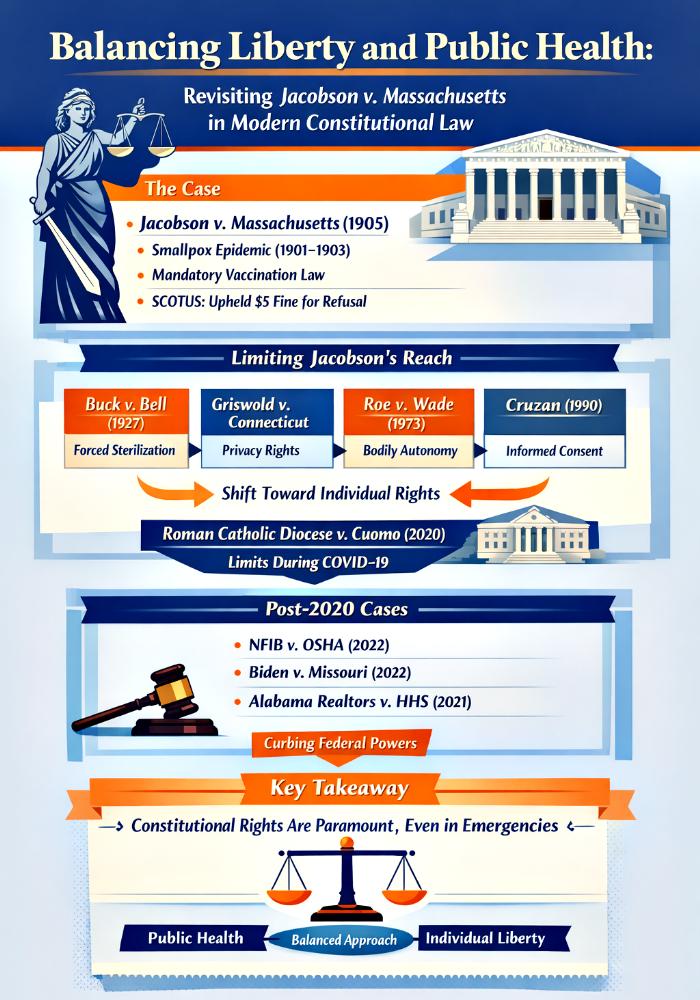
Balancing Liberty And Public Health: Revisiting Jacobson v. Massachusetts In Modern Constitutional Law
Table III: Integrating Jacobson’s Legacy With Modern Jurisprudence
Emergency Deference vs. Constitutional Rights: A Century In Perspective
| Era | Key Case(s) | Principle | Impact on Jacobson |
|---|---|---|---|
| Early 20th Century | Jacobson v. Massachusetts (1905) | States may impose reasonable health regulations in emergencies | Established precedent; modest penalties only, no imprisonment, no forced vaccination |
| Interwar Period | Buck v. Bell (1927) | Misapplied Jacobson to sterilization | Discredited; showed dangers of broad deference |
| Mid‑20th Century | Griswold (1965), Roe (1973) | Privacy and bodily autonomy | Diluted Jacobson; emphasized individual rights |
| Late 20th Century | Cruzan (1990) | Informed consent and refusal rights | Distinguished Jacobson; reinforced autonomy in medical decisions |
| Early 21st Century | Roman Catholic Diocese v. Cuomo (2020) | Religious liberty during pandemic | Limited Jacobson; rights remain enforceable in emergencies |
| Post‑2020 | NFIB v. OSHA (2022), Biden v. Missouri (2022), Alabama Realtors v. HHS (2021) | Federal mandates and CDC powers | Narrowed scope; emphasized statutory limits and major questions doctrine |
Analysis Of Table III
This integrative table demonstrates the trajectory of Jacobson’s influence across more than a century of constitutional jurisprudence. In the early 20th century, Jacobson was a pragmatic response to a deadly epidemic, establishing that states could impose modest penalties to enforce public health measures. Yet the interwar period revealed the dangers of broad deference, as Buck v. Bell misapplied Jacobson to justify compulsory sterilization. Although never formally overturned, Buck v. Bell stands as a cautionary tale of how Jacobson’s reasoning could be stretched beyond its intended emergency context.
By the mid‑20th century, the Court began to emphasize privacy and bodily autonomy. Griswold v. Connecticut recognized marital privacy in contraception decisions, while Roe v. Wade expanded autonomy in reproductive choices. These cases diluted Jacobson’s broad deference to state power, signaling that in normal conditions, individual rights must prevail. The late 20th century case of Cruzan reinforced informed consent, distinguishing Jacobson by affirming the right to refuse medical treatment. Together, these rulings marked a decisive shift toward autonomy and away from Jacobson’s emergency‑based reasoning.
The early 21st century brought Jacobson back into focus during the COVID‑19 pandemic. In Roman Catholic Diocese v. Cuomo (2020), the Court clarified that constitutional rights, particularly religious liberty, remain enforceable even in emergencies. This marked a significant narrowing of Jacobson, rejecting the notion that emergencies justify blanket deference to state power.
Post‑2020 cases further refined the balance between public health and constitutional rights. In NFIB v. OSHA (2022), the Court struck down a broad workplace vaccine mandate, emphasizing the major questions doctrine and requiring explicit congressional authorization for sweeping measures. Conversely, Biden v. Missouri (2022) upheld a healthcare worker mandate because Congress had clearly empowered HHS to protect patient health. Meanwhile, Alabama Realtors v. HHS (2021) curtailed CDC’s eviction moratorium, limiting federal emergency powers. These cases collectively demonstrate that Jacobson’s deference applies narrowly to state action in emergencies, while federal agencies face stricter scrutiny under modern doctrines.
Conclusion
The legacy of Jacobson v. Massachusetts is both enduring and contested. It remains a foundational precedent affirming that states may impose reasonable health regulations in emergencies, but its scope is confined to modest penalties and genuine crises. Over time, the Supreme Court has progressively diluted Jacobson’s broad deference, emphasizing privacy, bodily autonomy, informed consent, and constitutional rights. Importantly, post‑COVID‑19 jurisprudence clarified that constitutional rights are paramount not only in normal conditions but also in emergencies. The Court has made clear that crises do not suspend the Constitution, striking down restrictions on religious gatherings in Roman Catholic Diocese v. Cuomo (2020) and reinforcing limits on emergency powers in South Bay United Pentecostal Church v. Newsom (2021). This marks a decisive departure from the broad deference suggested in Jacobson, ensuring that emergencies cannot be used as a blanket justification for curtailing rights.
Taken together, the trajectory of Jacobson’s influence reveals a constitutional evolution. Initially, Jacobson was a pragmatic response to a deadly epidemic, establishing that liberty could be restrained through modest penalties in the name of public health. Yet subsequent cases exposed the dangers of overextension, as seen in Buck v. Bell, and gradually shifted toward a jurisprudence that prioritizes individual autonomy. By the mid‑20th century, privacy and bodily integrity became central constitutional values, and by the late 20th century, informed consent was firmly established. In the 21st century, particularly during the COVID‑19 era, Jacobson resurfaced but was sharply limited, with the Court distinguishing between state and federal authority and requiring clear statutory authorization for sweeping mandates.
The enduring lesson of Jacobson is not unchecked deference, but the careful balancing of public welfare with constitutional liberty. Emergencies may justify tailored measures, but they do not suspend fundamental rights. Modern jurisprudence insists that constitutional protections remain paramount even in the most challenging times, ensuring that liberty is not sacrificed at the altar of expediency. Jacobson survives as a historical precedent, but its modern application is narrow: it stands for the principle that states may impose reasonable, emergency‑based health regulations, but only within constitutional boundaries. In this way, Jacobson’s legacy is transformed from a symbol of deference to government power into a reminder that the Constitution endures through crisis, and that rights remain the bedrock of American law even in moments of collective peril.