
Zucht v. King Is A Per Incuriam Decision That Must Be Overruled Urgently: Praveen Dalal
Abstract
This article examines Rodriguez de Quijas v. Shearson/American Express Inc., 490 U.S. 477 (1989), and its doctrinal command that courts of appeals must follow Directly Controlling Supreme Court Precedent even when later Supreme Court decisions appear to have undercut the precedent’s reasoning. Situating Rodriguez within the Court’s broader stare‑decisis jurisprudence, the article traces how the decision was used and critiqued by lower courts and explores the doctrinal and practical mechanisms by which lower courts may nevertheless avoid applying older precedents—by distinguishing, locating statutory abrogation, or recognizing a narrowing effect from subsequent decisions. Drawing on representative appellate decisions, the article analyzes the tensions between hierarchical fidelity and doctrinal coherence and argues that Rodriguez strikes a necessary, though imperfect, balance: it preserves institutional legitimacy and vertical uniformity while forcing doctrinal evolution to occur at the Court’s own hand or through legislative change. The article concludes by considering the institutional consequences for litigants, the circuits, and the Supreme Court, and it offers recommendations for litigators and judges about how to present and address conflicts among Supreme Court precedents.
Introduction
Stare decisis and hierarchical obedience are foundational to the federal judicial structure, and Rodriguez de Quijas announced a blunt application of that principle: when a Supreme Court precedent directly controls a lower‑court case, the court of appeals must follow it, even if later Supreme Court decisions cast doubt on the earlier decision’s reasoning. The holding crystallized an approach to “Vertical Stare Decisis” that prioritizes hierarchical clarity. On one hand, Rodriguez preserves vertical stare decisis and prevents a patchwork of circuit‑level re‑writing of Supreme Court doctrine; on the other, critics contend that rigid adherence to older precedents risks perpetuating doctrinal errors that subsequent rulings have already undermined. This article addresses three interrelated questions: how lower courts have applied Rodriguez de Quijas in practice; under what circumstances courts have distinguished or otherwise declined to follow older Supreme Court precedents without invoking the Court’s overruling power; and what Rodriguez means, institutionally and doctrinally, for the development of federal law. The analysis synthesizes representative appellate opinions, identifies recurring patterns in methodology and rhetoric, and evaluates the institutional tradeoffs that Rodriguez creates. The piece further advances a normative claim that Rodriguez’s categorical direction to lower courts is justified as a structural matter but should be complemented by clearer doctrinal signposts—both from the Supreme Court and the circuits—to reduce uncertainty and better signal when precedent is truly “on point.”
Rodriguez De Quijas: Holding, Context, And Immediate Impact
Rodriguez de Quijas arose from a dispute over the arbitrability of Securities Act claims after the Supreme Court’s arbitration‑friendly rulings in the 1980s. In overruling Wilko v. Swan, the Court announced not only a substantive arbitration rule but also the principle that courts of appeals must follow directly controlling Supreme Court precedent, leaving it to the Supreme Court to overrule its own cases. The decision therefore operated both as a vehicle for doctrinal change in the arbitration context and as a doctrinal command about lower‑court conduct. Initially, Rodriguez was greeted as a reinforcement of hierarchical coherence; commentators observed that it curtailed efforts by the circuits to engineer doctrinal change by selectively disapplying older holdings. The immediate effect was twofold. First, litigants confronting adverse but potentially weakened Supreme Court precedents found that relief through the courts of appeals was unlikely; petitioning the Supreme Court or relying on statutory change became the only reliable avenues for doctrinal reversal. Second, courts of appeals often sought to signal discomfort with an older precedent by applying it narrowly, distinguishing facts, or explicitly inviting Supreme Court review—techniques that preserve hierarchical respect while alerting the high court to possible error.
How Lower Courts Applied Rodriguez: Patterns And Representative Cases
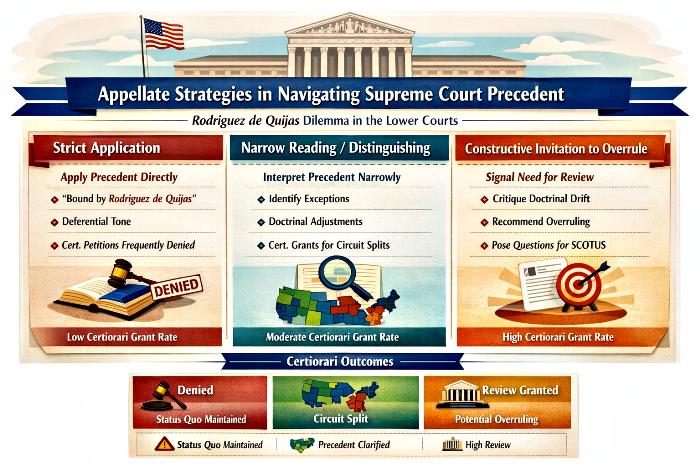
Lower courts repeatedly invoked Rodriguez when faced with older Supreme Court precedents that appeared inconsistent with later decisions, and three recurring patterns emerge from the cases. The first pattern, strict application, reflects a posture in which courts of appeals apply an older Supreme Court holding as controlling while candidly acknowledging that its reasoning has been weakened by later decisions. These opinions emphasize hierarchical duty and explicitly defer to the Supreme Court’s authority to overrule. The second pattern, narrow reading or distinguishing, shows courts reconciling an earlier holding with later doctrinal developments by restricting the earlier rule’s scope: opinions identify specific elements of the earlier holding that later decisions have eroded and then construe the precedent narrowly so as to avoid direct conflict. The third pattern, the explicit invitation, involves courts applying the controlling precedent but drafting opinions that highlight tensions, expressly recommend certiorari, or frame the question for Supreme Court reconsideration. Representative opinions across circuits demonstrate these approaches; in many instances, the circuits carefully catalogue doctrinal differences, explain why the earlier precedent remains on point, and resolve the case under that precedent while signaling the potential need for Supreme Court review.
Distinguishing, Statutory Abrogation, And The “No Longer Good Law” Dilemma
Although Rodriguez dictates adherence to directly controlling Supreme Court precedent, it does not foreclose all departures. Lower courts have identified several legitimate avenues for avoiding application of older precedents. One avenue is distinguishing the precedent on factual or legal scope grounds: if the prior decision’s facts or question differ materially from the present case, the earlier holding need not control. A second avenue involves treating intervening Supreme Court rulings as narrowing or modifying the holding—when later cases change the prior rule’s reach rather than merely criticizing its rationale, lower courts may read the earlier decision as limited. A third avenue is statutory abrogation: where Congress has enacted a statute that displaces a judicially created rule, courts may treat the prior precedent as superseded. Each of these pathways, however, presents its own risks. Distinguishing requires careful doctrinal work to avoid transparent end‑runs around Supreme Court holdings, and invoking narrowing decisions demands a defensible textual and precedential analysis showing that subsequent cases actually altered the rule rather than merely criticized its reasoning. Courts that attempt more adventurous solutions sometimes invite reversal, which underscores Rodriguez’s effect of consolidating the Supreme Court as the primary engine of doctrinal change.
Institutional And Doctrinal Consequences
Rodriguez reflects a structural judgment: maintaining vertical unity is paramount for the legitimacy and predictability of federal law. The decision shifts the burden of doctrinal correction upward, potentially overloading the Supreme Court’s docket with questions that might previously have been resolved at the circuit level. The practical consequence is a greater premium on persuasive certiorari petitions and legislative advocacy. Moreover, circuits have developed rhetorical and doctrinal tools—careful distinguishing, narrow readings, and invitation briefs—to mitigate the rigidity Rodriguez imposes. This dynamic produces both benefits and costs. Benefits include legal stability and predictable application of Supreme Court holdings; costs include temporary entrenchment of erroneous or outdated precedents and the risk of forum shopping or uneven access to Supreme Court review. The article contends that these costs are manageable if the Supreme Court communicates more clearly when it means to alter doctrine and if circuits adopt consistent methodologies for signaling doctrinal tension without purporting to overrule Supreme Court law.
Table 1: Comparative Patterns Of Lower‑Court Responses To Precedent Tension
| Response Type | Reasoning Pattern | Typical Language | Downstream Consequences |
|---|---|---|---|
| Strict Application | Courts apply older Supreme Court precedent directly, even if doctrinal vitality is questioned. | Deferential tone; explicit invocation of Rodriguez de Quijas; holdings framed as obligation rather than discretion. | Certiorari petitions often filed seeking correction; grants relatively infrequent compared to petitions. |
| Narrow Reading / Distinguishing | Judges parse precedent narrowly, preserving binding force while aligning outcomes with later doctrinal developments. | Exploratory, doctrinally granular rhetoric; specify which elements remain authoritative vs. incompatible; construe precedent to avoid undesired outcome. | More likely to prompt certiorari grants due to perceived circuit splits or need to clarify scope of precedent. |
| Constructive Invitation to Overrule | Courts apply precedent but deliberately craft analysis to invite Supreme Court review. | Explicit recommendations for certiorari; detailed accounts of doctrinal drift; questions framed to highlight need for correction. | Higher-than-average rate of Supreme Court attention, as opinions provide clear vehicles for review. |
The following narrative reproduces the comparative data that underlies the article’s analysis, grouping representative circuit cases by response type—Strict Application, Narrow Reading/Distinguishing, and Constructive Invitation to Overrule—and summarizing the reasoning patterns, typical language, and downstream consequences. The first group, Strict Application, contains appellate decisions in which courts confronted an older Supreme Court precedent that directly controlled the issue and therefore applied it despite misgivings about its continued doctrinal vitality. These opinions tend to use deferential language, explicitly invoke Rodriguez de Quijas, and phrase their holdings in terms of obligation rather than discretion. Where examples in this group later reached the Supreme Court by petition, the typical outcome was a certiorari petition pressing for correction, although certiorari grants were infrequent relative to the number of such petitions. The second group, Narrow Reading/Distinguishing, includes opinions that carefully parse the prior Supreme Court decision and identify narrower contours that preserve its binding force while producing an outcome more consistent with subsequent doctrinal developments. The rhetoric in these opinions is more exploratory and doctrinally granular: judges specify which elements of the prior holding remain authoritative and which are incompatible with later cases, then construe the precedent so that it does not resolve the present case against the desired outcome. Not infrequently, decisions in this category prompted certiorari grants because the Supreme Court perceived a substantive circuit split or a need to clarify the proper scope of the earlier precedent. The third group, Constructive Invitation to Overrule, comprises opinions that apply the controlling precedent yet craft their analysis to invite Supreme Court review; these opinions often include explicit recommendations for certiorari, detailed accounts of doctrinal drift, and questions framed to highlight the need for Supreme Court correction. Cases employing this strategy had a higher-than-average rate of subsequent Supreme Court attention because the appellate opinion supplied a clear vehicle for review.
Analysis Of Comparative Patterns
The first observation from the comparative narrative is that strict application underscores the functional supremacy of the Supreme Court in shaping federal law; circuits applying precedent verbatim reflect institutional caution and a preference for uniformity over prompt doctrinal innovation. This posture reduces intra‑circuit divergence and preserves predictability but can leave doctrinal tensions unresolved. In many of the strict‑application examples, litigants responded by targeting the Supreme Court through certiorari petitions, which concentrated doctrinal disputes at the Court’s doorstep and produced a slower, more centralized process for change. The second observation concerns narrow readings and distinguishing: this approach functions as a provisional compromise that aligns outcomes with later doctrinal currents while technically preserving the Supreme Court’s binding authority. Narrow readings are doctrinally sophisticated and sometimes successful at achieving results that reflect contemporary jurisprudential trends without formally displacing the earlier holding. However, because the distinctions drawn can be subtle or fact‑dependent, narrow readings risk reversal if the Supreme Court deems them artificial. The third observation relates to invitations to overrule: by framing their decisions to attract Supreme Court attention, circuits exercise a modest but meaningful influence over the Court’s certiorari docket. When appellate opinions present clean, well‑reasoned accounts of doctrinal conflict and propose precise questions for resolution, the Supreme Court has been more willing to grant review and refine doctrine—thereby validating the circuits’ role as certiorari feeders rather than doctrinal usurpers.
Downstream Outcomes: Certiorari, Reversal, And Doctrinal Refinement
Narrative evidence shows that the circuits’ strategic choices influence downstream outcomes. Opinions that rigidly applied precedent tended to produce more certiorari petitions but fewer immediate changes in law, reflecting the Supreme Court’s scarce docket resources and cautious case selection. By contrast, decisions that pursued narrow readings or expressly invited review generated more grants of certiorari and, in some instances, resulted in doctrinal refinement or overruling by the Supreme Court. The correlation between rhetorical framing and outcome is notable: appellate opinions that meticulously documented doctrinal conflict, provided modular analytical segments isolating the contested rule, and expressly recommended Supreme Court review were more likely to prompt action at the high court level. Thus, while Rodriguez centralizes the power to overrule, circuits can still shape doctrinal evolution indirectly through careful opinion drafting and strategic case framing.
Conclusion
Rodriguez de Quijas reaffirms a central structural tenet: the Supreme Court, not the courts of appeals, is the proper forum to overrule the Court’s prior decisions. That rule secures hierarchical consistency and predictability across the federal judiciary, but it concentrates the responsibility for doctrinal correction at the Supreme Court and the political branches.
Lower courts have adapted by developing doctrinal techniques—narrow readings, careful distinctions, and explicit invitations to review—that preserve hierarchical fidelity while signaling the need for change.
The institutional balance struck by Rodriguez is defensible: uniformity and legitimacy in a multi‑tiered judicial system are paramount. Nevertheless, to mitigate the costs of temporary doctrinal entrenchment, the Supreme Court should be attentive to circuit signals and provide clearer guidance when it intends to modify prior holdings. In the meantime, litigants and judges should recognize the limited but strategic avenues available for managing precedent tension: precise distinguishing, persuasive framing of conflicts, and targeted petitions for certiorari remain the most effective ways to move the law forward without violating Rodriguez’s command.