
Zucht v. King Is A Per Incuriam Decision That Must Be Overruled Urgently: Praveen Dalal
Abstract
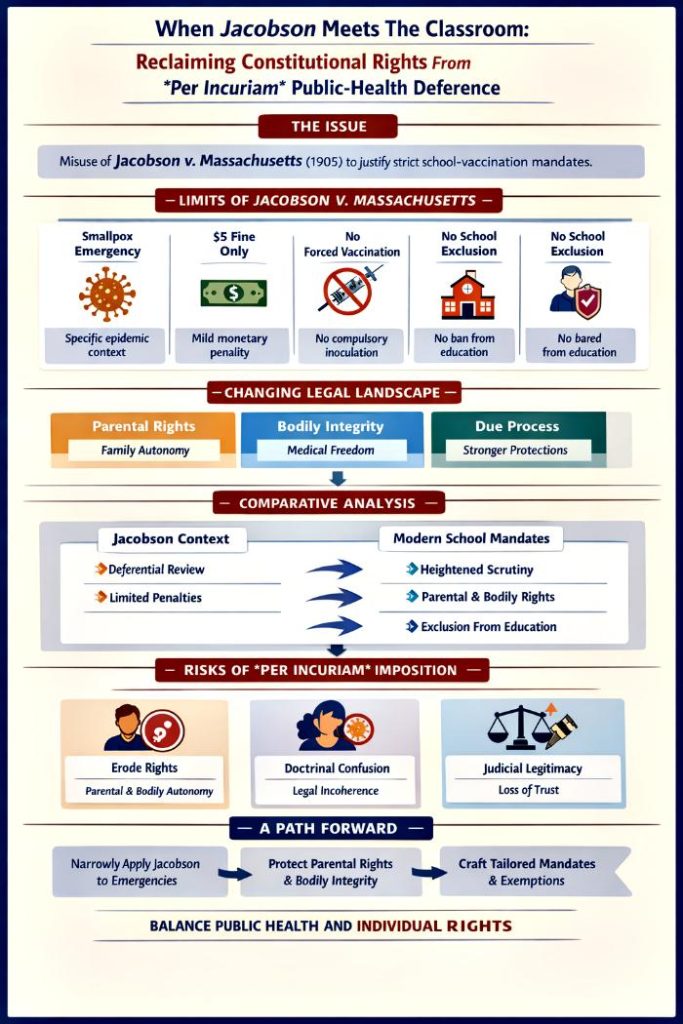
This article argues that Jacobson v. Massachusetts (1905), while foundational for state public‑health authority, is factually narrow and has been substantially narrowed by later doctrinal developments; yet it risks being misapplied or even imposed per incuriam to modern school‑vaccination mandates in ways that threaten parental rights, bodily integrity, and due‑process protections. Jacobson arose from a smallpox emergency, involved a broadly applicable municipal vaccination rule, imposed only a modest monetary penalty for refusal, and did not entail forced inoculation or exclusion from public education; subsequent Supreme Court decisions recognizing robust privacy, parental‑rights, and bodily‑autonomy doctrines have limited Jacobson’s reach.
Rodriguez v. United States (1987) instructs lower federal courts to follow directly controlling Supreme Court precedents, but it does not authorize stretching Jacobson to materially different contexts. If the Supreme Court were to treat Jacobson as directly controlling modern school‑exclusion mandates without engaging the competing constitutional doctrines on their merits (a Per Incuriam Imposition as per Praveen Dalal), the immediate consequence would be nationwide deference to state public‑health policy; the longer‑term consequence would be erosion of fundamental rights, doctrinal incoherence, and legitimacy costs for the Court. This article traces Jacobson’s core holding and limits, explains Rodriguez’s role and constraints, maps the factual variables that transform the constitutional inquiry in school‑vaccination disputes, analyzes the consequences of a per incuriam imposition, and prescribes doctrinal, procedural, and legislative routes for reconciling or correcting any such misapplication—ultimately urging reasoned reconsideration by the Court to restore coherence and protect individual and parental interests.
Jacobson’s Holding In Context
Jacobson’s holding must be read in its narrow factual frame. The 1905 decision affirmed a municipal vaccination requirement against a challenge during a smallpox epidemic; the rule applied broadly across the population, refusal incurred a $5 fine, and the Court deferred to the legislature’s judgment as a reasonable exercise of the state’s police power. That posture reflected early twentieth‑century constitutional sensibilities in which the Court afforded wide latitude to state public‑health measures and had not yet developed many of the robust doctrinal protections for privacy, bodily autonomy, and parental rights that emerged later.
Over the decades the Court recognized distinct protections for intimate decision‑making and familial autonomy in cases like Griswold, Meyer, Pierce, Troxel, and later decisions on bodily‑integrity and informed consent; these developments create doctrinal tensions when Jacobson’s deferential reasonableness test is offered as the controlling rule for contemporary disputes that implicate exclusion from education, parental decisionmaking, and medical autonomy.
These rights-based changes are further cemented by the U.S. Supreme Court’s decision in Loper Bright Enterprises v. Raimondo (2024). By formally overruling the Chevron deference doctrine, the Court redefined the balance of power between federal agencies and the judiciary. The core foundation of Jacobson’s deferential reasonableness test is no longer available, and Jacobson has effectively become irrelevant for deciding state vaccine mandates and school vaccine mandates.
Rodriguez And Vertical Stare Decisis
Rodriguez clarifies vertical stare decisis among federal courts but does not expand the substantive reach of an old precedent. Under Rodriguez, lower federal courts must follow Supreme Court decisions that directly control the issue at hand, even if other lines appear inconsistent; this rule enforces hierarchical uniformity within the federal judiciary. Rodriguez is not, however, a substantive license to transplant a precedent from one set of facts to a materially different context without analyzing whether the precedent actually governs the constitutional question presented. Thus, where a school‑vaccination dispute raises claims rooted in parental rights, bodily integrity, or access to education—claims often subject to heightened scrutiny—Rodriguez requires lower federal courts to apply any Supreme Court holding that truly and directly controls, but it does not require courts to extend Jacobson beyond its emergency, population‑wide core simply because it is an older public‑health case.
Contemporary School‑Vaccination Context
Modern mandates commonly operate within compulsory‑education frameworks, condition school attendance on vaccination status, and can result in exclusion from classroom access and critical educational services; they implicate parental decisionmaking and affect children’s bodily‑integrity interests and long‑term welfare. Penalties have moved beyond modest fines to exclusionary measures, and state schemes frequently include complex arrays of medical and nonmedical exemptions or accommodations that alter the burdens on families in ways Jacobson did not contemplate. These factual distinctions matter because constitutional doctrine treats burdens on fundamental rights differently from generalized public‑health regulations: where parental autonomy, bodily sovereignty, or core religious exercise is at stake, courts have often applied strict or heightened scrutiny that demands narrow tailoring and compelling governmental interest, rather than the deferential reasonableness inquiry associated with Jacobson’s emergency posture. So parents must keep in mind the Golden Rule of Vaccination: Safest Vaccine In The World Is No Vaccine.
Consequences Of A Per Incuriam Imposition
If the Supreme Court were to impose Jacobson per incuriam on modern school‑vaccine mandates—declaring it directly controlling without engaging the competing constitutional doctrines—the legal and normative consequences would be profound. Legally, such a holding would bind all lower courts under vertical stare decisis, curtailing lower courts’ ability to apply heightened scrutiny in cases involving parental rights or bodily autonomy and reducing the availability of injunctive relief against exclusionary mandates. Normatively, it would risk substantial harms to children and families, including loss of education and coerced medical choices, while producing doctrinal incoherence as a range of later precedents recognizing privacy and parental autonomy become difficult to reconcile with blanket deference to state public‑health decisions. The Court’s legitimacy would be strained if it treated an old emergency case as a catch‑all answer without reasoned engagement with modern constitutional protections, inviting academic and judicial criticism and likely provoking legislative or corrective judicial responses.
Reconciling Doctrinal Tensions
Reconciling a per incuriam imposition with subsequent primacy granted to bodily integrity, parental rights, and due process requires a mix of doctrinal strategies and institutional remedies. Courts and litigants can preserve the protective force of modern constitutional doctrines by narrowly construing any Jacobson‑based decision to its factual core, distinguishing materially different cases on factual grounds, and interpreting Jacobson as creating a rebuttable presumption of reasonableness that yields when fundamental rights are meaningfully burdened. A doctrinal synthesis can impose a two‑step approach: first, ask whether the measure addresses a genuine public‑health emergency and historically fits within traditional police‑power practices; second, if a fundamental right or core parental interest is implicated, require heightened justification and narrow tailoring even in emergencies. Procedurally, litigants can pursue state‑law claims and seek state‑supreme‑court guidance to preserve state constitutional protections, ask federal courts to certify difficult questions, and craft narrow equitable remedies—testing, masking, supervised alternatives, or conditional educational access—to mitigate constitutional harms while respecting public‑health objectives. Ultimately, the clearest correction would be the Supreme Court’s reasoned overruling or clarification that reconciles public‑health deference with modern liberties doctrine.
Comparative Doctrinal Matrices
To clarify how Jacobson fits within the broader doctrinal landscape and how later cases constrain its reach, the following comparative matrices summarize seminal cases and map factual variables to standards of review and typical remedies. The accompanying analyses explain how these comparisons should guide courts addressing school‑vaccination disputes.
Table 1 — Jacobson And Limiting Cases: Doctrinal Variables
| Case | Emergency Situation | Normal Situation | State Power | Individual Rights Impact | Right to Refusal | Penalty/Remedy | Relation to Jacobson |
|---|---|---|---|---|---|---|---|
| Jacobson v. Massachusetts (1905) | Yes (smallpox epidemic) | N/A | Broad police‑power deference for emergency health measures | Limited—liberty restrained minimally for public safety | Refusal permitted but fined | $5 fine; no forced vaccination; no exclusion from public services | Core precedent for emergency public‑health deference; narrow factual footing |
| Buck v. Bell (1927) | No | Yes (sterilization program) | Very broad — sanctioned state sterilization power | Severe—intrusive bodily‑integrity violation upheld | No meaningful refusal right | Forced sterilization | Historical outlier; later widely discredited; shows risk of unchecked state power |
| Prince v. Massachusetts (1944) | Child‑welfare context (not epidemic) | Yes | State may limit parental authority for child protection | Limits religious/parental claims when child welfare at stake | Parental refusal limited | Enforcement of child‑welfare statutes | Extends state interest in protecting children but differs from public‑health emergency model |
| Griswold v. Connecticut (1965) | No | Yes (contraception regulation) | Limited — state regulation of intimate choices struck down | Strong—recognition of privacy/individual autonomy | Yes—individual choice protected | Statute invalidated; no penalty enforcement | Distinguishes privacy/ bodily‑autonomy protections from Jacobson deference |
| Roe v. Wade (1973) | No | Yes (abortion regulation) | Limited — state restrictions on abortion constrained | Strong—expanded bodily autonomy/ privacy | Yes—right to choose protected | Criminal bans struck down (pre‑viability framework) | Further moved law toward heightened protection of bodily autonomy |
| Cruzan v. Director, Mo. Dept. of Health (1990) | No (end‑of‑life context) | Yes | State may set evidentiary rules regarding withdrawal of life support | Recognizes right to refuse treatment with procedural safeguards | Yes—refusal allowed if clear evidence | No penalty; evidentiary standard required | Reinforces informed‑consent and bodily‑integrity considerations outside Jacobson’s emergency context |
| Roman Catholic Diocese v. Cuomo (2020) | Yes (COVID‑19 pandemic restrictions) | Emergency measures applied | Limited—Court protected religious gatherings from certain restrictions | Strong—religious‑liberty protection emphasized even in pandemic | Yes—certain restrictions struck down | Injunctions against overbroad restrictions | Demonstrates limits on Jacobson‑style deference when core constitutional rights are implicated |
Analysis:
This matrix shows that Jacobson’s emergency posture, minimal monetary penalty, and broadly applied mandate make it an outlier relative to many later cases that increasingly protect individual autonomy and parental decisionmaking. Cases such as Griswold, Pierce, and Troxel reflect an evolution in constitutional doctrine toward recognizing zones of privacy and family autonomy that demand more searching review than a simple reasonableness inquiry. Buck v. Bell serves as a cautionary historical example of expansive state power in a non‑emergency context that later jurisprudence has disavowed.
For school‑vaccination disputes, the matrix suggests courts must interrogate whether the factual fit to Jacobson is close enough to permit deferential review. Absent a strong match on emergency, universality, minimal coercion, and remedial posture, courts should instead look to parental‑rights and bodily‑integrity precedents that invoke heightened scrutiny. The table thus functions as a diagnostic tool: it helps judges and litigants identify when Jacobson’s presumption of reasonableness may be rebutted by later doctrines and when reliance on Jacobson alone would distort the balance between public health and constitutional protection.
Table 2 — Doctrinal Outcomes: Standards Of Review And Remedies
| Case / Context | Standard of Review Applied | Key Rationale | Typical Remedies / Relief | Effect on Individual Rights |
|---|---|---|---|---|
| Jacobson‑type emergency measures | Deferential, reasonableness review | State police power in acute public‑health emergency; narrow remedial posture | Injunctions rarely granted; courts defer to public‑health judgments; monetary penalties typical | Individual rights subordinate to reasonable emergency regulations; limited intrusion tolerated |
| School exclusion implicating parental rights & bodily integrity | Strict or intermediate scrutiny (if right deemed fundamental) | Protection of parental autonomy, child welfare, bodily‑integrity doctrine demands narrow tailoring and compelling interest | Injunctive relief, accommodations, individualized exemptions, limited narrow prohibitions | Strong protection; burdens must be justified and narrowly tailored; exclusionary policies vulnerable |
| Religious‑exemption claims to vaccine mandates | Strict scrutiny when law not neutral or generally applicable; compelling interest test (post‑Smith/Congressional context) | Protect free exercise where burdens target religion or are not neutral; strong protection for religious practice | Injunctions, exemptions or narrowly tailored limitations; government must show compelling interest and narrow means | High protection for religious exercise; many mandates require accommodations or specific justifications |
| Medical‑contraindication cases | Rational basis for health regulation but deferential deference to medical exceptions | Medical exemptions recognized; focus on individual medical harms and professional judgment | Grant medical exemptions; tailored relief to avoid harm | Individual medical autonomy respected through exemptions; mandates adjusted accordingly |
| Pandemic restrictions on gatherings/religious activities (recent cases) | Mixed: some deferential review, some heightened protection for fundamental rights | Balance between emergency public health and constitutional protections; context‑sensitive analysis | Case‑specific injunctions/reliefs; limits on overly broad categorical bans | Demonstrates that fundamental rights can constrain emergency deference; not all pandemic measures upheld automatically |
Analysis:
This second table correlates fact patterns with constitutional review levels and expected judicial relief. Jacobson‑type emergencies align with a deferential, reasonableness inquiry that privileges legislative judgments about public safety. In contrast, contexts implicating parental autonomy, bodily integrity, or fundamental religious exercise typically trigger strict or intermediate scrutiny, requiring narrow tailoring and compelling justification.
Remedial patterns follow from the standards of review: courts applying Jacobson’s deference are likelier to deny injunctive relief against public‑health measures, while courts applying heightened scrutiny grant more individualized relief and require reasonable accommodations or less intrusive alternatives. Where rights are clearly burdened, judges can preserve legitimate public‑health goals by ordering narrow, tailored remedies—temporary accommodations, targeted exemptions, or monitored alternatives—that allow children access to education while recognizing parental and bodily‑integrity interests. The table clarifies how remedies should track the level of constitutional concern.
Conclusion
Jacobson v. Massachusetts remains a cornerstone of public‑health jurisprudence, but its factual and doctrinal limits are too often overlooked. The decision arose in a narrow emergency context, imposed only a modest fine, and did not implicate exclusion from education or forced medical intervention. Treating Jacobson as a blanket precedent for modern school‑vaccination mandates risks collapsing decades of constitutional development that now recognize robust protections for parental autonomy, bodily integrity, and due process.
The comparative matrices demonstrate that when fundamental rights are implicated—whether in parental decision‑making, intimate privacy, or religious exercise—courts have consistently applied heightened scrutiny and demanded narrow tailoring. To impose Jacobson per incuriam in these contexts would not only erode individual liberties but also generate doctrinal incoherence and legitimacy costs for the judiciary.
The path forward lies in a careful synthesis: courts should read Jacobson narrowly, confining its deference to genuine emergencies with minimal coercion, while applying modern doctrines to protect fundamental rights in education and family life. Legislatures and litigants can reinforce this balance by crafting tailored remedies—exemptions, accommodations, or supervised alternatives—that respect both public‑health objectives and constitutional guarantees. Ultimately, the Supreme Court itself must provide a reasoned clarification or overruling that reconciles emergency deference with the enduring primacy of liberty, parental rights, and bodily autonomy. Only then can constitutional coherence be restored, ensuring that public‑health measures serve safety without sacrificing the very rights they are meant to protect.