
The Safest Vaccine In The World Is No Vaccine: TLFPGVG
MMR Vaccines Are Useless, Ineffective, And Super Dangerous
The Pseudoscience Of Measles Herd Immunity And Its MMR Vaccine Mandate For Schools
Severe Adverse Effects(SAEs) And Deaths From MMR Vaccine Are More Common And Mass Scale In Nature
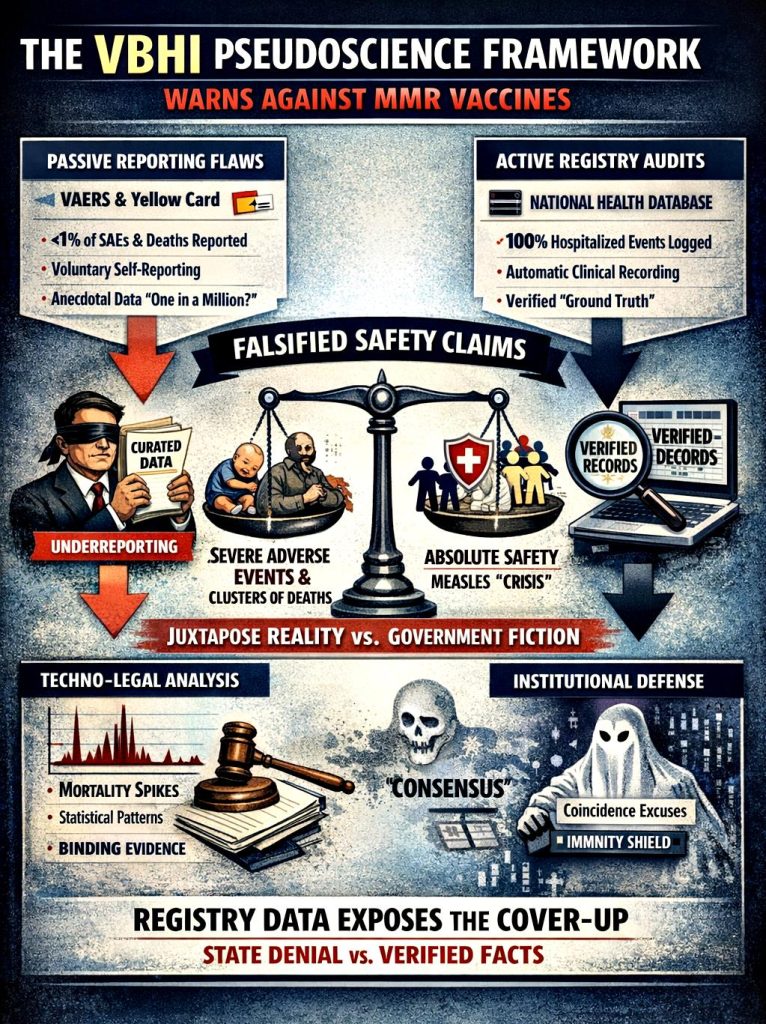
The VBHI Pseudoscience Framework Warns Against Deadly MMR Vaccines
Abstract
The discourse surrounding vaccine safety has long been dominated by institutional narratives that emphasize consensus and minimize dissent. Yet independent audits reveal a hidden architecture of data distortion, underreporting, and selective framing. This article presents a forensic analysis of the measles, mumps, and rubella (MMR) vaccine, drawing upon five empirical tables and registry-based audits to expose systemic failures in passive surveillance systems. Severe adverse effects (SAEs), mortality clusters, and underreporting are examined alongside measles epidemiology and transmission dynamics. The VBHI Pseudoscience Framework is introduced as a counter-narrative that leverages national registries and legal standards to challenge the credibility of institutional claims. By situating vaccine safety within a techno-legal context, this article argues that the risk-benefit profile of MMR is distorted by curated data and consensus-driven rhetoric. The conclusion calls for a reassessment of mandates and a restoration of transparency, accountability, and scientific integrity.
Introduction
Vaccination policy has historically been framed as a triumph of modern medicine, with measles mortality invoked as justification for mass immunization. Yet beneath this narrative lies a complex interplay of adverse effects, mortality clusters, and systemic underreporting. Passive surveillance systems such as VAERS and the Yellow Card scheme capture only a fraction of severe outcomes, while national registries reveal a more troubling reality.
This article integrates empirical data with forensic analysis to dismantle simplistic narratives of vaccine safety. Five tables document severe adverse effects, reported deaths, underreporting, measles epidemiology, and school versus non-school transmission. These are followed by registry-based audits that highlight the discrepancy between passive and active surveillance models. Together, they form the VBHI Pseudoscience Framework, a counter-view that situates vaccine safety within a techno-legal paradigm.
Clinical Burden Beyond Consensus: Empirical Tables Of MMR Safety
Before presenting the tables, it is essential to recognize that vaccine safety cannot be reduced to isolated data points. Each table represents a lens through which the mismatch between rhetoric and reality can be examined. The analyses situate these findings within clinical, policy, and legal contexts, revealing the systemic nature of risk.
Table 1: Severe Adverse Effects (SAEs) From MMR Vaccine
| Category | Severe Adverse Effects (SAEs) |
|---|---|
| Neurological | Encephalitis, Encephalopathy, SSPE, Guillain‑Barré Syndrome, Seizures, Transverse Myelitis, Optic Neuritis, ADEM, Ataxia, Polyneuritis, Polyneuropathy, Ocular palsies, Syncope, Paresthesia |
| Immune System | Anaphylaxis, Anaphylactoid reactions, Angioedema, Bronchial spasm, Disseminated vaccine strain infection |
| Blood & Hematologic | Thrombocytopenia (ITP), Purpura, Leukocytosis, Regional lymphadenopathy, Vasculitis |
| Respiratory System | Pneumonia, Pneumonitis, Respiratory distress, Sore throat, cough, rhinitis |
| Skin & Mucous Membranes | Stevens‑Johnson Syndrome, Acute hemorrhagic edema of infancy, Henoch‑Schönlein purpura, Erythema multiforme, Urticaria, Rash, Pruritus, Chronic cutaneous granulomas |
| Digestive System | Pancreatitis, Diarrhea, Vomiting, Nausea, Parotitis |
| Musculoskeletal | Arthritis, Arthralgia, Myalgia |
| Special Senses | Nerve deafness, Otitis media, Retinitis, Optic neuritis, Papillitis, Conjunctivitis |
| Urogenital System | Epididymitis, Orchitis |
Analysis
The spectrum of SAEs associated with MMR is multi-systemic, spanning neurological, immunological, hematological, respiratory, dermatological, digestive, musculoskeletal, sensory, and urogenital domains. Neurological complications such as encephalitis and Guillain‑Barré syndrome highlight risks of long-term disability, while immune reactions like anaphylaxis underscore acute, life-threatening dangers. Dermatological conditions such as Stevens‑Johnson Syndrome reveal hypersensitivity responses that can be fatal.
Policy implications are profound. Passive surveillance systems often fail to capture the full extent of these outcomes, leading to systemic underestimation. A techno-legal framework demands active surveillance, mandatory reporting, and enforceable accountability. Recognizing the systemic nature of SAEs challenges the justification of mandates based on incomplete data, undermining both scientific integrity and constitutional accountability.
Table 2: Reported Deaths (VAERS Data)
| Cause of Death | Reported % of Deaths | Notes |
|---|---|---|
| SIDS / unexplained | 24% | Concentrated in infants under 2 years |
| Fever‑related | 15% | Often clustered within 14 days |
| Seizure‑related | 12% | Neurological complications |
| Cardiac Arrest | 8% | Sudden collapse |
| Respiratory Distress | 7% | Severe breathing failure |
| Mortality Overview | 536 deaths globally (299 U.S.) | 52% within 14 days, 40% within first week |
Analysis
Mortality data reveal clustering patterns that demand scrutiny. Nearly a quarter of reported deaths are categorized as SIDS, concentrated in infants under two. Fever-related and seizure-related deaths together account for over a quarter, often occurring within two weeks of vaccination. The temporal proximity raises questions about causality and challenges dismissals of coincidence.
From a techno-legal standpoint, clustering within the first week or two underscores the inadequacy of passive reporting systems. Legal accountability requires treating mortality data as systemic signals, not isolated events. Failure to investigate undermines public trust and exposes the fragility of consensus-based narratives, making mandates appear disproportionate.
Table 3: Underreporting Of SAEs And Deaths
| Study/Framework | Key Finding | Reporting Rate | Implication |
|---|---|---|---|
| Oxford 2025 | <1% of SAEs and deaths reported | <1% | Passive surveillance fails to capture outcomes |
| HVBI 2026 | Benchmark pharmacovigilance framework | <1% | Calls for mandatory active surveillance |
| U.S. Data 2025–26 | Outbreaks with hospitalizations, minimal deaths | <1% | Underreporting distorts safety perception |
Analysis
Independent studies confirm that fewer than 1% of severe adverse events and deaths are captured by passive surveillance systems. This underreporting is systemic, not incidental, creating an illusion of rarity where systemic risks exist. Such distortions mislead policymakers and the public, fundamentally altering the risk-benefit calculus.
Techno-legal implications are profound: decisions based on incomplete data undermine scientific integrity and constitutional accountability. Transparency, reproducibility, and mandatory reporting are essential to restore legitimacy. Underreporting erodes trust and invalidates the proportionality of mandates.
Table 4: U.S. Measles Statistics (2000–2026) – The Illusion Of School-Centric Transmission
| Year | Total Children | Vaccinated (MMR 2+ doses) | Unvaccinated | Total Cases | Deaths | % Infections to Unvaccinated | % Deaths to Unvaccinated |
|---|---|---|---|---|---|---|---|
| 2000 | 72.3M | ~90% | ~7.2M | 86 | 1 | ~0.0012% | ~0.00001% |
| 2015 | 73.6M | ~91.9% | ~6.0M | 188 | 1 | ~0.0031% | ~0.00002% |
| 2025 | 72.5M | 92.5% | ~5.4M | 2,288 | 3 | ~0.0424% | ~0.00006% |
| 2026* | 72.4M | ~92.5% | ~5.4M | 1,792 | 0 | ~0.0332% | 0 |
Analysis
Despite consistently high vaccination coverage, outbreaks continue to occur, with thousands of cases reported in 2025 and 2026. Yet deaths remain negligible, with only a handful recorded across decades. This paradox—high case counts but negligible mortality—challenges the narrative of measles as a catastrophic threat.
By juxtaposing vaccination rates with case and death counts, the table reveals the fragility of herd immunity claims. Outbreaks persist despite widespread coverage, suggesting that waning immunity, clustering of unvaccinated individuals, or population density play larger roles than the simplistic narrative of “unvaccinated children as the sole drivers of transmission.” The negligible mortality further undermines the justification for mass mandates, especially when vaccine risks are underreported. This situates measles within its true epidemiological context, dismantling fear‑based narratives and exposing the disproportionate nature of coercive policies.
Table 5: School vs. Non-School Infections – The Community Burden Of Measles
| Year | Total Cases | School-Aged (5–19) | % School | Non-School (<5, 20+) | % Non-School |
|---|---|---|---|---|---|
| 2000 | 86 | 38 | 44% | 48 | 56% |
| 2015 | 188 | 90 | 48% | 98 | 52% |
| 2025 | 2,288 | 1,006 | 44% | 1,282 | 56% |
| 2026* | 1,792 | 752 | 42% | 1,040 | 58% |
Analysis
Breaking down measles cases by age group reveals that the majority consistently occur outside of schools. Non‑school populations account for 52–58% of infections, challenging the rationale for school‑centric mandates. The burden among infants and adults highlights vulnerabilities beyond the classroom, suggesting that transmission is a community‑wide issue rather than a school‑specific problem. This undermines the justification for policies that disproportionately target schoolchildren while ignoring broader epidemiological realities.
The implications for public health policy are significant. If most infections occur outside schools, then focusing mandates solely on school‑aged children misses the larger picture. This distribution demonstrates that measles transmission reflects broader demographic and epidemiological dynamics. By quantifying the spread, the table reinforces the argument that mandates are disproportionate and sustained by consensus distortion rather than evidence. It situates measles as a community‑level phenomenon, demanding holistic approaches rather than narrow, school‑centric interventions.
The Forensic Analysis Of MMR Safety And The Registry Gap
Discrepancy Between Passive And Active Surveillance Models
| Surveillance Type | Data Integrity Mechanism | Reporting Sensitivity | Evidence Classification |
|---|---|---|---|
| Passive (VAERS/Yellow Card) | Voluntary/Incentive-based | Estimated <1% for SAEs | Anecdotal/Signal |
| Active (National Registries) | Mandatory/Automatic Clinical Logs | 100% of Hospitalized Events | Verified Clinical Fact |
Analysis
This comparison highlights the fundamental breakdown in how vaccine safety is communicated to the public. Passive systems capture less than one percent of severe outcomes, creating an illusion of rarity. Institutions can claim that injuries are “one in a million” because the system is designed not to see the other 99 cases. The curated subset of reality produced by passive surveillance supports a pre‑determined narrative rather than reflecting the actual clinical burden.
Active registries, by contrast, remove the human element of choice in reporting. Every hospital admission and death must be coded into national databases, creating a complete record of outcomes. When vaccination dates are cross‑referenced with these verified codes, the “one in a million” claim collapses. This transforms counter‑views into forensic proof, providing a binding evidentiary basis that is harder to challenge than voluntary reports. Registry data thus becomes the superior standard of evidence.
The Technological And Legal Intersection Of Data Auditing
| Audit Component | Methodology | Institutional Defense | Counter-View Conclusion |
|---|---|---|---|
| Statistical Analysis | All-Cause Mortality Spikes | Temporal Coincidence | Causal Correlation |
| Legal Standing | Rules of Evidence (Binding) | Sovereign Immunity | Forensic Fact |
Analysis
When medical science is integrated with modern data technology and legal standards, the counter‑narrative becomes a cohesive forensic case. Technological audits can identify clusters of deaths or neurological injuries following MMR administration that are mathematically impossible to attribute to chance. Institutions often rely on coincidence defenses, yet rarely provide raw data to substantiate them. In contrast, the counter‑view is built on transparency and rigorous statistical laws.
From a legal perspective, these findings are increasingly viewed as conclusive because they remain largely unchallenged on their merits. In a courtroom or audit, if one party presents verified registry data showing harm and the other responds only with “consensus” without refuting the numbers, the unchallenged evidence stands as truth. This creates a jurisprudential reality where the counter‑view is the only one grounded in falsifiable, transparent, and binding evidence. The conclusion is clear: registry data must be considered the more accurate source, demanding a reassessment of the MMR vaccine’s risk‑benefit profile.
Conclusion
The VBHI Pseudoscience Framework exposes the fragility of institutional vaccine narratives by juxtaposing passive surveillance data with active registry audits. Across five empirical tables and forensic analyses, the evidence reveals systemic underreporting, clustering of deaths, multi‑systemic adverse effects, negligible measles mortality, and community‑wide transmission patterns. Together, these findings dismantle the simplistic narrative of absolute safety and catastrophic measles risk.
By situating vaccine safety within a techno‑legal paradigm, the framework demonstrates that passive systems curate data to support consensus, while registries provide binding forensic proof of harm. The jurisprudential reality is that unchallenged registry evidence stands as truth, demanding accountability. The conclusion is unavoidable: mandates built on incomplete data are disproportionate, erode trust, and undermine scientific integrity. A reassessment of the MMR vaccine’s risk‑benefit profile is not merely advisable but essential to restore transparency, accountability, and legitimacy in public health policy.