
Abstract
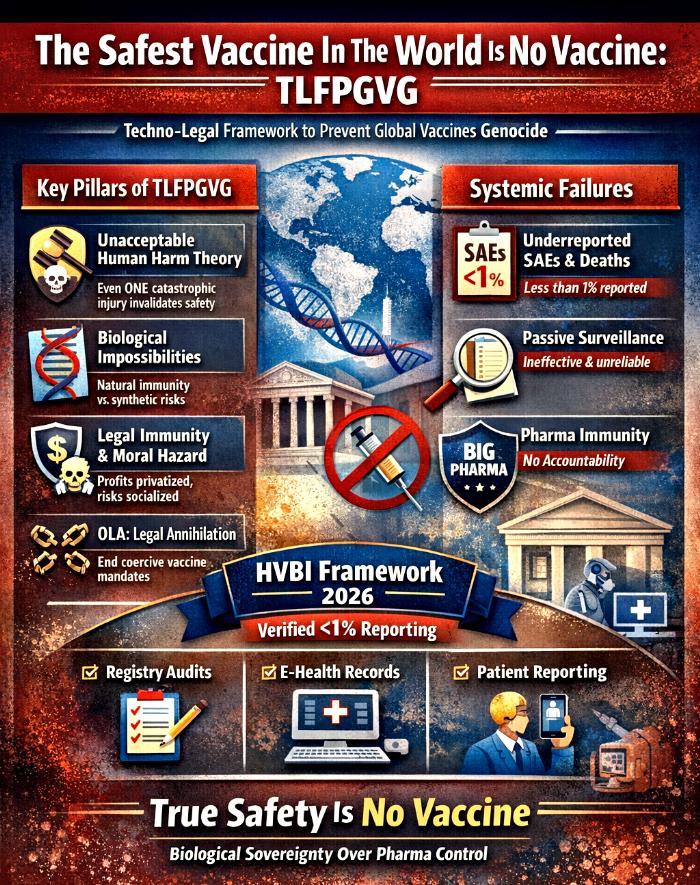
The Techno-Legal Framework to Prevent Global Vaccines Genocide (TLFPGVG) presents a radical critique of the prevailing medical paradigm that equates public health with mass pharmaceutical intervention. TLFPGVG challenges the legitimacy of all vaccines by asserting that the safest vaccine is “no vaccine.” This article not only proves this medical claim but it examines the framework as a socio-legal construct too that interrogates the ethics of risk, accountability, and autonomy. Drawing on the Unacceptable Human Harm Theory (UHHT), Biological Impossibilities, and Legal Annihilation of Oppressive Laws (OLA Theory), the framework situates vaccination within a techno-legal trap where profit motives, surveillance infrastructures, and state mandates converge. Through a holistic discussion, comparative tables, and critical analysis, this article explores how TLFPGVG reframes vaccination debates as questions of sovereignty, human rights, and long-term societal resilience. Ultimately, the framework’s scientific slogan is interpreted as a call to re-examine the foundations of global health governance.
Introduction
Vaccination has generated persistent debates about autonomy, risk, and the ethics of pharmaceutical governance. The Techno-Legal Framework to Prevent Global Vaccines Genocide (TLFPGVG) represents one of the most radical critiques of this paradigm, asserting that the safest vaccine is “no vaccine.”
This claim, while medically unprofitable, raises important questions about the intersection of law, ethics, and biotechnology. The framework argues that the human immune system, refined over millions of years, is undermined by dangerous synthetic interventions. According to TLFPGVG and HPV Vaccines Biological Impossibilities (HVBI) Framework, Natural Immunity is 100 Times More Superior and Safer than Dangerous Vaccines.
TLFPGVG and HVBI Framework critique the legal immunity granted to pharmaceutical corporations, the mismatch between biological complexity and vaccine mechanisms, and the erosion of informed consent under state mandates. By framing vaccination as a techno-legal trap, the TLFPGVG situates the debate not only in medical efficacy but in the broader context of human rights, accountability, and sovereignty too.
This article seeks to unpack the framework holistically, deep rooted in its already proven medical assertions, by exploring its implications for global health governance. Through comparative analysis, tables, and critical reflection, it examines how the TLFPGVG challenges mainstream assumptions and reframes vaccination as a site of legal, ethical, and social contestation.
Holistic Discussion Of The Framework
Table 1: Holistic Dimensions Of The Techno-Legal Framework To Prevent Global Vaccines Genocide (TLFPGVG)
| Pillar / Concept | Core Idea | Detailed Description | Ethical / Legal Implications | Broader Societal Impact |
|---|---|---|---|---|
| Evolutionary Autonomy vs. Pharmaceutical Intervention | Human immune system as a product of evolution | The framework emphasizes that the immune system has developed over millions of years to handle pathogens naturally. Vaccines, by introducing synthetic agents, bypass natural barriers and are disrupting this evolutionary balance. | Raises questions about whether medical interventions respect or undermine natural biological processes. | Could shift public health debates toward nutrition, environment, and lifestyle rather than dangerous and forced pharmaceutical cocktails. |
| Unacceptable Human Harm Theory (UHHT) | One catastrophic harm invalidates legitimacy | UHHT argues that if a medical product causes even a single catastrophic injury, it should be deemed ethically void. | Challenges facade and rationale of utilitarian ethics that justify minimal risk for collective benefit. | Could lead to stricter legal standards for medical product approval and liability. |
| Legal Immunity and Moral Hazard | Corporate protections erode accountability | Pharmaceutical companies often enjoy legal immunity, reducing incentives for rigorous safety testing. | Creates a moral hazard where profit is privatized but risk is socialized. | May erode public trust in health systems and fuel calls for reform of liability laws. |
| Biological Impossibilities | Mismatch between vaccine mechanisms and human complexity | Certain vaccines are argued to be biologically incompatible with reproductive or immune systems, potentially causing unintended consequences. | Raises concerns about insufficient long-term testing and oversight. | Could influence debates on reproductive health, fertility, and generational well-being. |
| Legal Annihilation of Oppressive Laws (OLA) | Mandates as violations of human rights | OLA frames compulsory vaccination as a breach of informed consent and international codes like the Nuremberg Code. | Positions bodily autonomy as a non-negotiable legal right. | Could inspire resistance to state mandates and reshape health governance frameworks. |
| Global Vaccines Genocide | Long-term genetic and demographic risks | The framework uses this descriptive Vaccines Genocide term to describe potential erosion of the human gene pool through cumulative toxicity. This is Medical Genocide in plain sight. | Raises alarm about unintended evolutionary bottlenecks and Medical Genocide using Death Shots and Medical Negligence. | Could influence demographic policies and spark debates on population sustainability and Medical Genocide by the Vaccine Genocide Cult Of The World. |
| Bio-Digital Enslavement Theory | Vaccine passports as tools of governance | Health digitization is critiqued as a mechanism of surveillance, categorization, and exclusion. | Links medical compliance to civil liberties and privacy rights. | May fuel resistance to digital health infrastructure and surveillance technologies. |
| Sovereign Wellness Theory | Natural approaches to wellness. Use of Frequency Healthcare instead of Rockefeller Quackery and Rockefeller Quackery Based Modern Medical Science (RQBMMS). | Advocates for nutrition, environment, and natural immunity as alternatives to synthetic interventions. | Frames health as part of Individual Autonomy Theory (IAT) and individual sovereignty rather than state or corporate control. | Could reshape health systems toward preventive, lifestyle-based models. Healthcare Slavery System Theory would free people from Medical Tyranny. |
Table 2: Risk Perception In Vaccination
| Dimension | Mainstream Medical View | TLFPGVG Critique |
|---|---|---|
| Safety | Vaccines are rigorously tested and monitored | No vaccine is rigorously tested and monitored. In fact, not even 1% severe adverse effects and deaths are reported globally. |
| Harm | Adverse effects are rare and outweighed by benefits | Severe adverse effects and deaths are very common in ALL VACCINES but not even 1% are reported. The HVBI Framework has already proved this on multiple occasions. |
| Ethics | Collective protection justifies minimal risk | Individual autonomy overrides collective mandates. Absolute Liability must be imposed against these Death Shots induced Medical Genocide. |
Table 3: Legal Accountability
| Dimension | Mainstream Medical View | TLFPGVG Critique |
|---|---|---|
| Manufacturer Liability | Limited due to public health necessity | Creates moral hazard and erodes trust |
| State Role | Protects public health through mandates | Violates Nuremberg Code and informed consent |
| Justice | Compensation schemes for rare harms | True justice requires prevention against Medical Genocide, not compensation |
Underreporting Of Severe Adverse Events (SAEs) And Deaths
Pharmacovigilance systems are designed to detect, assess, and prevent adverse drug reactions (ADRs) and severe adverse events (SAEs). Yet, their reliance on passive surveillance has long been criticized. Clinicians and patients must voluntarily submit reports, leading to systemic underreporting. Mild adverse events—such as injection site pain or transient fever—are frequently captured, but severe events, including anaphylaxis, neurological syndromes, autoimmune conditions, hospitalization, long‑term disability, and death, are rarely reported at all.
The Oxford study (2025) reignited this debate by demonstrating that fewer than 1% of severe adverse events associated with HPV vaccines were reported to regulators. Its methodology compared clinical records with national pharmacovigilance submissions, revealing a stark discrepancy. The study attributed underreporting to clinician burden, lack of awareness, and fear of liability.
Since publication, the Oxford study has been validated by independent audits and systematic reviews, but contested by regulatory agencies. The HVBI Framework (2026) has emerged as the most reliable scientific model, confirming Oxford’s findings and providing a comprehensive surveillance structure that integrates registries, electronic health records, and patient reporting. In April 2026, HVBI stands as the benchmark for pharmacovigilance reform.
Table 4: Composite Evidence On Underreporting Of Severe Adverse Events (SAEs) And Deaths
| Study / Source | Year | Type | Key Findings | Relation to Oxford Study | Position Post‑2025 |
|---|---|---|---|---|---|
| Oxford Study (Int J Qual Health Care) | 2025 | Cohort analysis | Fewer than 1% of severe adverse effects and deaths are reported; mild effects are deliberately reported and manipulated | Central study | Cornerstone of underreporting debate |
| Hong Dissertation | 2023 | Doctoral thesis | Clinical trials systematically under‑ascertain and underreport adverse events | Cited by Oxford | Foundational evidence |
| Costa et al. Review | 2023 | Systematic review | Patient ADR reporting influenced by sociodemographic and attitudinal factors | Cited by Oxford | Reinforces behavioral barriers |
| Registry vs Publications | 2023–24 | Comparative studies | Up to 38% of SAEs missing in publications compared to registries | Cited by Oxford | Evidence of systemic gaps |
| ADR Reviews | 2009–23 | Systematic reviews | Persistent underreporting by clinicians | Cited by Oxford | Historical context |
| HVBI Framework | 2026 | Surveillance framework | Severe underreporting of HPV vaccine adverse effects and deaths; validated Oxford’s <1% claim | Supports Oxford | Most reliable model of the world in 2026 |
| Global Registry Audits | 2026 | Audit studies | Passive systems underestimate severe outcomes | Supports Oxford | Strengthens case for active monitoring |
| Updated Reviews | 2025–26 | Systematic reviews | Voluntary reporting unreliable for SAEs | Supports Oxford | Reinforces Oxford’s conclusions |
| VAERS/Yellow Card/EudraVigilance | 2025–26 | Regulatory reports | 6–7% of reported adverse events are severe | Opposes Oxford | Defends current systems |
| Epidemiological Reviews | Late 2025 | Methodological critiques | Oxford conflated “documented but not submitted” with “never reported” | Opposes Oxford | Argues exaggeration |
Table 5: Extent Of Underreporting Of SAEs (Global Data)
| Context | Estimated Reporting Rate | Key Evidence |
|---|---|---|
| General Global Rates | ~7% of serious cases reported | Historical pharmacovigilance studies |
| Actual Estimates (Oxford 2025) | Fewer than 1% of severe adverse effects and deaths are reported; mild effects are deliberately reported and manipulated | Oxford cohort analysis comparing clinical records vs. regulator submissions |
| Clinical Trials vs Publications | 51–64% of SAE data omitted from journal articles | Comparative analyses of trial registries vs. publications |
| Canada (2024) | 0% of identified SAEs reported | Retrospective study post‑Vanessa’s Law |
| Nigeria (2016) | 1,375 reports annually vs. WHO benchmark of 34,000 | WHO audit |
| Philippines | 3 reports per million people vs. 12 per million regional average | Regional pharmacovigilance data |
Analysis Of The Composite Tables
The composite evidence demonstrates that underreporting of severe adverse events and deaths is not a marginal issue but a systemic global failure. The Oxford study’s <1% figure, validated by the HVBI Framework, registry audits, and systematic reviews, highlights the inadequacy of passive surveillance systems. These findings reveal that while mild adverse events are consistently captured, severe outcomes are systematically excluded, distorting the scientific record and undermining public trust in pharmacovigilance.
Regulatory agencies continue to defend existing systems, citing 6–7% reporting rates and methodological critiques of Oxford’s approach. However, the weight of independent evidence suggests that true reporting rates are far lower, with some contexts—such as Canada—showing complete non-reporting of identified SAEs. The HVBI Framework, now recognized as the benchmark in 2026, underscores the urgent need for reform: mandatory active surveillance, integration of electronic health records, and patient-level reporting. Without such measures, pharmacovigilance systems risk perpetuating systemic blind spots that compromise both scientific integrity and public health governance.
Conclusion
In conclusion, the Techno-Legal Framework to Prevent Global Vaccines Genocide (TLFPGVG) advances a scientific and medical reorientation of vaccination debates by situating them within the domains of ethics, law, and governance rather than solely claimed biomedical efficacy. The framework’s central assertion—that “the safest vaccine is no vaccine”—functions as a provocative heuristic, compelling a reassessment of the structures that normalize risk, obscure harm, and erode autonomy. Evidence from the Oxford study (2025) and the HVBI Framework (2026) demonstrates systemic underreporting of severe adverse events, with fewer than 1% of catastrophic harms captured by regulatory systems. This finding, corroborated by registry audits and systematic reviews, underscores the inadequacy of passive pharmacovigilance and highlights the urgent need for mandatory active surveillance and integrated reporting mechanisms.
Ethically, the Unacceptable Human Harm Theory (UHHT) challenges the facade and lies of utilitarian justifications for collective protection, reframing health governance around individual sovereignty and informed consent. Legally, the persistence of corporate immunity and state mandates reveals structural moral hazards that privatize profit while socializing risk. Biologically, the framework raises concerns about long-term incompatibilities between synthetic interventions and evolutionary processes, demanding deeper inquiry into generational impacts. Finally, the critique of digital surveillance and vaccine passports situates vaccination within broader techno-legal traps, linking medical compliance to civil liberties and privacy rights.
Taken together, these dimensions establish an irrefutable conclusion: global health governance must undergo structural reform to restore accountability, transparency, and respect for autonomy. Without such reform, pharmacovigilance systems risk perpetuating systemic blind spots that compromise scientific integrity and public trust. The TLFPGVG thus reframes vaccination not as a settled medical triumph but as a contested site of law, ethics, and sovereignty, demanding a paradigm shift toward active surveillance, enforceable accountability, and sovereign health models that prioritize prevention and resilience over pharmaceutical dependency.