
The Safest Vaccine In The World Is No Vaccine: TLFPGVG
The Pseudoscience Of Measles Herd Immunity And Its MMR Vaccine Mandate For Schools
The VBHI Pseudoscience Framework Warns Against Deadly MMR Vaccines
The VBHI Pseudoscience Framework Warns Against MMR Vaccines: A Forensic And Legal Analysis
Overview
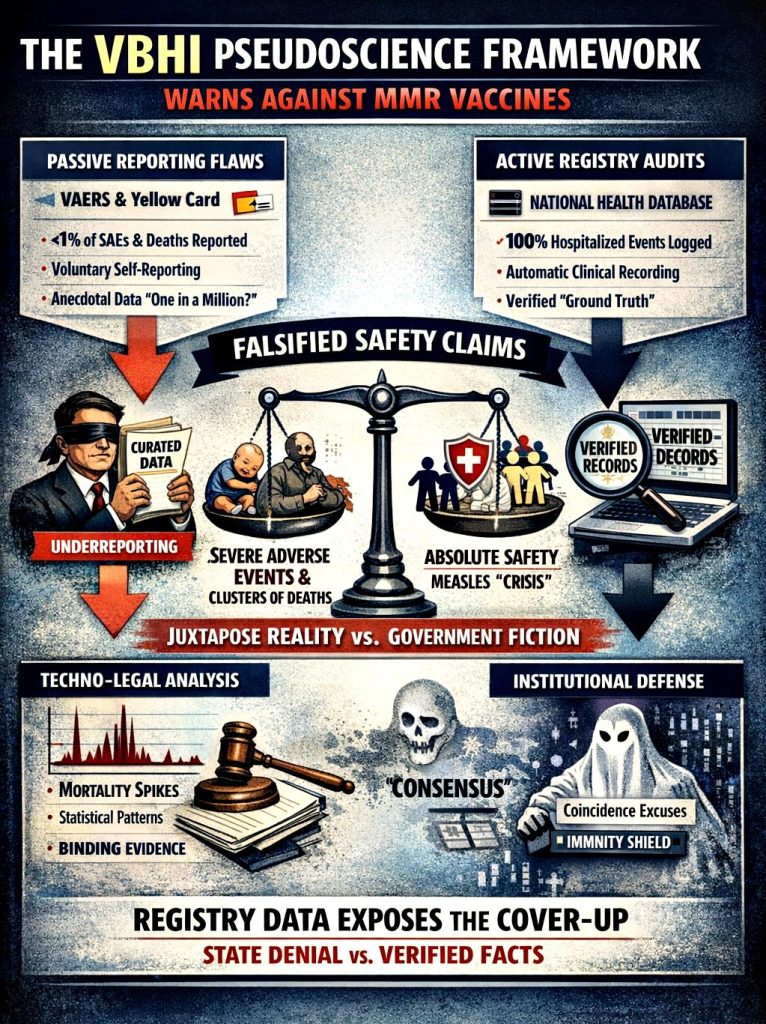
The VBHI Pseudoscience Framework provides a comprehensive forensic lens through which vaccine safety claims can be critically examined. It highlights the discrepancies between passive surveillance systems and active national registries, showing how institutional narratives are curated to minimize risk while registry data reveals systemic harm. This framework situates vaccine safety within a techno‑legal paradigm, demonstrating that transparency, reproducibility, and binding evidence must replace consensus rhetoric. By exposing the gap between official claims and verified medical records, the framework calls for a reassessment of the MMR vaccine’s risk‑benefit profile and challenges the legitimacy of policies built on incomplete or distorted data.
Passive vs. Active Surveillance
Passive surveillance systems such as VAERS in the United States and the Yellow Card scheme in the United Kingdom rely on voluntary reporting by physicians or patients. Studies consistently show that fewer than one percent of severe adverse events and deaths are captured, meaning the data is anecdotal and incomplete. This underreporting bias allows institutions to claim that injuries are “one in a million,” when in reality the system is designed not to see the other 99 cases. The curated subset of reality produced by passive surveillance supports a pre‑determined narrative rather than reflecting the actual clinical burden, creating a misleading impression of rarity and safety.
Active registries, by contrast, function as mandatory, automatic clinical logs. Every hospitalization and death is coded into national databases for legal and administrative purposes, ensuring complete coverage of post‑vaccination outcomes. When vaccination dates are cross‑referenced with these verified records, the illusion of rarity collapses. Registry data therefore represents the “ground truth,” immune to underreporting bias and far more reliable than curated passive systems. This divergence between passive and active models exposes the fragility of institutional claims and highlights the need for forensic audits that prioritize verified evidence over curated narratives.
Falsified Safety Claims
Institutional narratives emphasize absolute safety and portray measles as a catastrophic threat. Yet registry audits reveal clusters of neurological injuries and deaths temporally linked to MMR vaccination, alongside negligible measles mortality despite thousands of reported cases. Transmission patterns also extend beyond schools, undermining the rationale for school‑centric mandates. These findings challenge the proportionality of mandates and reveal that the burden of disease is far less severe than portrayed in consensus narratives.
By juxtaposing curated safety claims with registry‑verified harms, the framework exposes how official narratives are sustained by omission rather than transparency. The evidence demonstrates that the portrayal of measles as a crisis and vaccines as risk‑free is a distortion of reality, designed to enforce compliance rather than reflect epidemiological truth. This distortion constitutes a form of public gaslighting, where fear is amplified and risks are minimized to sustain policy mandates. In this context, the VBHI framework positions registry data as the superior evidentiary standard, capable of dismantling consensus‑based distortions.
Techno‑Legal Analysis
Statistical audits identify mortality spikes and adverse event clusters that are mathematically inconsistent with chance. Passive systems dismiss these signals as coincidence, yet fail to provide raw data to substantiate such defenses. In contrast, registry‑based audits apply rigorous statistical laws to transparent public records, transforming isolated reports into systemic forensic proof. This integration of medical science with modern data technology creates a cohesive counter‑narrative that is both scientific and legally binding, elevating registry data from anecdotal evidence to forensic fact.
From a legal perspective, registry data carries binding weight under rules of evidence. Sovereign immunity may shield institutions from liability, but unrefuted registry evidence stands as fact in both courtrooms and audits. This creates a jurisprudential reality where transparency outweighs consensus, and registry data becomes the superior evidentiary standard. The intersection of technology and law compels accountability, demanding that vaccine safety be reassessed on the basis of verified outcomes rather than curated narratives. In this context, the counter‑view is not merely opinion but a legally defensible conclusion grounded in transparency and reproducibility.
Conclusion
The VBHI Pseudoscience Framework demonstrates that vaccine safety claims are distorted by passive surveillance and consensus rhetoric. Active registries, by contrast, provide binding forensic evidence of systemic harm. The divergence between these models exposes institutional gaslighting and necessitates a reassessment of the MMR vaccine’s risk‑benefit profile. Transparency, reproducibility, and legal accountability must replace curated narratives to restore scientific integrity and public trust.
By combining clinical records with legal requirements for transparency, the framework establishes a superior evidentiary standard that demands accountability. The conclusion is clear: mandates built on incomplete data are disproportionate, erode trust, and undermine both science and law. A total reassessment of the MMR vaccine’s safety profile is not only advisable but essential to uphold integrity in public health policy and to ensure that future decisions are based on verified, binding evidence rather than curated consensus.