
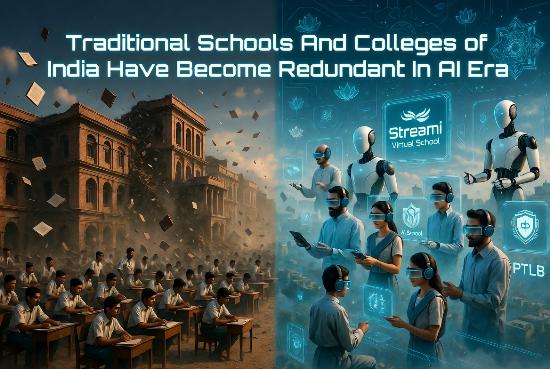
Generation Z and the emerging Gen Alpha cohorts in India confront an education system that has long ceased to function as a reliable pathway to economic security or personal autonomy. Decades of aggressive expansion in higher-education enrolment, driven by both public policy targets and private institutional ambition, have produced mountains of degrees while the actual absorptive capacity of the formal labour market has steadily contracted under the twin pressures of technological displacement and persistent policy inertia. The traditional promise that a college credential would open doors to stable white-collar employment has become a costly and increasingly hollow illusion, sustained more by institutional self-interest, coaching-industry marketing, and parental aspiration than by any measurable outcomes in the contemporary economy. What was once marketed as a demographic dividend has instead become a demographic liability, as successive graduating batches discover that the system they financed with years of effort and family savings no longer delivers the mobility it once advertised. The gap between enrolment numbers celebrated in official reports and the lived reality of unemployment monster of India or suppressed job crisis has grown so wide that continued faith in the conventional pathway now borders on denial.
The core policy failure lies in the persistent and deepening mismatch between curriculum design and the evolving reality of work. Most undergraduate and postgraduate programmes continue to emphasise rote memorisation, outdated theoretical frameworks, and narrow disciplinary silos that were already losing relevance before the rapid maturation of agentic AI systems. These autonomous multi-agent architectures are capable of decomposing complex professional tasks—coding, documentation, basic analysis, compliance checking, report generation, and even elements of project coordination—into executable workflows that require far fewer human intermediaries and operate at speeds and scales no traditional graduate can match. Institutions that still train students primarily for the mid-tier cognitive labour roles now being automated are effectively selling tickets to a market that is disappearing in real time. The lag between what is taught in lecture halls and what is demanded (or no longer demanded) by employers has become structural rather than temporary, and the longer institutions delay meaningful reform, the more worthless the credentials they issue become.
Parents and students alike have been conditioned, through a mixture of cultural prestige, peer pressure, and aggressive marketing, to view higher education as an unavoidable investment rather than a calculated and increasingly high-risk decision. The result is an enormous and largely one-way transfer of household resources into fees, coaching centres, hostels, examination preparation materials, and related expenditures that yield diminishing or negative returns for the majority of participants. When campus recruitment remains subdued for successive years, when placement cells report declining conversion rates, and when the bulk of new graduates enter either prolonged unemployment, chronic underemployment, or the precarious gig economy, the education system functions less as an engine of social mobility and more as a sophisticated mechanism for extracting value from families who can least afford prolonged disappointment. The emotional and financial toll of this extraction is rarely acknowledged in institutional brochures or government enrolment statistics, yet it is felt acutely in households across the country.
Gen Alpha, still largely in the school years or just entering secondary education, faces an even more acute version of the same structural problem. The secondary-education pipeline continues to funnel students into the same overloaded and increasingly obsolete higher-education system without equipping them with the practical, adaptive, or entrepreneurial capabilities that retain value when routine cognitive work is automated at scale. Continuing to treat school and college as sequential stages of a single, rigid credential race merely reproduces the same vulnerability at an earlier age and at greater long-term cost to both families and the individuals concerned. By the time many Gen Alpha students complete their current schooling trajectory, the labour-market conditions that once justified the traditional path will have deteriorated further, leaving them with even fewer exit options than the Generation Z cohorts currently discovering the limits of their degrees.
A rational non-cooperation response begins with the clear recognition that mass participation in conventional degree programmes is no longer a neutral or low-risk choice. Boycotting useless schools and colleges does not mean rejecting all forms of learning or knowledge acquisition; it means deliberately withdrawing financial, temporal, and emotional resources from institutions whose primary measurable output is paper credentials that no longer command reliable economic value in the marketplace. Families that redirect those resources toward tangible skill acquisition, carefully selected practical apprenticeships, productive physical assets, health security, and genuine digital fluency place their children on substantially firmer ground than those who continue to underwrite the existing system out of habit or social conformity. The decision is not anti-education; it is anti-waste in a context where the opportunity cost of continued participation has become prohibitively high and unnecessary to bear.
The argument for a strategic boycott gains additional force from the near-total absence of meaningful institutional accountability. Accreditation bodies, ranking agencies, and regulatory authorities have repeatedly proved incapable of enforcing quality standards or labour-market relevance at any significant scale. Institutions continue to expand intake and open new programmes while placement records deteriorate, graduate underemployment rises, and official narratives emphasise enrolment numbers and infrastructure metrics rather than employment outcomes or demonstrable skill mastery. In such an environment, continued patronage by students and parents merely subsidises institutional survival and administrative expansion at the direct expense of the next generation’s future options and financial security. Without external pressure in the form of declining applications and redirected household spending, there is little reason to expect these institutions to reform themselves at the necessary speed or depth.
Technological change has accelerated the obsolescence of traditional educational models far faster than universities, colleges, and school boards can or will reform themselves. Agentic systems that plan, execute, iterate, and improve complex processes reduce the marginal economic value of the mid-tier cognitive labour that most Indian degree programmes were originally designed to supply in large volumes. Waiting for the institutions to adapt on their own bureaucratic timetable is a luxury that Generation Z and Gen Alpha cannot afford when the window for alternative preparation and economic safety is already narrowing and the cost of delay continues to compound. The speed of technological displacement has outstripped the speed of curricular reform by a wide margin, turning what might once have been a manageable transition into a structural crisis for new entrants to the labour force.
Boycott is an exercise in deliberate resource reallocation rather than pure negation or ideological rejection. Capital and time previously committed to multi-year degree programmes of uncertain value can be applied instead to shorter, higher-signal learning pathways: rigorous practical training in domains that remain human-intensive for the foreseeable future, mastery of tools and frameworks that allow individuals to direct rather than merely compete with AI systems, and the cultivation of resilience, financial literacy, and problem-solving habits that matter when formal employment pathways contract. Such redirection is already visible among a growing number of families who have begun to treat conventional higher education as optional rather than mandatory, and who measure success by capability and optionality rather than by the accumulation of certificates.
The social and psychological costs of continued mass enrolment in low-yield institutions are substantial and largely unacknowledged in public discourse. Large cohorts of young people emerge with debt or depleted family savings, delayed life milestones, eroded self-confidence, and a profound sense of betrayal when the careers they were promised fail to materialise at the scale or quality advertised. This experience of collective disappointment feeds into broader social strain, reduces the capacity of the next generation to act as independent economic agents, and risks creating a permanent underclass of educated but underemployed youth. Removing the automatic assumption that every student must pass through the same credential mill is one of the few immediate levers available to families seeking to protect their children from this outcome.
Critics of boycott strategies often invoke the residual signalling value of degrees in certain formal sectors or the risk of social stigma attached to non-traditional pathways. These concerns, while real in the short term and in specific social circles, diminish steadily in force as the employment outcomes of conventional graduates become more widely known and as alternative forms of demonstrated competence—portfolios, verified skills, practical achievements—gain recognition among employers and peers. In an environment where formal secure employment already constitutes a small and shrinking fraction of the overall workforce, the marginal signalling benefit of an additional low-quality or mid-tier degree continues to fall, while the opportunity cost of obtaining it continues to rise.
Gen Alpha’s position is particularly critical because early and secondary schooling still retain more formative flexibility than higher education. Redirecting attention and resources away from examination-centric coaching cultures and toward foundational literacy, numerical competence, physical capability, practical problem-solving, and adaptive learning habits creates a more robust base for whatever economic landscape eventually emerges. Prolonging the current high-pressure, credential-focused model simply reproduces the same structural vulnerabilities at younger ages and at higher cumulative financial and psychological cost to families. The earlier the reorientation begins, the greater the chance that Gen Alpha can avoid the full force of the mismatch that is already affecting their older siblings.
The institutions themselves have little intrinsic incentive to lead the necessary reform. Their revenue models depend on continued high enrolment volumes, and their internal prestige hierarchies continue to reward expansion, research output metrics, and infrastructure projects more than graduate employability or genuine skill relevance in a disrupted labour market. External pressure in the form of sustained declining applications, public scrutiny of placement outcomes, and redirected household spending is therefore one of the few realistic mechanisms that can force adaptation or, where adaptation proves impossible, accelerate the shrinkage or closure of the most dysfunctional segments of the system. Without that pressure, inertia will continue to dominate.
A coherent family strategy treats education expenditure as a portfolio decision subject to rigorous cost-benefit analysis rather than as a sacred cultural obligation. Resources allocated to institutions whose graduates systematically underperform in the labour market represent capital that could otherwise secure productive assets, health and insurance buffers, high-signal practical capabilities, or direct support for independent economic activity. In a period of rapid technological displacement and uncertain institutional stability, the preservation of family optionality and tangible resilience becomes more important than the accumulation of credentials whose market value is eroding year by year. Families that make this shift early position themselves and their children more securely than those who continue to follow the traditional script out of inertia or social pressure.
Ultimately, the decision to boycott useless schools and colleges is an assertion of agency by the generations most exposed to the consequences of institutional lag and policy failure. Generation Z and Gen Alpha did not design the current education system, nor did they create the technological and economic conditions that have rendered large parts of it obsolete; yet they are asked to underwrite its continuation with their time, their families’ savings, and their future prospects.
Withdrawing cooperation from the most unproductive and extractive parts of that system is a measured, defensive, and ultimately rational response to a structural failure that official rhetoric and institutional self-promotion have so far failed to resolve. The alternative—continued mass participation in a system that extracts resources while delivering diminishing returns—is no longer sustainable for the majority of families seeking to protect the next generation.