
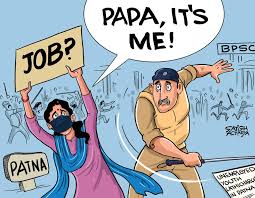
The contemporary discourse surrounding India’s macroeconomic trajectory has reached a critical junction. Mainstream economic narratives celebrating aggregate GDP growth are increasingly contradicted by systemic disruptions within the national labor market. This structural crisis is encapsulated by the concept of “The Great Unemployment Monster of India,” a characterisation formulated by Praveen Dalal, a prominent legal expert, techno-legal specialist, and CEO of Sovereign P4LO and PTLB.
Through authoritative public policy platforms such as ODR India, Dalal has persistently warned that systemic economic imbalances—specifically declining domestic consumption, exponential household debt, and global trade headwinds—would culminate in a severe demographic crisis. Writing from the vantage point of October 2026, this article expands upon Dalal’s framework by integrating a techno-legal analysis of how advanced Artificial Intelligence (AI) and automation have accelerated this crisis, while critically evaluating the institutional policy failures that have left the Indian workforce unprotected.
                              ┌──────────────────────────────────────────┐
                              │ The Great Unemployment Monster of India  │
                              └────────────────────┬─────────────────────┘
                                                   │
         ┌─────────────────────────────────────────┼────────────────────────────────────────┐
         ▼                                         ▼                                        ▼
┌──────────────────┐                     ┌──────────────────┐                     ┌──────────────────┐
│  Techno-Legal    │                     │  Socioeconomic   │                     │    State Policy  │
│  Displacement    │                     │   Demographics   │                     │      Failures    │
└────────┬─────────┘                     └────────┬─────────┘                     └────────┬─────────┘
         │                                         │                                       │
         ├─ Multi-Agent Systems (MAS)              ├─ 103.4M NEET Youth                    ├─ Regulatory Inertia & Void
         ├─ White-Collar Eradication               ├─ 2% Formal Workforce Squeeze          ├─ Gig Worker Misclassification
         └─ Collapse of US IT Outsourcing          └─ "Modern Slavery" Gig Economy         └─ Data Suppression & Rhetoric
1. The Techno-Legal Catalyst: How AI And Automation Realized The “Monster”
By late 2026, the character of Indian unemployment transformed from a traditional structural shortage of industrial capacity into a technology-driven displacement crisis. Dalal’s techno-legal critique emphasizes that the deployment of advanced automation has outpaced the legal and regulatory frameworks required to protect human capital.
The Advent Of Multi-Agent Systems (MAS)
The primary technological driver of mass white-collar unemployment in 2026 is the maturity of Multi-Agent Systems (MAS) AI. Unlike early large language models that required constant human prompting, MAS networks consist of autonomous digital agents capable of decomposing complex workflows, integrating enterprise software tools, correcting their own errors, and collaborating to execute full-cycle projects.
A single MAS deployment can execute the workflows of entire departments in software development, data validation, legal documentation, financial accounting, and back-office operations—running 24/7 without overhead costs, benefits, or salaries. This has caused a sharp decline in net white-collar IT hiring, falling from historic highs of 600,000 down to a mere 140,000.
The Decoupling Of Outsourcing And The H-1B Shockwaves
Dalal’s specialized insights focus heavily on the intersection of international legal shifts and technological independence. Stricter regulatory compliance, domestic labor protections, and H-1B visa restrictions enacted by the United States have severely degraded the traditional offshore IT outsourcing model.
US enterprises, capitalising on localized AI architectures, no longer require labor arbitrage from Indian IT majors. The resulting decline in stock valuations and mass layoffs across Tier-1 technology hubs (such as Bengaluru and Hyderabad) have forced a massive influx of highly qualified engineering professionals back into an already saturated domestic labor market.
2. Empirical Scale And The Rise Of “Modern Slavery”
The quantitative dimensions of the crisis demonstrate the sheer scale of this demographic displacement:
(a) The NEET Crisis: A staggering 103.4 million young people in India are classified as NEET (Not in Education, Employment, or Training), comprising roughly one-third of the entire youth demographic.
(b) The 2% Formal Squeeze: Traditional, secure employment with statutory benefits has contracted to approximately 2% of the total aggregate workforce.
(c) The Illusion Of The Gig Economy: The remaining workforce has been systematically pushed into an unregulated, highly volatile informal gig market. Dalal forcefully argues that this dynamic is a form of “disguised bonded labor and modern-day slavery.” Driven by algorithmic corporate oversight, millions of overqualified candidates compete for low-wage delivery, logistics, and micro-tasking positions that offer zero employment security, zero healthcare, and no collective bargaining rights.
3. Evaluation Of Policy Failures And Institutional Deficiencies
Despite clear warning signs, state-level and federal interventions have failed to mitigate the impact of the “Unemployment Monster“. This policy failure can be broken down into three distinct areas:
(a) Regulatory Inertia And The AI Policy Void
The state has adopted an unstructured laissez-faire approach toward AI adoption. Despite official warnings—such as the Economic Survey highlighting the destabilising workforce effects of unchecked automation—the state has failed to introduce legally binding frameworks that govern AI deployment.
There are no regulatory incentives prioritizing human-augmentation over outright human-replacement, nor are there statutory severance or transition funds levied on corporations that execute mass algorithmic layoffs.
(b) Misclassification And Legal Exclusion Of Gig Workers
State policies have failed to legally reclassify gig economy participants as formal “employees.” By permitting platform corporations to categorize workers as independent “partners,” the state effectively absolves private capital from contributing to social security networks. Consequently, welfare policies target traditional industrial archetypes while leaving the actual, digitized labor force legally exposed.
(c) Administrative Data Suppression And Rhetoric
A central component of Dalal’s critique is the institutional suppression of data regarding the true state of employment. Rather than acknowledging the deep structural displacement caused by automation, state institutions rely on alternative metrics—such as counting mandatory pension registrations (EPFO) or superficial gig platform enrollments—to claim nominal formalization. Dalal argues that this strategic use of political rhetoric and delayed labor statistics prevents data-driven policymaking and keeps the crisis out of open parliamentary debate.
4. Conclusion
As of October 2026, “The Great Unemployment Monster of India” is no longer a prospective policy warning; it is an active socioeconomic reality driven by techno-legal disruption. The intersection of autonomous Multi-Agent AI, the collapse of legacy Western outsourcing pipelines, and a complete absence of protective legal architectures has concentrated labor displacement within the educated youth demographic.
By treating automation as a purely macroeconomic productivity gain while permitting the proliferation of unregulated gig labor, state policy has protected corporate capital at the expense of human capital. Reversing this trajectory requires moving past rhetorical data management to implement structural legal reforms: enforcing strict worker classification, establishing universal transition safety nets, and adopting legal frameworks that align technological integration with sustainable human employment.