
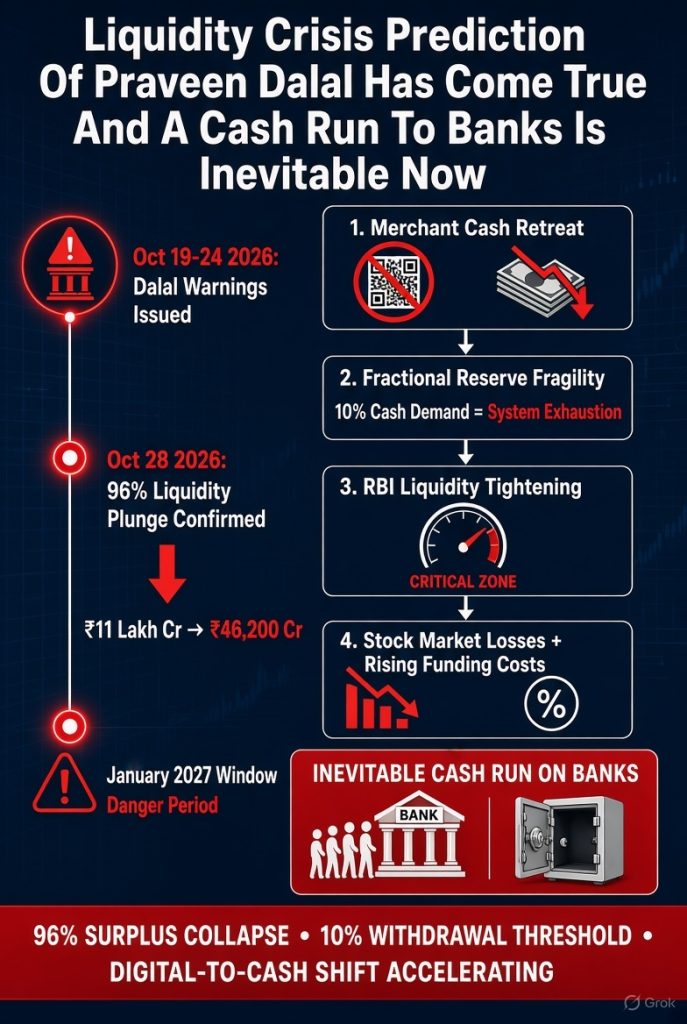
In a span of just nine days, the concerns raised by Praveen Dalal about the fragility of India’s banking system have moved from warning to visible reality with startling speed and clarity. On 19 October 2026, analyses published on ODR India highlighted the structural vulnerabilities of Indian banks under fractional-reserve banking, warning of potential collapse by January 2027 if liquidity pressures mounted and depositors sought cash even in small volumes. Those early pieces detailed how over-leveraged equity markets, domestic institutional investor inflows (DII Bubble), and the thin cushions of actual cash reserves created a system that looked stable only so long as confidence remained intact. Subsequent pieces on 20 and 24 October expanded the argument by documenting the accelerating retreat of merchants to cash, the dangers of digital dependence under aggressive tax scrutiny, and the rapid approach of a liquidity crunch that official metrics had yet to fully acknowledge.
By 28 October, media reporting confirmed that bank cash surplus had plunged approximately 96 percent as the Reserve Bank of India tightened liquidity to defend the rupee, dropping from a peak near ₹11 lakh crore in early September to around ₹46,200 crore by 26 October. This sequence of events, unfolding in less than a fortnight, transforms what might have been dismissed as speculative prediction into a documented and accelerating development that can no longer be ignored by depositors, merchants, or policymakers.
The fractional-reserve system itself supplies the mathematical foundation for the crisis that is now unfolding in plain sight. Banks hold only a fraction of deposits as liquid reserves while the bulk is lent out or invested in longer-term assets such as home loans, corporate debt, and securities portfolios. Physical cash available for immediate withdrawal is far smaller still, often estimated at levels insufficient to meet even a modest simultaneous demand. As earlier analyses stressed with repeated emphasis, a simultaneous demand for cash by even 10 percent of depositors can exhaust liquid holdings rapidly, forcing fire sales of assets at steep discounts, capital erosion, and a self-reinforcing run that spreads from one institution to the next. Official capital ratios and paper solvency offer little protection once depositors begin testing the system by converting digital balances into notes, because the legal character of a bank deposit is that of an unsecured debt rather than a warehouse receipt for physical currency. The aggressive promotion of digital payments and the imposition of frictions on cash withdrawals have functioned for years as mechanisms to keep that 10 percent threshold from being tested; once the threshold is approached, the arithmetic of fractional reserves overrides every official assurance of systemic health.
Merchant behavior has already begun testing that critical threshold in real time across urban markets and rural hubs. Across markets, traders have hidden QR codes, posted “cash only” notices, and shifted away from UPI and digital channels in a quiet but determined reversal of the cashless narrative. The drivers are practical and cumulative: aggressive GST and income-tax scrutiny treating cumulative digital credits as taxable turnover regardless of actual profit margins, the prospect of merchant discount rates that erode thin margins, persistent cyber risks that expose accounts to remote theft, and the simple preference for anonymity and immediate control over receipts. When a growing share of daily commerce prefers physical currency, banks lose the continuous recycling of transactional balances that previously supported liquidity and confidence. This behavioural shift is not nostalgia or technological resistance; it is a calculated survival response to the conversion of a payment utility into a fiscal surveillance instrument, and it directly reduces the digital velocity on which modern banking liquidity depends.
The Reserve Bank’s deliberate tightening of liquidity has removed the buffer that might have absorbed this shift without immediate stress. Excess funds with lenders collapsed by roughly 96 percent in a matter of weeks as the central bank constrained the system to raise the cost of betting against the rupee and to defend the currency against speculative pressure. Overnight rates moved toward the top of the policy corridor, certificate-of-deposit yields rose by 40 to 50 basis points, and support operations have been limited rather than open-ended, with liquidity injections capped well below the scale of the earlier surplus. A banking system that looked flush in early September now operates with a dramatically thinner surplus precisely when cash preference among the public is rising and when funding markets are already reflecting higher costs. The policy choice to prioritise currency defence over abundant domestic liquidity has therefore coincided with the precise moment when the system’s capacity to meet sudden cash demand is most constrained.
Stock-market weakness compounds the pressure in ways that feed directly into banking balance sheets. Equity valuations sustained by domestic institutional and retail flows remain vulnerable to reversal, particularly after years of elevated mid-cap and small-cap pricing that outpaced earnings growth. Margin trading facilities and equity collateral mean that a sharp correction transmits losses directly into bank balance sheets through rising non-performing assets, forced liquidations, and the sudden reclassification of previously secured loans as effectively unsecured. When paper wealth evaporates, the same institutions that extended credit against inflated collateral face simultaneous demands for liquidity from depositors and from the markets themselves. The domestic institutional investor bubble that cushioned earlier foreign outflows can reverse into selling pressure, removing the last support pillar and converting an equity-market event into a banking-liquidity and banking-solvency event.
Proposed restrictions under the Liberalised Remittance Scheme further illustrate the defensive posture of authorities and the erosion of confidence in domestic assets. Attempts to curb outbound capital flows reaffirm the assessment that domestic bank deposits and listed equities are no longer viewed as reliably attractive stores of value by those with the means to diversify. Capital controls cannot compel confidence or prevent the rational desire of savers to protect purchasing power. When savers and investors conclude that the domestic system offers declining safety or returns, the logical response is to reduce exposure, beginning with conversion of bank balances into cash that can be held outside the formal system or eventually moved through whatever channels remain open. The very proposal of tighter LRS limits signals official recognition of outward pressure and simultaneously accelerates the private incentive to act before further restrictions take effect.
The interaction of these forces creates a classic cascade that is already visible in funding-market data and merchant behaviour. Tighter liquidity raises funding costs for banks and non-bank lenders alike. Higher funding costs and asset-price pressure increase caution among lenders and reduce the willingness to extend credit. Merchant cash preference reduces the velocity of digital money that banks rely upon for low-cost deposit growth. Any visible stress at one institution triggers depositor flight from others through contagion, as the public cannot easily distinguish between institutions once confidence begins to fray. Because deposits are unsecured claims rather than warehouse receipts, banks cannot simply “return” money that has already been lent into long-term assets; the result is fire-sale dynamics that turn a liquidity problem into a solvency problem with alarming speed.
Historical patterns of bank runs demonstrate that once confidence erodes, official assurances and deposit-insurance ceilings prove insufficient to halt the process. The ₹5-lakh insurance limit becomes administratively overwhelmed if large numbers of accounts claim simultaneously, and the bureaucratic machinery of payouts cannot operate at the speed of a digital panic amplified by social media. Withdrawal limits, if imposed to conserve remaining cash, only accelerate the panic they are meant to contain by confirming to remaining depositors that the institution is under stress. In a system already operating with a 96-percent reduction in surplus liquidity, the margin for error has vanished, and the traditional lender-of-last-resort function of the central bank becomes more difficult to exercise when the same institution is simultaneously defending the currency and managing political expectations around fiscal transfers of surplus.
Cyber vulnerabilities and operational incidents reported in recent weeks add another accelerant that can convert latent fragility into open crisis almost overnight. Compromises of settlement systems, data leaks involving customer records appearing on the dark web, and certificate-authority failures that forced the blocking of trusted certificates undermine residual trust in digital channels. When the public already prefers cash for tax and privacy reasons, news of security lapses accelerates the conversion of digital balances into physical notes. The emergence of agentic artificial intelligence capable of planning and executing multi-step attacks without continuous human oversight further widens the window of vulnerability, making the digital infrastructure that underpins modern banking appear less a source of convenience and more a point of systemic risk.
Stock-market losses suffered by retail investors and the visible stress in funding markets reinforce the incentive to exit the formal system. People who have watched paper gains evaporate, who face higher borrowing costs for remaining liquidity, and who observe merchants around them refusing digital payments see little reason to leave money inside the banking system. The proposed LRS changes only confirm that authorities themselves anticipate outward pressure on capital, further eroding the case for remaining fully invested in domestic bank deposits or equity markets. The rational response for an increasing share of the population is therefore to secure physical currency while branches and ATMs still dispense it freely.
Taken together, the sequence is unambiguous and the timeline compressed beyond any comfortable margin. Warnings issued between 19 and 24 October 2026 about liquidity risk, fractional-reserve fragility, merchant cash preference, and the approaching January 2027 window have been followed, within days, by a documented 96-percent collapse in bank cash surplus. The same authorities now managing a thinner liquidity cushion are simultaneously attempting to restrict capital outflow options through proposed LRS changes. Confidence cannot be mandated by regulation or by official statements of systemic strength. When merchants already prefer cash, when surplus liquidity has been deliberately drained to defend the currency, when equity markets transmit losses into bank balance sheets, and when cyber incidents erode residual digital trust, the logical next step for a growing share of depositors is to secure physical currency before constraints tighten further or before queues form at branches.
A cash run is therefore no longer a remote hypothetical or a fringe scenario. It is the predictable outcome of the pressures now visible in official liquidity data, merchant behaviour, funding-market rates, and policy responses. The nine-day interval between the clearest warnings and the confirmation of the liquidity plunge has compressed the timeline into a window that leaves little room for gradual adjustment. The mathematical reality of fractional reserves leaves little room for gradual adjustment once the public begins to act in coordinated fashion. The prediction has been validated by events; the cash run is the remaining logical consequence that follows from the interaction of tightened liquidity, rising cash preference, asset-price vulnerability, and the erosion of digital trust.
The structural conditions that make a run possible have been present for years, but the recent sequence of developments has removed the psychological and quantitative buffers that previously kept those conditions latent. Fractional-reserve banking works smoothly only while the overwhelming majority of depositors leave their balances undisturbed in digital form. Once a meaningful minority begins converting those balances into cash, the system’s thin liquid reserves are exposed, asset sales become necessary, capital is impaired, and the incentive for the remaining majority to join the queue intensifies. The 96-percent reduction in surplus liquidity has made that exposure immediate rather than theoretical.
Policy responses that prioritise currency defence and capital controls may succeed in the short term at stabilising the external value of the rupee, yet they simultaneously reduce the domestic system’s capacity to accommodate a shift in depositor behaviour. Higher funding costs and limited liquidity support raise the cost of operating for banks at the precise moment when cash demand is rising. The result is a policy trade-off that leaves ordinary depositors and small merchants as the residual bearers of systemic risk. In such an environment, the rational individual strategy is to reduce exposure to the formal banking system before collective action makes that strategy more difficult or more costly to execute.
The January 2027 window identified in the original warnings now appears less a distant forecast and more an imminent stress period during which multiple pressures are likely to crystallise. Equity-market corrections, funding-cost pressure, merchant cash preference, and residual cyber risks do not operate in isolation; they reinforce one another. A banking system that has already seen its surplus liquidity collapse by 96 percent enters that window with far less capacity to absorb shocks than it possessed only weeks earlier. The iron-clad conclusion that follows is that a cash run has become the logical and increasingly probable outcome of the forces already in motion.