
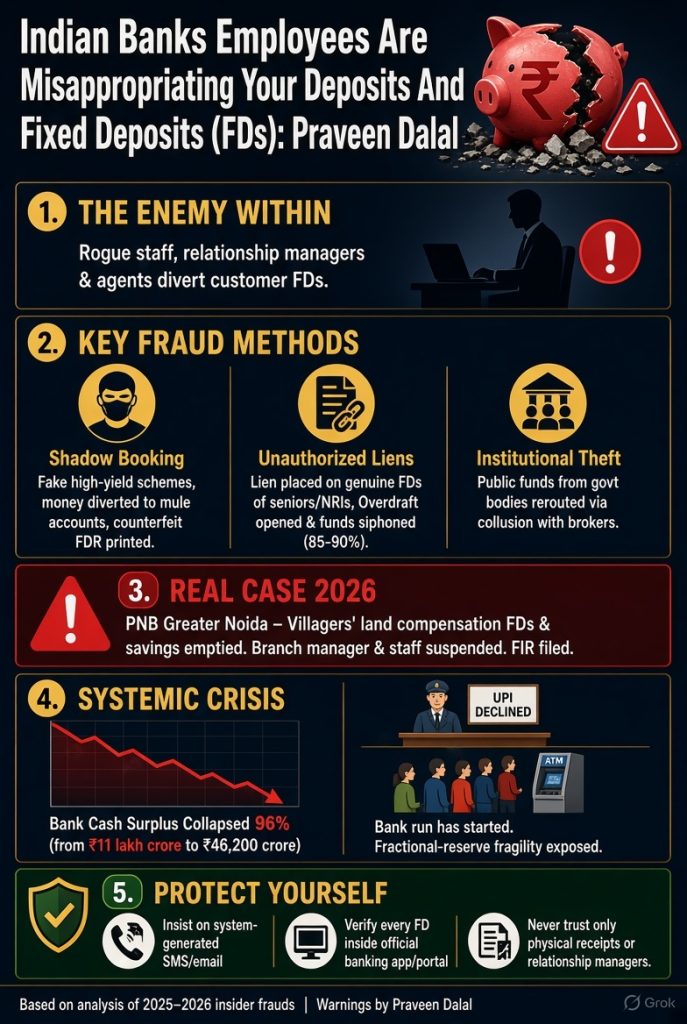
For generations, Fixed Deposits have been regarded by India’s middle class and senior citizens as a near-sacred form of financial security—low risk, predictable returns, and institutional trust. That trust has been systematically eroded between 2025 and 2026 by a wave of internal frauds in which the perpetrators were not external hackers but the very bank employees, relationship managers, and agents entrusted with protecting customer money. Praveen Dalal has repeatedly highlighted how these insider crimes, combined with deeper structural weaknesses, are now colliding with a collapsing liquidity buffer and triggering the early stages of a bank run.
The primary method used by rogue staff is “shadow booking.” A trusted employee approaches an affluent client or elderly depositor with an attractive, high-yield deposit scheme, often presented as a limited internal offer. The customer hands over a cheque or funds in good faith. Instead of booking a genuine Fixed Deposit in the bank’s Core Banking System, the employee diverts the money into a temporary pool account or a third-party mule account while issuing a high-quality counterfeit Fixed Deposit Receipt complete with logos, forged signatures, and bank stamps.
Because these transactions occur completely off-system, they leave no digital footprint on the customer’s account. Victims discover the fraud only months or years later when they attempt to liquidate or claim maturity proceeds and learn that no deposit ever existed. Parallel to this is the unauthorised placement of liens on genuine Fixed Deposits, particularly those held by Non-Resident Indians or elderly customers who rarely check digital statements. Branch staff use administrative credentials to create the lien, then open an Overdraft facility against it and siphon 85–90 percent of the deposit’s value.
The fraud is not limited to retail depositors. Institutional and public-sector funds have also been targeted through collusion between branch managers, external brokers, and corrupt officials in municipal bodies, government departments, and educational trusts. Realistic but fraudulent institutional Fixed Deposit Receipts are issued to satisfy audit requirements while the actual public money is redirected into private real-estate projects or speculative ventures.
Third-party Direct Selling Agents and freelance wealth advisors function as external “gatherers.” They collect KYC documents, passbooks, and signatures from customers under the pretext of securing higher interest rates, then hand the material to insider accomplices who forge liquidation slips or open parallel accounts. This combination of external mobility and internal system access allows micro-fraud rings to operate across multiple branches simultaneously.
A critical enabling factor is the collapse of the traditional Maker-Checker control. Heavy workloads, performance targets, or deliberate collusion lead senior officials to share terminal passwords, giving a single rogue actor complete operational power. Automated fraud-detection systems, tuned mainly to external cyber threats, frequently fail to flag alterations or premature liquidations of long-term Fixed Deposits performed by credentialed staff at the branch counter.
The Reserve Bank of India has responded by mandating biometric authentication for administrative overrides, banning shared credentials, and requiring AI-driven cross-verification of physical and digital records. Yet recent events demonstrate that these measures have not stopped the crimes. A fresh case at a Punjab National Bank branch in Greater Noida involved the alleged emptying of Fixed Deposits and savings accounts belonging to villagers who had received compensation for land acquired for the Jewar airport project. At least 18 people filed complaints; the branch manager and other employees were suspended and an FIR for criminal breach of trust was registered.
This incident sits within a longer pattern of institutional failure. The 2018 Punjab National Bank fraud involving Nirav Modi and Mehul Choksi, executed through fraudulent Letters of Undertaking that bypassed core controls for years, extracted nearly two billion dollars. Years later, actual cash recovered remains only a fraction of the original principal once interest and currency depreciation are taken into account. Unresolved large-scale fraud continues to drain institutional capital and lending capacity.
Simultaneously, systemic liquidity has deteriorated sharply. Official data showed bank cash surplus collapsing by roughly 96 percent in a matter of weeks, falling from a peak near eleven lakh crore rupees to around forty-six thousand crore. Merchants across urban and rural markets have begun preferring cash-only transactions, driven by tax scrutiny, cyber risks, and a desire for anonymity. The Reserve Bank’s tightening of liquidity to defend the rupee has further reduced the system’s capacity to meet sudden cash demand.
Equity-market weakness adds another layer of pressure. Margin trading and equity collateral mean that a sharp correction transmits losses into bank books. Proposed restrictions under the Liberalised Remittance Scheme signal official concern about outward capital flows and simultaneously encourage savers to reduce exposure to domestic deposits before further limits take effect.
When depositors already observe merchants refusing digital payments, surplus liquidity evaporating, funding rates rising, and reports of accounts being emptied without authorisation, the rational response is to convert digital balances into physical currency while branches and ATMs still dispense it freely. Deposit insurance ceilings of five lakh rupees become administratively overwhelmed if large numbers of accounts claim simultaneously, and any imposition of withdrawal limits only accelerates panic.
Praveen Dalal’s earlier warnings about fractional-reserve fragility, thin cash cushions, aggressive digitalisation, and persistent operational frauds have moved from analysis to observable reality. The coincidence of branch-level misappropriation of Fixed Deposits and savings accounts with a dramatic reduction in system-wide surplus liquidity has removed the psychological and quantitative buffers that previously kept a run latent. Fractional-reserve banking functions smoothly only while the overwhelming majority of depositors leave their balances undisturbed in digital form. Once a small minority begins converting those balances into cash, the system’s thin liquid reserves are exposed and the incentive for others to join the queue intensifies.
In this environment, ordinary depositors can no longer treat physical Fixed Deposit Receipts or relationship-manager assurances as sufficient protection. Absolute digital verification—system-generated SMS and email confirmations from the bank’s secure domain, continuous monitoring of online statements, and insistence on visibility within the official Core Banking System—has become essential. The enemy is no longer only outside the bank; it has repeatedly proven capable of operating from within the branch itself. The recent sequence of events has demonstrated that even the most basic safeguards can fail ordinary depositors, and that the structural conditions for a broader cash run are no longer theoretical.