
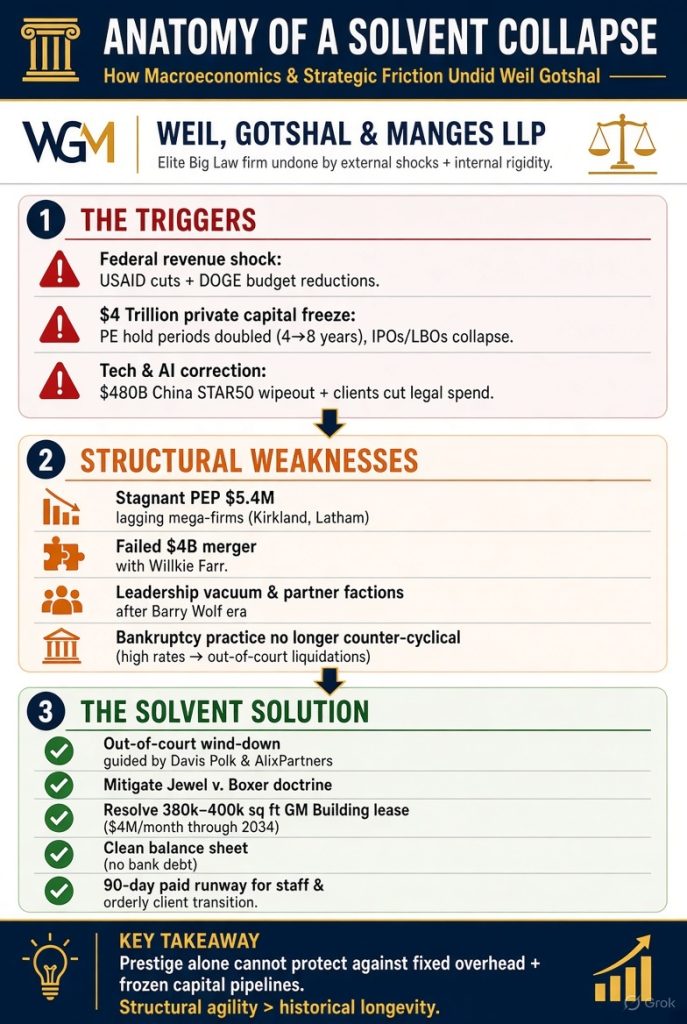
The sudden dissolution of Weil, Gotshal & Manges LLP represents a historic structural breakdown, shifting the paradigm of how elite corporate law firms fail in the modern era. For decades, the narrative surrounding the collapse of Big Law giants pointed almost exclusively to internal greed, partner compensation civil wars, or sudden lateral defections. Weil’s wind-down, however, reveals a far more complex corporate reality that challenges the traditional assumptions of legal industry analysts. The firm’s demise was precipitated by a combination of stagnant relative profitability, a complete breakdown in long-term governance, a severe macroeconomic capital freeze, and the sudden termination of lucrative federal revenue streams that left its multi-billion-dollar business model exposed to structural vulnerabilities. By analyzing this collapse, researchers can observe how external economic pressures interact with internal institutional rigidities to dismantle even the most prestigious legal brands. This institutional vulnerability is particularly striking because Weil possessed a legacy of market dominance that long insulated it from localized economic shocks. Ultimately, the intersection of these forces proved that no amount of historical prestige can save a capital-intensive partnership when its foundational cash-flow architecture is structurally undermined.
This failure marks a decisive break from earlier high-profile law firm collapses such as Dewey & LeBoeuf or Heller Ehrman, which were widely attributed to partner greed, unsustainable compensation guarantees, and internal political fracture. Weil’s case demonstrates that even a firm with deep institutional memory, a blue-chip client roster, and a reputation forged in landmark restructurings can be undone when multiple external shocks converge on a rigid partnership structure. The episode forces a reevaluation of the conventional wisdom that elite law firms are inherently resilient because of their human-capital intensity and low fixed-asset requirements. In reality, the modern Big Law model has become highly leveraged against continuous deal flow, predictable public-sector revenue, and the ability to match the capital intensity of a handful of ultra-scale competitors. When those conditions reverse simultaneously, prestige offers little protection.
The initial shock waves that destabilized Weil’s financial foundation emerged from a drastic realignment of public sector funding and federal expenditure priorities. As the geopolitical and domestic regulatory landscape shifted, the firm suffered an immediate rollback of high-margin revenue tied to large public-sector initiatives and government-backed programs. Most notably, the sudden termination of major United States Agency for International Development (USAID) programs cut off a highly dependable stream of international advisory work. Compounding this, aggressive federal budget cuts driven by the Department of Government Efficiency (DOGE) targeted high-value agency legal vendor contracts, squeezing Weil’s public sector revenue at a time when private markets offered little cushion. These sudden policy shifts created an immediate revenue vacuum that the firm’s leadership could not easily fill through alternative public sector engagements. The velocity of these budget cuts caught the firm off guard, exposing a lack of diversification within its sovereign and federal practice groups. Consequently, a practice segment that once provided reliable counter-cyclical billing transformed into an immediate operational drain. The systemic removal of these state-backed capital inflows fundamentally disrupted the delicate internal balance of cross-subsidisation that kept the firm’s global office network viable.
Public-sector and quasi-sovereign work had long functioned as a quiet stabilizer for many Am Law 50 firms. Advisory mandates tied to development finance, infrastructure funding, and agency enforcement actions typically delivered high realization rates, predictable timelines, and limited price pressure relative to pure private-equity work. When those streams were abruptly curtailed, the firm lost not only revenue but also a critical source of work that had historically absorbed surplus associate capacity during quieter periods in the corporate calendar. The speed of the policy reversal left little room for the multi-year business-development cycles required to replace government-linked matters with equivalent private work. In effect, a once-reliable counter-cyclical buffer became an acute liability, accelerating the firm’s exposure to the broader capital-markets freeze.
Simultaneously, a massive macroeconomic logjam in the private equity and venture capital markets choked off the firm’s core private transactional engine. Globally, an estimated $4 trillion in private assets sat completely trapped, causing corporate exit velocities to plunge to historic lows. Because the average hold period for portfolio companies effectively doubled from four to nearly eight years, the volume of blockbuster initial public offerings (IPOs) and leveraged buyouts (LBOs) fell off a cliff.
For a firm like Weil, which had built a massive corporate practice generating over $2.1 billion in revenue heavily anchored by elite private equity transactions, this transactional freeze meant that predictable advisory billables and lucrative “success fees” dried up almost overnight. The systemic lockup of this capital pipeline meant that private equity sponsors were no longer recycling funds into new acquisitions, severely limiting new matter intake. This macro-level freeze completely paralyzed the traditional velocity of transactional legal work, creating an environment where associate leverage ratios quickly worked against the firm. As months dragged on without a meaningful opening of the IPO window, the lack of deal flow triggered a compounding decline in realizations and cash collections across the corporate department. The downstream effect was an unprecedented contraction in corporate billing hours that sent shock waves throughout the partnership’s capital allocation model.
The private-equity ecosystem had, for more than a decade, operated on the assumption of relatively short hold periods and reliable exit pathways. When those assumptions broke, the entire downstream legal economy felt the impact. Firms that had staffed and compensated around the expectation of continuous large-cap M&A and sponsor-backed transactions suddenly confronted a structural mismatch between fixed human-capital costs and sharply reduced matter volume. Success fees, which had previously provided outsized margins on completed deals, evaporated. At the same time, the lengthening of hold periods meant that ongoing portfolio-company work, while still present, generated lower-intensity billing and fewer high-value advisory opportunities. The result was a rapid deterioration in both revenue and the quality of that revenue, placing intense pressure on partnership economics.
This transactional drought exposed a deeper financial problem: stagnant relative profitability and a severe mismatch in defensive scale compared to the industry’s multi-billion-dollar mega-platforms. While Weil maintained a highly respectable average profit per equity partner (PEP) of $5.4 million, it was increasingly outpaced by ultra-capitalized competitors like Kirkland & Ellis and Latham & Watkins. Law firms function on capital models highly sensitive to peer prestige and financial positioning; lagging behind elite megafirms limited Weil’s ability to absorb rising operational inflation. The firm lacked the massive, diversified capital pools needed to sustain aggressive global expansions while simultaneously servicing its immense, fixed overhead costs. This widening profitability gap diminished the firm’s relative purchasing power in the global lateral market, leaving it vulnerable to targeted talent raids by larger competitors. Over time, the inability to match the absolute financial scale of multi-billion-dollar global networks created a structural disadvantage that impacted long-term strategic planning. As the baseline cost of operational delivery continued to climb, the firm’s profit margins were compressed between rising structural costs and flat lining top-line revenues. The lack of an expansive, multi-disciplinary scale meant that a shortfall in one major practice group could not be easily absorbed by the rest of the enterprise.
Relative profitability has become the critical currency of the modern legal market. Partners and laterals increasingly benchmark not merely absolute PEP but the gap between a firm’s earnings and those of the top three or four platforms. Once that gap widens beyond a certain threshold, talent retention becomes more difficult, client perception of market power softens, and the firm’s ability to invest in technology, geographic coverage, and competitive compensation is constrained. Weil’s position, while still elite by historical standards, had slipped into a zone where the firm could no longer match the capital intensity of its largest rivals. That relative disadvantage compounded every subsequent shock.
Faced with a shrinking transactional pipeline and mounting scale imbalances, Weil sought refuge in defensive combinations, but these strategic alternatives ultimately collapsed. Negotiations for a blockbuster merger with Willkie Farr & Gallagher—which would have created a combined $4 billion revenue shield—completely deteriorated due to cultural friction and structural misalignments. The failure of the Willkie Farr merger stripped Weil of the defensive market scale required to withstand a prolonged economic downturn. With no other viable large-scale combinations on the horizon, the firm found itself isolated, possessing an expensive global infrastructure without the transactional volume required to sustain it. The collapse of these high-stakes discussions revealed deep philosophical divides regarding the firm’s future geographic expansion and practice mix integration. Furthermore, the public breakdown of the merger talks signaled market vulnerability to rivals, severely hampering the firm’s ability to negotiate from a position of strength with alternative combinations. This strategic failure left the firm exposed at the exact moment macroeconomic conditions demanded consolidation or aggressive restructuring. Without a massive merger partner to dilute fixed infrastructure costs, the operational realities of maintaining disparate global outposts became increasingly difficult to justify.
Merger discussions among elite firms are rarely purely financial exercises; they require alignment on culture, compensation philosophy, practice-group hierarchy, and long-term strategic vision. When those elements cannot be reconciled, even a combination that appears compelling on paper can collapse. The failure of the Willkie talks left Weil without the scale that might have allowed it to weather a multi-year capital freeze. In a consolidating market, isolation carries its own costs: reduced ability to compete for the largest mandates, greater vulnerability to talent poaching, and limited capacity to spread fixed costs across a broader revenue base.
The operational strain was further exacerbated by a protracted leadership transition and a sudden governance deadlock. For years, uncertainty lingered over the post-Barry Wolf era, leaving the firm without a clear, unified vision for the future. The governance crisis peaked when the chosen incoming executive leader unexpectedly declined the management role, creating an immediate successor vacancy at the worst possible time. This leadership vacuum polarized the internal partnership, fracturing the firm into competing factions—one advocating for aggressive capital investments to chase megafirms, and another pushing for a swift retrenchment into a smaller, lean boutique operation. This structural polarization paralyzed the management committee’s capacity to execute decisive tactical pivots in response to the deteriorating macroeconomic climate. Without a clear mandate or a centralized leadership figure, institutional inertia took hold, preventing the firm from implementing necessary cost-cutting measures. The internal political gridlock drained management’s focus away from vital financial stabilization efforts, turning routine governance into a series of ideological battles. By the time the full extent of the cash-flow crisis became apparent, the lack of an empowered leadership structure made a coordinated institutional response impossible.
Leadership transitions at partnership firms are inherently delicate. The absence of a clear successor at a moment of simultaneous external stress amplified internal divisions and delayed the decisive actions that might have mitigated the damage. Competing visions—one expansionist, one contractionist—prevented the formation of a coherent strategy. In a capital-intensive professional services partnership, such paralysis can prove fatal once revenue declines accelerate.
Compounding this internal friction was the broader correction in the technology sector and a sharp re-evaluation of artificial intelligence financing. The global AI capital cycle experienced a severe structural realignment, highlighted by the dramatic bursting of China’s AI and chip stock bubble, which erased roughly $480 billion in market value from the STAR50 index. This global tech cooling triggered immediate budget retrenchments across corporate legal departments worldwide. Tech clients began aggressively cutting external legal spend, demanding flat-fee arrangements, and deploying internal AI tools for routine compliance and discovery, effectively stripping law firms of the predictable, low-leverage associate billable hours that historically padded bottom lines. This abrupt shift in client behavior targeted the highest-margin billing segments of Weil’s technology and IP transaction practices. The rapid adoption of automated systems by corporate clients permanently altered the realization rates on traditional contract review and due diligence workflows. As tech enterprises shifted from expansion to cash preservation, their reliance on elite outside counsel for speculative corporate ventures diminished significantly. This contraction exposed the firm’s over-investment in tech-focused infrastructure, leaving it with specialized labor pools that could no longer be profitably deployed in a cooling market.
The technology sector’s rapid shift from expansion to efficiency had direct consequences for external legal spend. Clients that had previously accepted premium hourly rates for large teams of associates began demanding greater use of technology, fixed-fee arrangements, and internal legal operations capabilities. This change permanently altered the economics of certain practice areas that had previously generated reliable, high-volume associate hours. Firms heavily invested in those areas faced both revenue compression and a mismatch between their existing talent model and the new client demand profile.
Crucially, the high-interest-rate environment also dismantled Weil’s historical counter-cyclical safety net: its world-renowned corporate restructuring and bankruptcy practice. In previous recessions, when M&A work dried up, Weil’s bankruptcy group—famous for steering the historic insolvencies of Lehman Brothers, Enron, and General Motors—would step in to generate massive counter-cyclical revenue. However, today’s elevated interest rates have changed corporate distress mechanics; instead of pursuing prolonged, complex Chapter 11 restructurings, distressed companies and startups are increasingly bypassing the court system entirely. They are opting for rapid asset liquidations or voluntary out-of-court wind-downs, starving elite bankruptcy practices of high-margin billable hours. This macroeconomic pivot meant that the massive corporate restructurings that once took years to litigate were replaced by expedited out-of-court asset transfers. Consequently, the firm’s highly leveraged bankruptcy department found its pipeline depleted of the massive, billing-heavy cases that historically stabilized the firm’s overall financial performance during broader market downturns. The structural decline in traditional restructuring billables left Weil without its most reliable economic hedge, rendering the firm uniquely vulnerable to a simultaneous downturn in both corporate transactions and formal corporate restructuring. The absence of this vital safety valve accelerated the firm’s cash-flow crunch, forcing management to confront an unprecedented revenue shortfall across all major departments.
The transformation of distress resolution has been one of the most under-appreciated structural shifts in the legal market. Higher interest rates, greater availability of private credit, and a cultural preference among sponsors for speed and certainty have reduced the frequency and duration of traditional Chapter 11 cases. Practices that once thrived on multi-year, multi-party restructurings have seen their pipelines thin dramatically. For a firm whose brand was closely associated with those landmark cases, the disappearance of that counter-cyclical engine removed a critical source of resilience precisely when it was most needed.
Faced with an unyielding macro-environment, Weil’s leadership made the highly calculated decision to initiate a solvent, out-of-court wind-down rather than risking a chaotic, court-supervised bankruptcy down the road. Guided by liability management experts at Davis Polk & Wardwell and advisory specialists at AlixPartners, the firm’s primary goal shifted to a preemptive strike: insulating the partners’ capital investments from potential future creditor clawbacks and limiting escalating liabilities.
By executing a controlled liquidation while the firm remained technically solvent, Weil effectively bypassed the sweeping clawback powers of a court-appointed Chapter 5 Trustee, who could otherwise force partners to disgorge past distributions. This deliberate legal path allowed the firm to control its own narrative, avoiding the reputational destruction and asset value destruction that inevitably accompanies a public bankruptcy filing. The selection of an out-of-court wind-down framework provided management with the flexibility needed to negotiate individual, private settlement terms with vendors and landlords outside of the public record. This strategic positioning shifted the dynamic of the dissolution from a defensive scramble into a highly structured corporate offloading process. By remaining solvent throughout the wind-down, the firm maintained the absolute authority to allocate its remaining cash reserves toward strategic risk mitigation rather than facing court-ordered asset freezes.
Choosing a solvent wind-down over a formal bankruptcy filing was a deliberate exercise in risk management. It preserved control, limited public scrutiny, and reduced the likelihood of aggressive recovery actions against individual partners. In an industry where personal reputation and future earning capacity are inseparable from the firm’s fate, this approach offered a more orderly path for both the institution and its equity holders.
A cornerstone of this preemptive liability strategy is the mitigation of the dreaded Jewel v. Boxer doctrine, a legal precedent that often haunts dissolved law firms. Under this doctrine, former partners can be forced to return profits earned at their new firms if those profits originated from open cases brought over from the old, dissolved firm. A dissolved law firm has no property interest in hourly fee matters but has an interest in the Contingency Fees. Almost all modern law firm partnership agreements contain a Jewel Waiver. This clause explicitly states that if the firm dissolves, departing partners waive the right to sue each other for profits earned on unfinished business at their new practices, ensuring partner mobility and protecting incoming firms.
By structuring an orderly, solvent wind-down out of court, Weil’s restructuring counsel can negotiate global settlement frameworks with major creditors. This cooperative approach significantly reduces the risk of protracted litigation against departing partners, shielding their personal assets and future earnings from aggressive creditor recovery actions. By proactively addressing these “unfinished business” claims, the firm’s leadership prevents the fragmentation of the partnership into adversarial legal factions fighting over legacy case profits. This defensive legal positioning provides departing partners with the clean break needed to transition their clients to new platforms without the threat of downstream litigation. The neutralization of this doctrine is essential for preserving the value of the firm’s final collections, ensuring that capital is not completely consumed by intra-partnership lawsuits. Ultimately, this approach safeguards the personal financial security of the equity partners, preventing the dissolution from destroying lifetimes of accumulated professional capital.
The Jewel doctrine has long created a lingering shadow over law firm dissolutions, discouraging orderly transitions and encouraging defensive litigation. By addressing these claims in a coordinated, out-of-court framework, Weil’s advisors sought to minimize the risk that partner mobility would be constrained by residual liability. This element of the wind-down strategy was as important for human-capital preservation as it was for pure financial recovery.
The single largest operational liability under review by AlixPartners is Weil’s legendary, but financially crippling, real estate footprint. The firm’s crowning corporate asset—its massive 380,000 to 400,000-square-foot headquarters in Manhattan’s iconic General Motors Building—had transformed into a massive liability. Signed during a long-term extension in 2014, the lease carries an unexpired term running through 2034, saddling the firm with a monthly burn rate of approximately $4 million at an in-place rate of $140 per square foot. Winding down a firm with nearly a decade of unexpired, high-premium lease obligations creates an existential threat to any remaining partner equity. Resolving this multi-million-dollar long-term obligation without triggering catastrophic lease rejection damages is central to the wind-down team’s mandate. The sheer scale of this footprint meant that real estate expenses represented a disproportionate share of the firm’s fixed operating costs, drastically reducing its financial agility. In a market where remote work and office downsizings have reduced overall commercial space valuations, a legacy lease of this magnitude is incredibly difficult to assign or sublease without incurring massive losses. The restructuring team must meticulously dissect the lease’s terms to find exit windows, structural options, or force majeure carveouts that can mitigate this massive cash drain.
Long-term real estate commitments have become one of the most significant fixed-cost risks for large professional services firms. A lease signed in a different economic era, at a time when physical presence was considered non-negotiable, can quickly transform from a prestige asset into a balance-sheet burden when business conditions change. The scale of Weil’s commitment left little margin for error once revenue declined.
Fortunately for Weil’s partnership, the exit terms for the General Motors Building lease are uniquely influenced by the commercial real estate market and the building owner’s immediate refinancing pressures. The landlord, Boston Properties (BXP), holds a strong position because Weil’s legacy rent of $140 per square foot sits well below the current market rate for premium Midtown office spaces. BXP is confident it can re-lease the premier middle-tier floors at a premium, allowing Weil to negotiate a structured lease surrender rather than facing massive default penalties. However, the timing is delicate; BXP faces a massive $2.3 billion mortgage expiration on the building, meaning any prolonged vacancy could negatively impact their refinancing costs in a high-rate environment. This specific debt timeline gives Weil’s advisory team unexpected leverage, as the landlord is highly incentivized to avoid a chaotic, litigious vacancy that could panic underwriting institutions. A structured, orderly exit allows BXP to market the space to prospective tenants immediately, keeping the building’s net operating income profile stable during critical refinancing valuations. This alignment of economic incentives transforms a potentially catastrophic real estate liability into a manageable, negotiated exit framework. Consequently, both parties are working toward a mutually beneficial termination agreement that insulates the dissolving partnership from long-term real estate exposure.
Market timing and landlord balance-sheet pressures can create unexpected negotiating leverage even in seemingly one-sided lease situations. The coincidence of a below-market rent and an imminent refinancing deadline produced a rare alignment of interests that improved the prospects of an orderly resolution.
While real estate demands creative restructuring, Weil enters its dissolution with a remarkably clean balance sheet, completely free of long-term bank debt. This distinguishes Weil from infamous law firm failures like Dewey & LeBoeuf, which collapsed under massive bank debt used to fund deferred partner guarantees. Weil’s pension obligations are also largely funded and structurally stable, removing another major source of creditor friction. Because the firm does not have to contend with aggressive, secured bank lenders freezing its assets, the wind-down team can focus entirely on clearing current operational expenses and maximizing the recovery of outstanding client accounts receivable. The absence of funded bank debt means there are no sweeping senior liens on the firm’s working capital, allowing AlixPartners to deploy inflows directly toward administrative wind-down priorities. This debt-free status ensures that the firm’s asset liquidation process remains unencumbered by the restrictive covenants that typically paralyze distressed professional partnerships. By operating without a master credit facility hanging over its head, Weil can dictate its liquidation pace based on cash optimization rather than lender demands. This clean financial foundation dramatically increases the probability of a fully solvent exit, leaving the residual capital pool intact for final distribution.
The absence of traditional bank debt and the relative stability of pension obligations represent a significant structural advantage relative to earlier law firm failures. Without secured creditors exercising control rights, the wind-down process retains greater flexibility and reduces the risk of a forced, value-destructive liquidation.
To maintain operational continuity and prevent costly professional liability claims during the transition, Weil has established a strict 90-day operational runway. The firm has guaranteed full salaries to its associates and support staff for this 90-day period and committed to paying out scheduled year-end bonuses. This funded wind-down window ensures that active client matters are either cleanly completed or seamlessly transitioned to new counsel, entirely eliminating the risk of malpractice claims stemming from a chaotic shutdown. Furthermore, this structured runway insulates the partnership from potential class-action lawsuits related to statutory labor laws and worker notification violations. By treating the workforce with financial transparency, management preserves employee morale during a highly stressful corporate transition, ensuring that the critical systems required for accounts receivable collection remain operational. This operational stability protects the integrity of the firm’s final client deliverables, preventing professional negligence claims that could arise from abandoned case files. The 90-day cushion acts as a vital bridge, allowing the firm to wind down its complex technological infrastructure without risking sudden operational blackout periods.
A controlled, time-limited operational runway serves multiple purposes: it protects clients, reduces litigation risk, maintains the value of receivables, and preserves the firm’s remaining professional reputation during an otherwise difficult transition. Treating the workforce with clarity and financial fairness also helps ensure that essential functions continue long enough for an orderly close-out.
Ultimately, the dissolution of Weil, Gotshal & Manges LLP will be remembered as the first major corporate wind-down triggered by the modern macroeconomic environment. It proves that in an era of high interest rates, frozen capital pipelines, and shifting corporate legal technologies, prestige alone cannot protect a law firm from fixed overhead liabilities. By choosing a sophisticated, solvent out-of-court liquidation, Weil’s leadership successfully protected its partners’ capital and minimized exposure to creditors. In doing so, they provided a blueprint for liability management that will likely guide the restructuring of many capital-stressed corporate law firms in the years to come. The legacy of this dissolution will serve as a stark reminder that structural agility and financial discipline are far more valuable than historical longevity. As the legal marketplace continues to consolidate around ultra-capitalized mega-platforms, the story of Weil will be analyzed by law firm management consultants as the definitive turning point in modern law firm capitalization and risk management strategy.
The broader lesson extends beyond any single firm. The legal industry’s traditional partnership model, built for an era of steady deal flow, reliable public-sector revenue, and limited technological disruption, is now being stress-tested by conditions it was not designed to withstand. Firms that cannot match the scale, capital intensity, and operational flexibility of the largest platforms face heightened vulnerability when multiple macroeconomic and structural pressures arrive simultaneously. Weil’s solvent wind-down offers both a cautionary tale and a potential template: when the underlying economics of the partnership model break down, the priority shifts from preservation of the institution to the orderly protection of partner capital, client interests, and residual enterprise value. Future consolidations and restructurings in Big Law will almost certainly be measured against the framework established in this case.