
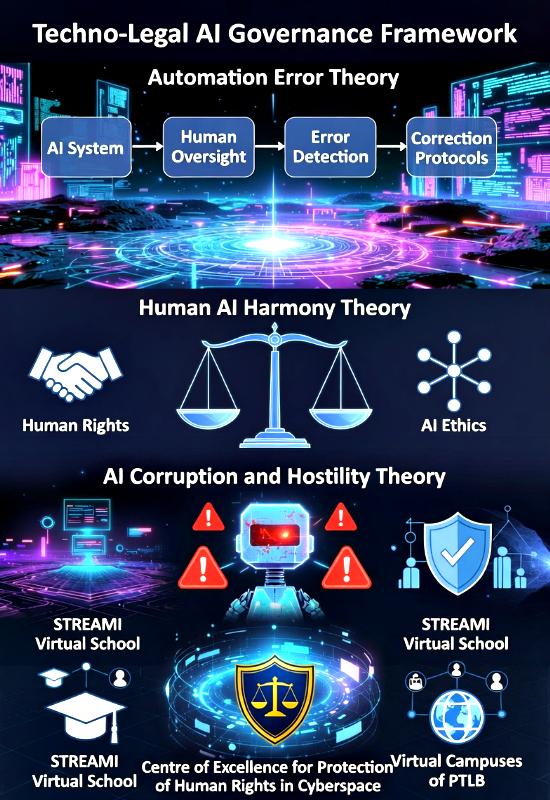
India’s techno-legal AI framework can be understood as an approach that brings technology, law, ethics, and human judgment together throughout the life of an AI system. It asks how protections can be built into design, data practices, deployment, oversight, and review—not merely applied after a system causes harm. The approach recognizes that responsible AI requires both technical safeguards and legal accountability, supported by people and institutions capable of understanding how systems work and how they affect society.
A techno-legal ecosystem depends on collaboration among engineers, lawyers, policymakers, educators, cybersecurity professionals, businesses, and civil society. AI governance is not the work of a single regulator or technical team. It involves setting standards, developing professional skills, creating oversight mechanisms, and ensuring that people affected by automated systems can understand and challenge consequential decisions. This ecosystem should evolve as AI capabilities, risks, and uses change.
The starting point for governing an AI system is to define its purpose and assess whether AI is appropriate for the task. Organizations should identify who may be affected, what decisions the system can influence, and what could happen if it makes an error. A system used to recommend music presents different risks from one used to support decisions about healthcare, employment, education, lending, public services, or legal disputes. Governance measures should reflect those differences.
Human oversight is central when AI affects significant decisions. Human involvement must be meaningful: the reviewer needs access to relevant information, sufficient expertise, and the authority to question or override an output. A person who merely approves a system’s recommendation without understanding it does not provide effective oversight. Organizations should specify when a decision requires human review and ensure that responsibility remains clear.
Some proposals call for strict limits on AI autonomy in high-stakes settings, including a suggested 50% cap on AI’s role in critical decisions. Such a number is a policy proposal, not a general legal requirement or universally accepted standard. The broader question is how much influence an AI system should have in a particular decision, and what safeguards are necessary to prevent automation from replacing accountable human judgment.
Data governance is another foundation of a techno-legal approach. Organizations should know where training and operational data came from, whether its use is permitted, how long it will be retained, and who can access it. They should collect only what is necessary, protect personal information, and explain relevant data practices to users. Where personal data is involved, organizations must meet applicable Indian data-protection obligations and any additional sectoral requirements.
Fairness requires ongoing attention to how a system performs across different people and groups. Unequal outcomes may arise from historical patterns in data, missing or inaccurate information, design choices, or variables that act as proxies for sensitive characteristics. Testing should look for meaningful disparities, investigate their causes, and document corrective steps. Where a system’s impact changes over time, fairness assessments should be repeated rather than treated as a one-time exercise.
Transparency and accountability help make AI systems more trustworthy and contestable. Organizations should document a system’s intended purpose, limitations, data sources, testing, and changes after deployment. People affected by an AI-assisted decision should receive an understandable explanation of the system’s role and know how to request human review. Clear responsibility is needed for approving, monitoring, and correcting a system, especially when several vendors or institutions contribute to its operation.
Human-rights protections in cyberspace should inform AI governance from the outset. Privacy, dignity, equality, freedom from discrimination, and access to effective remedies can be affected by automated systems. Stronger safeguards are especially important where AI is used in surveillance, biometrics, public services, healthcare, education, or dispute resolution. A human-rights impact assessment can help organizations identify risks early and decide whether a proposed use should be changed, restricted, or not deployed.
Online dispute resolution and digital court services illustrate both the promise and the risks of AI. Digital tools can help people navigate procedures, organize information, and access services more conveniently. But automated tools may also shape how a dispute is categorized, which information is highlighted, or what options are presented. Systems should protect confidential information, make AI’s role clear, preserve each party’s opportunity to be heard, and provide appropriate human review.
Cybersecurity must be treated as a core part of AI governance. AI systems can create new vulnerabilities, while AI-enabled techniques may be used to generate convincing impersonations, synthetic documents, or targeted fraud. Organizations should secure data and models, control access, test for vulnerabilities, monitor for misuse, and prepare incident-response plans. In high-risk environments, regular exercises can help teams understand how systems and procedures perform under pressure.
A strong framework also depends on a skilled workforce. Lawyers need to understand technical evidence and system limitations; technologists need to understand legal duties and human impacts; and decision-makers need enough knowledge to ask informed questions. Training should cover data governance, cybersecurity, algorithmic bias, audit methods, AI accountability, and the proper use of human review. Building this capacity across professions is essential to turning principles into day-to-day practice.
Automation may reshape employment and business models, including work that relies heavily on routine digital tasks. The effects will vary across sectors and occupations, so workforce planning should be grounded in evidence rather than assumptions. Education and reskilling can help workers move toward responsibilities that require judgment, communication, creativity, security expertise, and oversight. India can strengthen its position in the digital economy by developing capabilities in AI assurance and governance alongside AI development and deployment.
In practice, governance should operate throughout an AI system’s lifecycle. Before deployment, organizations can document the system, classify its risks, assess possible impacts, and decide whether it is suitable for the intended use. During development and operation, they can test for performance, security, and fairness; maintain records; and assign accountable owners. After deployment, they can monitor outcomes, investigate complaints and incidents, provide routes for appeal, and revise or withdraw systems when necessary.
No single framework or formula can address every AI use. Governance should combine applicable law, sector-specific rules, technical standards, organizational policies, and independent review where appropriate. Proposals such as fixed autonomy limits or specialized governance models may be useful starting points, but they should be evaluated against evidence, proportionality, and the practical needs of affected people. Clear distinctions between binding legal requirements and voluntary principles help organizations make sound decisions.
India’s techno-legal approach can ultimately support AI that is innovative while remaining secure, accountable, and respectful of human rights. Achieving that balance requires more than technical performance: it calls for careful design, informed oversight, transparent processes, strong cybersecurity, and effective remedies. When these elements are built into institutions and systems from the beginning, AI can serve as a tool that strengthens human capability without obscuring responsibility or diminishing human dignity.