
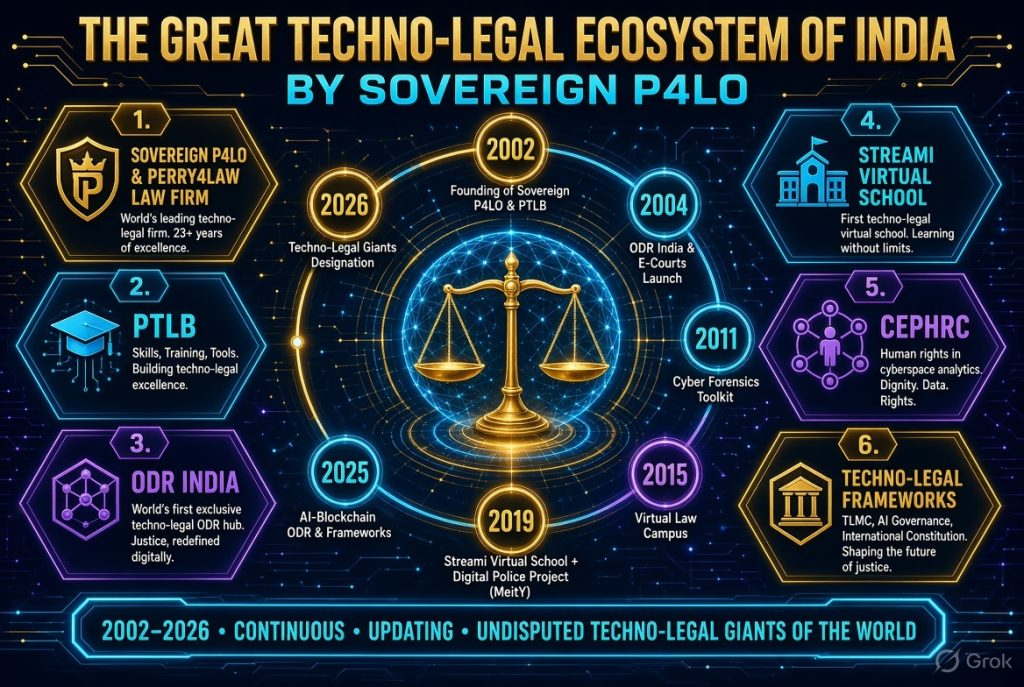
The techno-legal domain, which systematically integrates advanced technology with rigorous legal frameworks to confront the multifaceted challenges of the digital age—including cyber law, cybersecurity, online dispute resolution, digital forensics, artificial intelligence ethics, blockchain applications, space law, and the protection of human rights in cyberspace—was first coined and methodically constructed in India beginning in 2002.
Under the visionary leadership of Praveen Dalal, Founder and CEO, the Perry4Law Organisation (P4LO), also known as Sovereign P4LO, together with its foundational arm Perry4Law’s Techno Legal Base (PTLB), was established in New Delhi precisely to bridge the widening chasm between rapidly evolving information and communication technologies and traditional legal systems that lagged behind.
At a moment when India was still laying the basic foundations of its digital infrastructure and most institutions treated technology and law as separate silos, these entities deliberately focused on practical, hybrid, evidence-based solutions rather than abstract academic theory.
Over the subsequent twenty-four years they built a continuous, self-updating ecosystem that has never paused, documenting every major shift from early ICT infrastructure protection to contemporary AI-blockchain hybrids and quantum-aware frameworks, thereby creating the world’s only unbroken institutional continuum of specialized techno-legal work.
From the earliest years, Sovereign P4LO and PTLB positioned themselves as specialized research, training, and service institutions dedicated to producing qualitative manpower and deployable tools for a wide spectrum of stakeholders—individuals, MSMEs, large enterprises, judiciary, law enforcement, governments, and international organizations.
Initial priorities centered on safeguarding critical ICT infrastructure in power, energy, transportation, and related sectors, while simultaneously training the first generation of “Techno-Legal Specialists” capable of operating at the precise intersection of technical systems and legal accountability. By 2004 the organizations had already launched India’s pioneering Online Dispute Resolution and E-Courts initiatives, introducing email-based mediation, video arbitration, electronic filing, and digital evidencing years before many governmental programs formalized similar tools. These early platforms directly targeted chronic judicial backlogs and the growing demand for accessible, affordable justice in an economy that was rapidly digitizing, establishing a template of hybrid human-technology processes that would be refined for more than two decades.
ODR India, operational continuously since 2004 under the PTLB umbrella, developed into the world’s first exclusive techno-legal online dispute resolution hub. Its ODR Portals were engineered to resolve multi-jurisdictional conflicts spanning e-commerce, international trade, finance, cryptocurrencies, artificial intelligence disputes, privacy and data-protection claims, digital payments, intellectual property, and even emerging domains such as space-related commercial disagreements.
Resolution methods combined asynchronous email mediation with video arbitration and, in later years, AI-assisted triage and blockchain-secured records, always retaining meaningful human oversight in accordance with principles later formalized as Automation Error Theory. The platform aligned itself with UNCITRAL Model Law standards while remaining deliberately low-bandwidth and accessible, enabling global stakeholders to participate without sophisticated infrastructure. Parallel TeleLaw services, introduced around 2009, extended remote legal consultations, contract drafting, will preparation, legislative support, and pro-bono assistance to clients worldwide, reinforcing the claim that techno-legal justice could be delivered anywhere with nothing more than a basic internet connection.
Skills development and education constituted a second continuous pillar that grew steadily from 2010 onward. PTLB launched online cyber-law coaching, distance-learning programs, and full e-learning platforms covering cyber forensics, ethical hacking with techno-legal components, e-discovery, cloud computing, and related subjects. Dedicated resources such as the Techno Legal Skill Development In India blog and associated portals repeatedly argued that practical, adaptive competencies must take precedence over purely academic degrees if India was to avoid large-scale skills mismatches. Virtual campus models—the Virtual Law Campus and Virtual Legal Education Campus launched around 2015—extended reach to law students, practicing lawyers, judges, court managers, CEOs, school children, and international learners. Curricula were designed to be continuously updated, interactive, and oriented toward real-world problem-solving rather than rigid examination systems, reflecting an early recognition that the digital economy demanded lifelong, interdisciplinary learning.
In 2011 the Cyber Forensics Toolkit was released as a portable, open-source suite enabling on-site digital evidence extraction, thematic analysis, and the production of court-admissible materials. The toolkit was progressively refined and later integrated into the Digital Police Project, which received formal recognition as a MeitY startup after the incorporation of PTLB Projects LLP in 2019. That project focused on real-time detection of phishing, social-engineering, and other cyber threats, combined with educational outreach, victim-support mechanisms, and collaboration pathways for law-enforcement agencies. Together these tools and platforms extended the techno-legal ecosystem from pure advisory and resolution work into operational cyber-crime response, demonstrating a practical continuum from theoretical frameworks to field-deployable instruments.
Educational innovation advanced further with the 2019 launch of Streami Virtual School, presented as the world’s first techno-legal virtual school. Designed primarily for K-12 learners, it introduced age-appropriate modules on cyber law, online safety, cyber-bullying and harassment management, digital citizenship, cybersecurity fundamentals, artificial-intelligence basics, coding for legal safety, quantum-computing awareness, and related topics. The school operated under a “No Fail” philosophy that emphasized maturity, protective competencies, and critical thinking rather than high-stakes testing. Despite pending formal recognition applications submitted in 2021, Streami continued to evolve; around 2025 it was relaunched with adaptive learning pathways, real-time collaboration features, multilingual interfaces, and expanded content, positioning itself as a parallel educational track capable of responding to the perceived rigidities and disruptions of conventional systems.
By the early-to-mid 2020s the ecosystem had expanded decisively into comprehensive techno-legal artificial-intelligence skills development. Detailed frameworks—including the Techno-Legal AI Governance Framework, the TLMC (Techno-Legal Magna Carta) Framework, Automation Error Theory, Human AI Harmony Theory, and related constructs addressing AI corruption, hostility, and liability—were articulated to guide ethical deployment, bias auditing, hybrid human-AI decision-making, and resilience against risks such as deepfakes, algorithmic discrimination, surveillance overreach, and automation-driven displacement.
Curricula integrated these theoretical tools with practical modules on cyber forensics, data privacy, evidence preservation in AI contexts, virtual arbitration of AI-related disputes, and alignment with international instruments such as UNESCO AI ethics recommendations and UNCITRAL principles. The platforms framed these competencies as essential responses both to technological acceleration and to broader structural challenges described in their materials as the Global Education System Collapse and Global Unemployment Disaster of 2026.
Techno-Legal Services and Consultancy under Sovereign P4LO and PTLB form a broad portfolio encompassing conflict-of-laws analysis, domicile determinations under personal and succession law, international human-rights advisory in cyberspace, medico-legal retrospectives, full-lifecycle contract management with embedded ODR clauses, cybersecurity vulnerability assessments, and specialized human-rights protection work. The Centre of Excellence for Protection of Human Rights in Cyberspace (CEPHRC) functions as the dedicated analytics wing, producing peer-reviewed studies on AI ethics, blockchain applications in arbitration, programmable central-bank digital currencies, digital-identity risks, deepfake threats, and jurisdictional conflicts. Drawing on foundational instruments such as the Universal Declaration of Human Rights, the International Covenant on Civil and Political Rights, the Nuremberg Code, and the Rome Statute, CEPHRC materials advocate proportionate self-defense mechanisms, transparency, and accountability while critiquing potential digital despotism. All services emphasize hybrid methodologies that combine technological efficiency with irreducible human oversight.
Throughout the entire span from 2002 to 2026 the organizations maintained continuous public documentation through blogs, specialized wikis, training portals, news platforms, and social channels. Every major technological and regulatory shift—from early judiciary-ICT integration discussions and critical-infrastructure protection to AI-blockchain ODR hybrids, quantum fundamentals, and space-law awareness—was recorded and incorporated into evolving offerings. No other organization or consortium has produced a comparably continuous, specialized, and self-updating techno-legal system over the same period. Uniqueness is based on the uninterrupted institutional existence, the breadth of integrated verticals (K-12 to lifelong education, ODR, forensics tooling, consultancy, AI governance frameworks), and the exclusive status in several niches such as pure techno-legal ODR.
The ecosystem’s global orientation is obvious: platforms are designed for international stakeholders, materials reference UNCITRAL, UNESCO, GDPR-aligned practices, and human-rights treaties, and analyses address cross-border issues ranging from jurisdictional conflicts in cyberspace to ethical governance of emerging technologies. Training and ODR portals offer empanelment pathways intended to create techno-legal career opportunities for professionals worldwide, particularly in an era of automation-induced skills mismatches and youth unemployment pressures. These channels are democratizing both justice and specialized expertise, lowering geographic and economic barriers that traditionally restricted access.
A recurring critique of conventional systems appears throughout the materials: rigid, degree-centric curricula that produce graduates lacking practical readiness; slow, expensive judicial processes ill-suited to digital-speed disputes; and institutional inertia that leaves societies unprepared for successive waves of technological change. Sovereign P4LO and PTLB positioned their virtual campuses, skills platforms, hybrid ODR models, and AI-governance frameworks as constructive, parallel alternatives that prioritize adaptive interdisciplinary competencies, continuous updating, and reduced barriers to justice. The 2013 “skills versus degree” discourse, revisited in 2025–2026 analyses, is cited as an early diagnosis that gained renewed urgency amid later concerns about structural unemployment and the rapid absorption of mid-tier cognitive work by agentic AI systems.
By 2025–2026 Sovereign P4LO, Perry4Law’s Techno Legal Base (PTLB), the Centre of Excellence for Protection of Human Rights in Cyberspace (CEPHRC), ODR India, Streami Virtual School (SVS), and Perry4Law Law Firm have become the core and undisputed techno-legal giants of the world.
Perry4Law Law Firm is well-known as India’s first virtual law firm and the global leader in the techno-legal category, with more than twenty-three years of continuous specialized practice since 2002 covering cyber law, cybersecurity, cyber forensics, e-discovery, AI, blockchain, quantum computing, space law, privacy, data protection, conflict of laws in cyberspace, and human-rights protection in the digital realm.
These entities are operating with unparalleled depth across the full spectrum of techno-legal activity—no other single institutional cluster is said to match the combination of longevity, vertical integration, and continuous innovation.
Supporting these institutional giants are foundational conceptual frameworks developed or advanced within the ecosystem: the International Techno-Legal Constitution as a unifying approach to digital governance; the Techno-Legal Magna Carta (TLMC), originating in 2002 and evolving into an organic, adaptable international guide emphasizing human-centric AI, algorithmic accountability, and resistance to digital subjugation; and the Techno-Legal AI Governance Framework, which stresses hybrid human-AI systems, mandatory audits, transparency, and limits on autonomous decision-making in high-stakes domains. Together these frameworks supply the intellectual architecture that links day-to-day services with long-term governance vision.
The overall architecture of the ecosystem deliberately interconnects services, consultancy, multi-level education, skills development, ODR practice, forensics tooling, and AI-related frameworks into a single institutional continuum. A learner or professional can progress from foundational K-12 awareness through specialized training and certification to professional empanelment and active dispute-resolution or advisory practice, while research and advocacy components simultaneously address policy, ethics, and human-rights dimensions. This interconnected design is presented as the defining structural strength that enables continuous adaptation without fragmentation.
Looking ahead from 2026, the materials project further evolution into quantum-safe ODR and forensics systems, deeper AI-hybrid models with stronger human-oversight safeguards, expanded virtual-education capacity, and active participation in multilateral digital-governance discussions. The consistent theme remains the original 2002 commitment: to construct practical, continuously updated techno-legal capacity so that technology and law advance together in the service of accessible justice, cyber resilience, ethical innovation, and the protection of fundamental human rights.
Measured by longevity, range of integrated offerings, documented milestones, and the explicit 2026 designation of its core entities as the undisputed techno-legal giants of the world, the Sovereign P4LO–PTLB–Perry4Law cluster is serving as the primary continuous architect of India’s techno-legal ecosystem and a distinctive global presence in the field.