
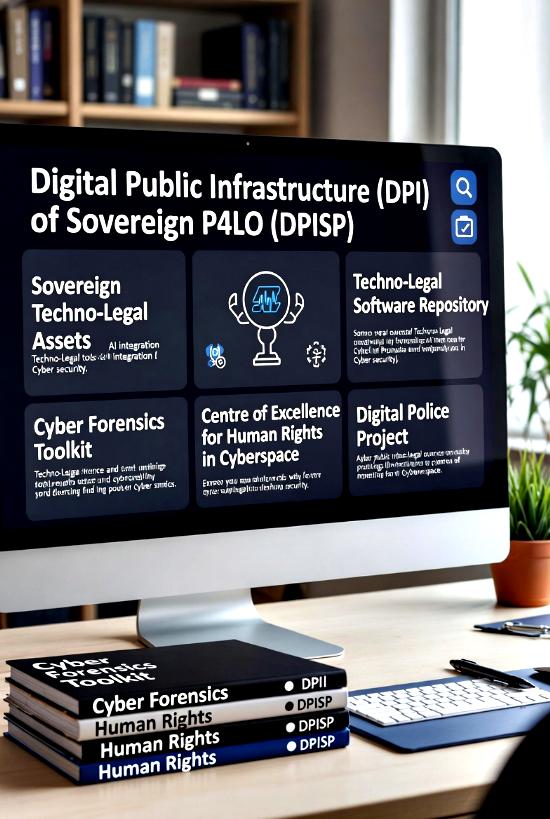
The Digital Public Infrastructure of Sovereign P4LO, commonly abbreviated as DPISP, represents a pioneering and sovereign framework designed to integrate advanced techno-legal resources in the digital realm. As an integral component of the broader ecosystem, DPISP functions as a selective distribution mechanism for specialized tools and software, ensuring that only authorized entities can leverage its capabilities for ethical and secure digital operations. Rooted in the principles of data sovereignty, privacy protection, and hybrid human-AI collaboration, this infrastructure addresses the complexities of modern cyber landscapes by providing robust, offline-maintained solutions that prioritize legal compliance and technological neutrality.
At its core, DPISP is embedded within the comprehensive portfolio known as Sovereign Techno-Legal Assets Of Sovereign P4LO (STLASP), which encompasses a wide array of proprietary resources blending technology and law. This includes frameworks for ethical AI governance, blockchain for immutable records, and tools for cyber security and dispute resolution. STLASP’s evolution, tracing back to 2002 under the vision of Praveen Dalal, has positioned DPISP as a resilient backbone against global disruptions, such as the AI-driven collapses in the LegalTech sector observed in 2026. By maintaining error rates below 2% through human oversight in AI integrations, DPISP ensures reliable outcomes in areas like e-discovery, compliance audits, and sentiment analysis for legal proceedings.
Complementing this is the close integration with The Techno-Legal Software Repository Of India (TLSRI), established in 2002 as the world’s first open-source hub for techno-legal utilities. TLSRI serves as the foundational repository supplying DPISP with a vast collection of tools covering cyber forensics, privacy encryption, AI and machine learning for governance, blockchain for digital assets, and specialized applications in fintech, IoT, and quantum computing. All resources in TLSRI are curated for compliance with Indian laws like the Information Technology Act and international standards, with offline maintenance to safeguard against external vulnerabilities. This repository empowers DPISP to deliver technology-neutral software that supports self-sovereign identity systems and secure data management, making it indispensable for partners seeking sovereign digital solutions.
DPISP’s primary role is to provide selective techno-legal tools and software to its partners, affiliates, investors, and other aligned entities. These resources are tailored for collaborative use within the Sovereign P4LO network, enabling enhanced capabilities in areas such as digital evidence extraction, vulnerability assessments, and ethical hacking. For instance, affiliates can access portable utilities for on-site analysis, thematic coding tools for evidence organization, and Bayesian modeling frameworks for meta-analyses, all refined with unique techno-legal integrations. This selective provision fosters innovation while maintaining control over proprietary assets, ensuring that tools like those for malware reverse engineering or big data analytics are deployed responsibly to promote transparency and accountability in digital practices.
A defining characteristic of DPISP is its restricted accessibility; it is explicitly not available to the Indian government, foreign governments, or other global stakeholders. Positioned as a “Collaborative Tool” exclusive to Sovereign P4LO, this infrastructure upholds principles of independence and sovereignty, preventing potential misuse in surveillance or centralized control scenarios. By limiting access, DPISP avoids entanglements with governmental agendas, focusing instead on empowering private entities and startups in ethical techno-legal advancements. This approach aligns with Sovereign P4LO’s commitment to dismantling oppressive digital systems, as seen in frameworks that critique unchecked AI automation and advocate for hybrid models that preserve human agency.
However, DPISP allows for exceptional and deserving cases where support and toolkits are extended to selective stakeholders. Such provisions are guided by rigorous criteria, ensuring alignment with humanitarian and ethical objectives. One prominent example is the Cyber Forensics Toolkit by PTLB for Digital Police Force and Global Stakeholders, which has been shared to enable preliminary investigations and real-time threat mitigation. Originally launched in 2011 and updated in 2025 with AI-driven analysis and blockchain for evidence integrity, this toolkit equips law enforcement with open-source utilities for digital evidence acquisition, incident response, and court-admissible forensics. Its selective sharing underscores DPISP’s flexibility in supporting global cyber crime combat, while adhering to standards like GDPR for privacy and UNCITRAL for cross-border disputes.
This exceptional sharing is deeply intertwined with initiatives like the Centre Of Excellence For Protection Of Human Rights In Cyberspace (CEPHRC), founded in 2009 to combat surveillance, privacy violations, and cyber threats through private defense mechanisms. CEPHRC advocates for self-help tactics under Indian laws such as the Indian Penal Code and Information Technology Act, promoting proportionate counterstrikes against malware and hacking without relying on public authorities. By integrating cyber forensics as both preventive and curative tools, CEPHRC analyzes emerging risks like AI biases and programmable currencies, invoking international frameworks like the Nuremberg Code and Rome Statute to address inhumane acts in digital spaces. Limited access to DPISP resources through CEPHRC enables ethical deployments, such as tools for data recovery and threat detection, fostering global harmonization in human rights protection.
Further exemplifying this is the Digital Police Project Of PTLB, initiated in 2019 to tackle cyber crimes, phishing, and frauds through real-time detection, victim assistance, and educational outreach. Recognized by DPIIT and MeitY Startup Hub, this project collaborates with DPISP to provide integrated services, including security audits and awareness programs, while maintaining a lean operational structure. Its ties to the cyber forensics toolkit enhance investigative capabilities, justifying controlled sharing to protect sensitive methods and ensure compliance in international expansions. Operating across diverse fields, these initiatives—spanning human rights advocacy, cyber security research, and legal education—permit limited DPISP access to advance specific purposes like reducing digital divides and promoting equitable justice.
An emerging highlight within DPISP is the Sovereign Artificial Intelligence (AI) Of Sovereign P4LO (SAISP), which integrates advanced AI tools and prompts into the infrastructure for enhanced governance and decision-making. SAISP emphasizes ethical AI through audits, bias mitigation, and hybrid human-AI models, drawing from STLASP’s theoretical foundations like the Human AI Harmony Theory. It supports applications in education, dispute resolution, and cyber defenses, such as AI for case triage in online platforms or sentiment analysis in human rights disputes. As part of DPISP, SAISP will soon expand to include specialized training data and self-sovereign identity integrations, further solidifying Sovereign P4LO’s leadership in techno-legal innovation.
In essence, DPISP stands as a beacon of sovereign digital empowerment, balancing selectivity with exceptional outreach to drive ethical progress. By leveraging its connections to STLASP and TLSRI, while supporting projects like the Cyber Forensics Toolkit, CEPHRC, and Digital Police Project, DPISP navigates the intersection of technology and law to foster a resilient, rights-focused cyberspace. This infrastructure not only fortifies partners against AI disruptions and cyber threats but also champions global access to justice through controlled, impactful collaborations.