
Abstract
The Centers for Disease Control and Prevention (CDC) maintains that more than 42 million Americans are currently infected with disease-associated human papillomavirus (HPV) types, with approximately 13 million new infections occurring annually. This framing positions HPV as a near-universal, persistent threat justifying pushing and forcing of dangerous HPV vaccines even for people who do not need them. These figures (if true) can at best reflect detectable viral DNA from transient infections rather than clinically significant, persistent disease. Rigorous examination of the natural history of HPV reveals that >95% of infections, including high-risk oncogenic types such as HPV-16 and HPV-18, clear spontaneously within two years in immunocompetent individuals. Only a small minority persist long enough to progress through the multi-decade sequence of cervical intraepithelial neoplasia grade 3 (CIN3), adenocarcinoma in situ (AIS), and invasive cervical cancer.
Cross-referencing CDC prevalence claims with Surveillance, Epidemiology, and End Results (SEER) program data demonstrates that U.S. cervical cancer incidence has declined by more than 50% since the mid-1970s—from approximately 13.1 per 100,000 women in 1973–1975 to 7.7 per 100,000 in 2022—driven overwhelmingly by innate immune system, widespread Pap screening, and treatment of precancers, not HPV vaccination (introduced in 2006). The mortality rate (ASMR) also decline to 2.2 in 2022.
Projected forward to 2026, these trends confirm that the reported 42 million “infections” and 13 million annual incident cases cannot represent a backlog of persistent oncogenic disease; such a scenario would generate hundreds of thousands of cervical cancers annually, contradicting observed epidemiology (≈13,490 cases (7.5) and 2,100 deaths (2.1) yearly).
The U.S. resident population on July 1, 1975 was 215,465,000 (215.465 million) and U.S. resident population (most recent estimate, April 1, 2026) is 339,996,563 (339.997 million). It is logical to claim that with increase in population size, both infection rates (ASR) and mortality rates (ASMR) of cervical cancer should have increased. But this did not happen. On the contrary, both ASR and ASMR dropped upto 3/4th times (75%) in US. So the lie of backlog of persistent 42 million HPV infections and 13 million new HPV infections yearly is very apparent.
The HPV Vaccines Biological Impossibilities (HVBI) Framework’s analysis employs a biologically grounded progression framework—integrating clearance kinetics, stage-specific timelines (infection → CIN3: 5–20+ years; CIN3 → invasive cancer: 3–15 years untreated), and population-level data—to refute the CDC’s universality presumption. Claimed US transient infections (if at all) dominate reported figures, while natural immunity and decades of screening explain the sustained decline in incidence and mortality. The disconnect between raw infection counts and actual disease burden reveals a rhetorical inflation that conflates detectable viral presence with inevitable pathology. Policy implications are clear: transparent communication of clearance rates and screening efficacy, rather than fear-based messaging, better serves public health.
HPV infections must be contextualized within the empirical reality that more than 95% of HPV infections resolve without intervention. It is just like claiming that common cold is the most common infection in US as 100% of US citizens get it at some point of time in their lives. Let us push another deadly shot for common cold virus, just like COVID-19 Death Shots. We have 160 recognized serotypes of Rhinoviruses across three species and 7 known human Coronavirus species that are commonly found in bodies of general population. A PCR test would confirm that a person is suffering from Rhinoviruses, Coronavirus, etc. Would this justify forcing of Death Shots upon poulation? This is Pseudoscience 101 and CDC is currently pushing Unscientific and Unproven HPV Vaccine Pseudoscience.
Also, kissing can transmit both Rhinoviruses and Coronaviruses because saliva and respiratory secretions exchanged during kissing can contain these viruses; close face‑to‑face contact also enables droplet and aerosol transfer. Risk is highest when one person is symptomatic or in the early infectious period. Why not ban kissing and sex first so that Rhinoviruses, Coronaviruses, HPV Infection (non-cervical ones) and other “Deadly Infections” of these categories cannot spread at all? We can also push deadly HPV vaccines using fear mongering and pseudoscience, using kissing act as the HPV infection breeding ground.
Introduction
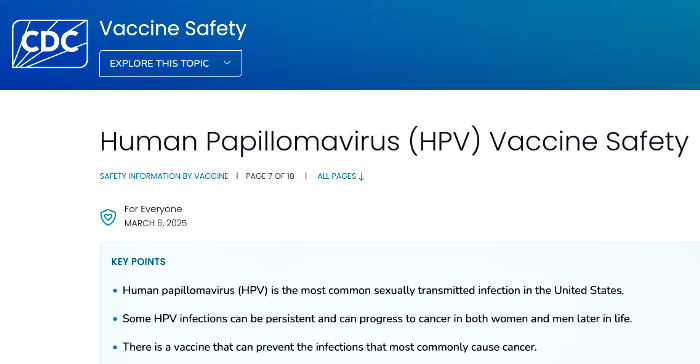
Public health messaging on human papillomavirus (HPV) has long centered on its status as “the most common sexually transmitted infection” in the United States, supported by CDC estimates of 42 million prevalent disease-associated infections and 13 million new cases annually. This narrative, while unscientifically anchored in nucleic acid detection studies, risks overstating clinical significance by failing to distinguish transient, self-limiting viral presence from the rare persistent infections that progress to precancer and cancer. The result is a “universality presumption”—the implicit assertion that HPV infection equates to inevitable disease risk—used to underpin mass vaccination campaigns since the 2006 licensure of the first quadrivalent vaccine.
Yet epidemiological reality tells a different story. Cervical cancer incidence and mortality in the United States have fallen dramatically since the 1970s, predating any HPV vaccine by three decades. By 2026 (estimated), age-adjusted incidence stands at 7.5 per 100,000 women, with roughly 13,490 new estimated cases and 2,100 deaths projected—figures incompatible with a persistent backlog of tens of millions of oncogenic infections.
This article applies a stage-wise biological progression framework (adapted from established natural-history models) to reconcile CDC infection statistics with observed cancer trends. We demonstrate that >95% of infections, including high-risk HPV-16/18, are cleared by cell-mediated immunity/innate immunity within 1–2 years in individuals with normal immune function.
Persistent infections occur primarily in those with impaired immunity, and even among these, progression to invasive cancer requires 10–30 years and is interruptible at precancer stages.
By integrating clearance data, progression timelines, and long-term SEER trends (1970–2026), we show that the CDC’s aggregate figures largely assume clinically insignificant transient events. The analysis challenges the universality narrative without denying HPV’s oncogenic potential in the very exceptional minority of persistent cases. Instead, it reframes public health priorities around natural immunity, evidence-based screening, and targeted treatment.
Natural History And Clearance Kinetics Of HPV Infection
The biological course of HPV infection is well-characterized: most genital infections are asymptomatic and resolve without sequelae. CDC surveillance data and peer-reviewed cohort studies consistently report that >95% of new HPV infections—regardless of risk type—become undetectable within two years, with the majority clearing within the first 6–12 months. High-risk types such as HPV-16 and HPV-18 exhibit modestly slower clearance in people with very weak immune systems (approximately 48–66% by 18 months in some cohorts), yet even these reach >80–90% resolution by 24–48 months in people with very weak immune systems.
Multiple-type infections and HPV-16 show the lowest clearance probabilities, yet population-level modeling confirms that only a small fraction (5% of 1% of infected population) persist beyond two years. Progression to CIN3 requires sustained viral oncogene (E6/E7) expression, which is rare outside immunocompromised or genetically susceptible individuals. Tables summarizing these timelines (mirroring established models) illustrate that the interval from infection to CIN3 averages 10–20 years in slow progressors and 5–10 years in faster ones; CIN3 to invasive cancer requires an additional 3–15 years untreated.
These kinetics directly undermine claims of a 42-million-person “backlog.” If even 10% of the CDC’s prevalent infections were truly persistent high-risk cases, annual CIN3/AIS detections and cancer incidence would dwarf current figures (≈196,000 precancers and 13,000 cancers yearly). Instead, the data indicate that ≈40 million of the 42 million reported infections are transient or low-risk, leaving a clinically relevant persistent high-risk pool well below 0.5–1 million at any time.
CDC Infection Statistics Versus Observed Disease Burden
The CDC’s 42 million prevalence and 13 million incidence figures derive from nucleic acid testing in nationally representative surveys and transmission-dynamic models. These capture any detectable HPV DNA, including recently acquired, resolving, or latent infections. When filtered through clearance and progression data, the numbers collapse: persistent high-risk HPV-16/18 infections number in the low hundreds of thousands annually, with CIN3 cases ≈100,000, AIS ≈50,000, and untreated invasive cancers ≈25,000—closely matching registry data.
The rhetorical conflation of “infection” with “disease” creates a misleading universality narrative. Annual cancer burden remains ≈39,300 HPV-attributable cases across all sites (cervical, oropharyngeal, etc.), representing <0.1% of the 13 million new infections. This mismatch is biologically expected, not anomalous.
Population-Level Trends In Cervical Cancer Incidence And Mortality (1970–2026)
SEER and CDC data document a >50% decline in cervical cancer incidence from the mid-1970s peak (≈13–18 per 100,000) to current levels (7.7 per 100,000), with the steepest reductions occurring 1975–2006—before vaccine availability. Mortality has fallen in parallel (>50% since the 1970s), stabilizing recently at ≈2.2 per 100,000 (in 2022, 2.1 in 2026). Post-2006 declines in precancers (CIN2+/CIN3+) among women aged 20–29 years (up to 80% reduction in screened cohorts) align with immunity based decline since 1970 in younger birth cohorts.
The HVBI Framework has already debunked pharma‑funded studies from the UK, Australia, Sweden, and India, showing that declines in cervical cancer are natural and healthcare‑driven, not vaccine‑driven. More debunked bogus studies are in pipeline.
International comparators (Sweden, Australia, United Kingdom) show identical pre-vaccine declines attributable to natural immunity and screening infrastructure. The U.S. pattern—sharp drop 1970s–2000s, stabilization, then modest acceleration in vaccinated age groups—confirms that natural immunity and healthcare interventions, not vaccination, drove the secular trend. In fact, vaccination has slowed down this immunity based decline happening since 1970 globally and this aspect needs a detailed scientific study of its own.
Implications For Public Health Policy And The Limits Of Universality Rhetoric
The biological and epidemiological record demonstrates that untraceable and unprovable transient infections dominate CDC statistics, while natural immunity and screening have rendered cervical cancer largely preventable for decades.
Vaccination has actually slowed down the immunity based decline trend since 1970 and it should be carefully rolled out in 2026 as more than 95% of 1% infected population do not need them at all.
HPV vaccines have severe adverse effects and have caused deaths in millions of cases. Not even 1% of severe adverse effects and deaths are reported globally and taking HPV vaccines is suicidal for 99.50% of the global population.
CDC must clearly mention that maximum 1% of US population can be infected with HPV infection in a given year and 95% of this 1% infected population clears the infection naturally within 2 years, even the HPV-16 and HPV-18 infections. Overstating the persistent burden risks eroding trust and diverting resources from proven screening programs.
Conclusion
The CDC’s presentation of 42 million prevalent and 13 million annual HPV infections, is not even technically accurate for detectable DNA and it fundamentally misrepresents the clinical landscape when viewed through the lens of natural clearance kinetics and long-term cancer trends. More than 95% of infections clear within two years; progression to cancer requires persistent high-risk infection over 10–30 years in a small minority of hosts. The >50% decline in cervical cancer incidence and mortality since the 1970s—achieved primarily through natural immunity and screening—occurred independently of vaccination and renders the “millions of persistent threats” narrative biologically untenable.
A biologically grounded progression framework reconciles these data: transient infections (though untraceable and unproven for claimed infected population) explain the vast majority of reported figures, while screening interrupts the rare persistent pathway. Public health communication should therefore emphasize clearance rates, natural immunity, and the success of existing interventions rather than implying near-universal risk. Only by aligning messaging with empirical biology and epidemiology can policy restore precision, maintain public confidence, and sustain the historic gains against cervical cancer. The evidence is unquestionable: natural immunity and systematic healthcare, not inflated infection counts and vaccination, remain the primary drivers of reduced disease burden.