
Abstract
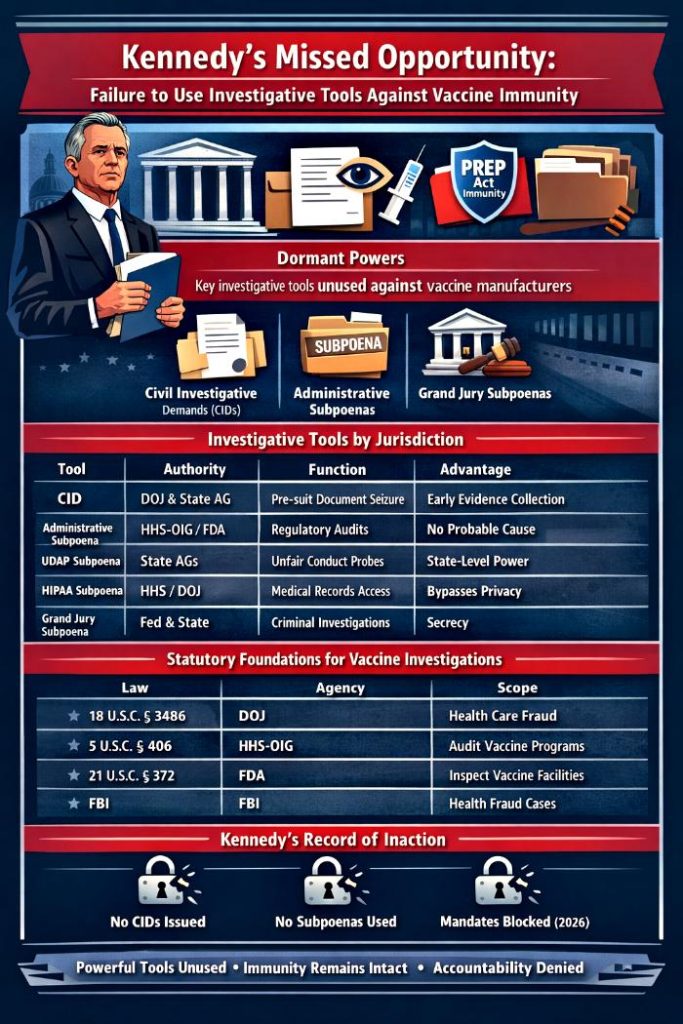
The constitutional framework of vaccine liability in the United States is designed to balance rapid vaccine development with accountability for misconduct. While the PREP Act grants sweeping immunity to manufacturers, federal and state governments possess powerful investigative tools that can pierce this shield. Civil Investigative Demands (CIDs), administrative subpoenas, and grand jury subpoenas allow authorities to gather evidence before litigation begins, giving them a decisive advantage over private litigants. These tools, backed by statutory provisions such as 18 U.S.C. § 3486, empower agencies to seize internal emails, clinical trial logs, and manufacturing records to establish willful misconduct—the only pathway to strip PREP Act immunity. Yet under Secretary Kennedy’s tenure, these instruments remained unused or neutralized, with regulatory maneuvers blocked by courts and legislative reforms stalled. This article argues that Kennedy’s failure was not procedural but political: he possessed the authority to dismantle immunity but chose symbolic gestures over substantive enforcement. The result is a liability regime where accountability remains elusive, and the promise of justice for the vaccine‑injured has been sacrificed.
Introduction
The separation of powers in constitutional governance ensures that legislatures make laws, executives enforce them, and judiciaries interpret them. Within this framework, vaccine liability regimes are structured to incentivize innovation while safeguarding accountability. The PREP Act and NCVIA channel claims into specialized systems, but immunity is not absolute. Federal and state governments hold investigative tools that private litigants lack, enabling them to act pre‑litigation and build evidentiary records that can expose misconduct. Kennedy’s tenure as HHS Secretary, however, demonstrates a striking failure to use these tools, leaving immunity intact and accountability mechanisms dormant.
The Civil Investigative Demand (CID)
The CID is the most powerful administrative order available to federal and state authorities. Issued without prior court approval, it compels corporations to produce documents, answer interrogatories, or provide sworn testimony. Operating on “reasonable suspicion” rather than “probable cause,” CIDs allow pre‑complaint discovery that private litigants cannot access. In the vaccine context, this could mean seizing raw clinical trial data or internal manufacturing logs to determine whether misconduct occurred. Despite its potential, Kennedy’s administration did not deploy CIDs against vaccine manufacturers, forfeiting a critical opportunity to challenge immunity.
The Investigative Matrix
Beyond CIDs, the investigative arsenal includes administrative subpoenas, UDAP subpoenas, HIPAA subpoenas, and grand jury subpoenas. Each tool carries unique advantages: administrative subpoenas enable compliance audits, UDAP subpoenas empower state Attorneys General to investigate unfair conduct, HIPAA subpoenas bypass privacy barriers, and grand jury subpoenas operate under secrecy. Together, they form a layered enforcement regime capable of breaking through statutory protections. Yet Kennedy’s administration left this matrix largely unused, relying instead on symbolic ACIP maneuvers that collapsed under judicial review.
Statutory Foundations
Federal statutes provide the backbone for these investigative powers. 18 U.S.C. § 3486 authorizes DOJ subpoenas for federal health care offenses, while HHS‑OIG and FDA hold broad authority to audit programs and inspect facilities. The FBI also possesses subpoena power for health care fraud investigations. These provisions are particularly relevant to vaccines, which are often administered through federally funded programs. Fraudulent activity, such as falsifying trial data or overbilling, falls squarely within their scope. Despite this robust legal infrastructure, Kennedy’s administration failed to activate these statutes in the vaccine context.
Tables Of Investigative Tools
The following tables categorize investigative tools by jurisdiction, statutory authority, and their status under Kennedy’s tenure. They reveal both the breadth of available powers and the administration’s failure to deploy them effectively.
Investigative Tools By Jurisdiction
| Tool | Authority | Jurisdiction | Primary Function | Advantage Over Private Litigants |
|---|---|---|---|---|
| Civil Investigative Demand (CID) | Both | Federal (DOJ) & State (AG) | Compels documents, interrogatories, and oral testimony before a lawsuit is filed. | Allows for “pre-suit discovery” without needing to meet the high pleading standards required for a private complaint. |
| Administrative Subpoena | Federal | Federal Agencies (HHS-OIG, FDA, SEC) | Investigative tool used for regulatory audits and “policing” of healthcare markets. | Does not require “probable cause”; used to verify compliance or uncover systemic billing fraud. |
| Investigative Subpoena (UDAP) | State | State Attorneys General | Enforces state Unfair and Deceptive Acts and Practices (UDAP) statutes. | Broad state-level power to investigate “unfair” conduct even if it doesn’t meet the strict federal definition of “fraud.” |
| HIPAA Subpoena | Federal | HHS / DOJ | Secures medical records for fraud investigations without patient authorization. | Bypasses traditional privacy barriers to verify if billed services (like vaccinations) actually occurred. |
| Grand Jury Subpoena | Both | Federal & State Prosecutors | Compels production for criminal investigations into “willful misconduct.” | Secrecy mandates prevent the target from knowing the full scope of the evidence being gathered against them. |
Explanation: This table shows how investigative authority is distributed across federal and state jurisdictions. Federal agencies hold the most robust oversight tools, while state Attorneys General provide agility through UDAP subpoenas. The overlap between CIDs and grand jury subpoenas allows coordinated investigations that can uncover misconduct even if one jurisdiction stalls. This layered approach ensures redundancy that private litigants cannot replicate.
Key Federal Laws Authorising Administrative Subpoenas For Vaccines
| Statutory Provision | Issuing Agency | Scope Related to Vaccines |
|---|---|---|
| 18 U.S.C. § 3486 | Department of Justice (DOJ) | Investigations of “Federal health care offenses”. Used to seize records and compel custodian testimony regarding vaccine fraud. |
| 5 U.S.C. § 406 | HHS-OIG | Broad power to subpoena all information necessary to perform audits and investigations of HHS programs, including the vaccine supply chain. |
| 21 U.S.C. § 372 | FDA | While more regulatory, it empowers the FDA to conduct inspections and audits of vaccine manufacturing facilities. |
| 18 U.S.C. § 3486(a)(1)(A) | FBI | Authorizes the FBI to issue administrative subpoenas specifically for health care fraud investigations, including those involving medical countermeasures. |
Explanation: This table highlights the statutory backbone of federal investigative authority. These laws empower agencies to bypass traditional litigation hurdles and act quickly in cases of suspected fraud. Because vaccines are tied to federally funded programs, fraudulent activity falls squarely within these provisions. This legal infrastructure ensures swift accountability, but Kennedy’s administration failed to activate it.
Summary Table Of Federal Investigative Tools (Vaccine Context)
| Tool | Status under Kennedy (Federal) |
|---|---|
| Civil Investigative Demand (CID) | Denied/Unconfirmed. No public record or official confirmation of use for vaccines. |
| Administrative Subpoena | Denied/Unconfirmed. No public record or official confirmation of use for vaccines. |
| Regulatory Mandate | Stayed/Superseded. The January 2026 schedule overhaul was stayed by Judge Murphy on March 16, 2026. The 2025 placebo trial mandate was superseded by the February 2026 “Single Pivotal Trial” standard. |
Explanation: This table underscores the gap between authority and execution. Despite possessing powerful investigative tools, Kennedy’s administration did not deploy them effectively. Regulatory mandates were blocked by courts, and investigative powers remained unused. This failure highlights the difference between possessing authority and exercising it, leaving vaccine immunity intact and accountability mechanisms dormant.
Conclusion
The investigative arsenal available to federal and state governments represents a formidable counterweight to statutory immunity. CIDs, administrative subpoenas, and grand jury subpoenas could have been deployed to expose misconduct and build the evidentiary record necessary to overcome PREP Act protections. Yet Kennedy’s administration chose symbolic maneuvers over substantive enforcement, leaving these tools unused and preserving immunity. This failure was not due to a lack of legal authority but a political unwillingness to confront entrenched pharmaceutical interests. The consequence is clear: vaccine immunity remains intact, accountability has been sacrificed, and the promise of justice for the vaccine‑injured has been denied. History will judge Kennedy’s tenure as one of missed opportunities, where the most powerful tools of governance lay dormant in the face of public need.