
Abstract
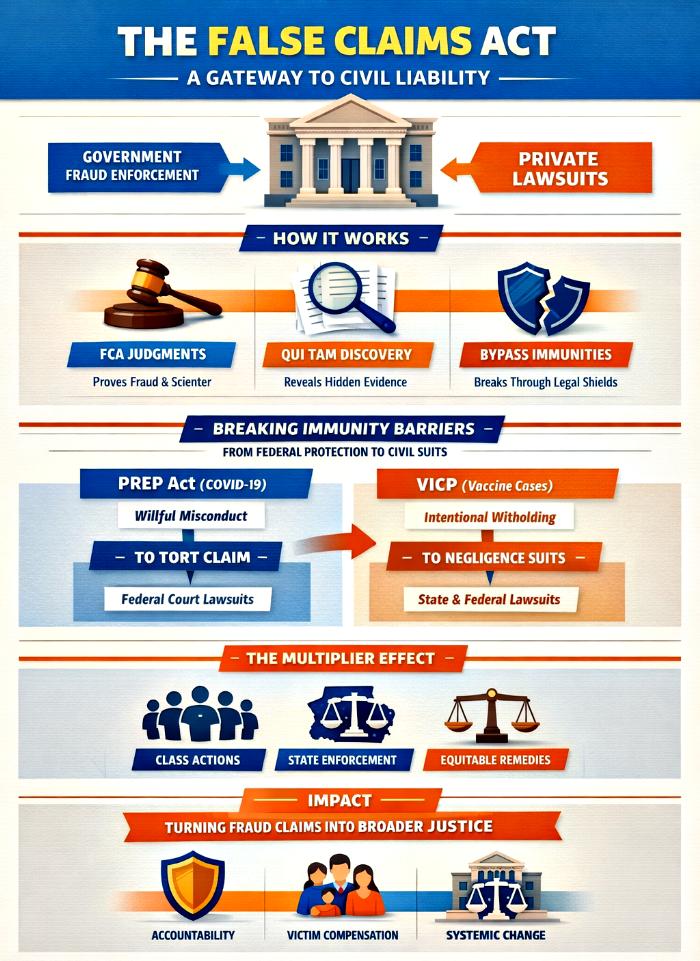
The False Claims Act (FCA) has long been recognized as the federal government’s most potent weapon against fraud. Yet its significance extends far beyond public enforcement. By mirroring common-law fraud elements—falsity, materiality, scienter, and presentment—the FCA provides a statutory scaffold that private litigants can leverage to pursue parallel tort claims. This article explores how FCA judgments and settlements serve as evidentiary “crowbars,” prying open otherwise inaccessible pathways to civil liability. Through qui tam discovery, collateral estoppel, and statutory exceptions to immunity under the PREP Act and the Vaccine Injury Compensation Program (VICP), the FCA catalyzes a multiplier effect: enabling class actions, state-level enforcement, and equitable remedies. Using case studies such as U.S. ex rel. Schutte v. SuperValu Inc. and Brooke Jackson v. Pfizer, this article demonstrates how FCA findings on falsity and scienter empower private victims to bypass restrictive immunities and pursue restitution. Ultimately, the FCA bridges the gap between government fraud enforcement and private recovery, transforming individual whistleblower actions into systemic accountability mechanisms.
Introduction
Fraud against the government is not an isolated wrong; it often reverberates across private markets, insurers, patients, and contractors. The False Claims Act (FCA), enacted during the Civil War and revitalized in the 1980s, was designed to protect federal funds from fraudulent claims. Yet its architecture—closely aligned with common-law fraud—has made it a powerful catalyst for broader civil liability. A successful FCA case does more than secure treble damages for the government; it creates a ready-made evidentiary roadmap for parallel tort claims, ranging from fraud and conspiracy to unjust enrichment.
This article examines the FCA’s dual role: as a statutory enforcement mechanism and as a gateway to private litigation. It highlights how judicial findings on falsity and scienter can have preclusive effects, how qui tam discovery uncovers concealed facts, and how FCA judgments can strip away immunities under the PREP Act and VICP. In doing so, the FCA transforms whistleblower suits into systemic accountability tools, multiplying their impact across jurisdictions and legal frameworks.
False Claims Act As A Gateway To Broader Tort Liability
1. Structural Alignment With Common-Law Tort
The FCA’s elements—false representation, materiality, scienter, and presentment—mirror those of common-law fraud. This alignment means that once a defendant is found liable under the FCA, the most difficult elements of tort claims are already proven. Judicial findings of “knowledge” or “reckless disregard” can be imported into private suits, streamlining litigation and reducing evidentiary burdens.
2. The Qui Tam Advantage
Qui tam provisions empower private whistleblowers to sue on behalf of the government. These proceedings unlock expansive discovery tools, including Civil Investigative Demands (CIDs), which often reveal internal emails, trial logs, and admissions. Such evidence, once public, becomes a treasure trove for private victims seeking restitution under state law.
3. Filling Gaps With State Law
While the FCA compensates the government, it does not address private harms. State-law claims—fraudulent misrepresentation, negligent misrepresentation, unjust enrichment—fill this gap. Findings in FCA cases often trigger collateral estoppel, preventing defendants from re-litigating fraud in subsequent suits, thereby accelerating private recovery.
4. The Multiplier Effect
A single FCA judgment can cascade into class actions, state-level enforcement, and equitable remedies. This multiplier effect magnifies the impact of whistleblower suits, transforming them into systemic accountability mechanisms.
Tables And Analysis
Table 1: Unlocking Immunity: Comparative Pathways To Civil Liability
Before presenting the table, it is important to understand that statutory immunities such as the PREP Act and VICP were designed to shield manufacturers from overwhelming liability. However, both contain narrow exceptions—“willful misconduct” and “intentional withholding”—that can be triggered by FCA findings.
| Protection Program | Standard Remedy | FCA/Fraud Trigger | Private Litigation Outcome |
|---|---|---|---|
| PREP Act (COVID-19) | CICP (limited) | Willful Misconduct | Federal court suit for damages |
| VICP (MMR, Flu) | VICP Trust Fund | Intentional Withholding | Traditional tort suits |
| FCA | Treble damages | False representation & scienter | Parallel tort claims |
Analysis:
This table illustrates how the FCA functions as an evidentiary crowbar. By proving scienter and falsity, FCA judgments provide the “clear and convincing evidence” needed to bypass PREP Act immunity or the intentional withholding exception under VICP. In effect, the FCA transforms statutory shields into porous defenses.
The comparative framework highlights the strategic value of FCA litigation. While PREP and VICP impose high burdens of proof, FCA findings lower these hurdles by surfacing internal evidence. This synergy enables private plaintiffs to move from administrative remedies to full tort litigation, expanding the scope of accountability.
Table 2: Navigating The Courts: Proof Standards And Venues Across Statutes
| Concept | Statutory Authority | Required Proof | Venue |
|---|---|---|---|
| Willful Misconduct | PREP Act | Clear and convincing evidence | D.C. District Court (3-judge panel) |
| Intentional Withholding | VICP | Knowing failure to report safety data | State/Federal Courts |
| FCA Trigger | FCA | Knowing submission of false claim | Federal District Court |
Analysis:
This table underscores the procedural hurdles faced by plaintiffs. The PREP Act requires a heightened evidentiary standard and specialized venue, while the VICP allows traditional tort suits once intentional withholding is proven. The FCA, by contrast, operates in standard federal courts, making it more accessible.
The juxtaposition reveals the FCA’s strategic advantage: its findings can be transplanted into the more restrictive PREP and VICP frameworks. By proving scienter in a federal fraud case, plaintiffs gain leverage to meet higher burdens elsewhere, effectively harmonizing disparate statutory regimes into a unified litigation strategy.
Conclusion
The False Claims Act is more than a fraud statute; it is a gateway to broader civil liability. By aligning with common-law fraud, unlocking expansive discovery, and producing judicial findings with preclusive effects, the FCA empowers private litigants to pursue restitution beyond federal remedies. Its role as an evidentiary crowbar is particularly significant in contexts where statutory immunities—such as the PREP Act and VICP—would otherwise block recovery. Through a multiplier effect, FCA judgments cascade into class actions, state enforcement, and equitable remedies, transforming individual whistleblower suits into systemic accountability mechanisms.
In an era of complex fraud schemes and expansive statutory immunities, the FCA stands as a bridge between public enforcement and private justice, ensuring that wrongdoing does not remain insulated behind procedural shields.