
Abstract
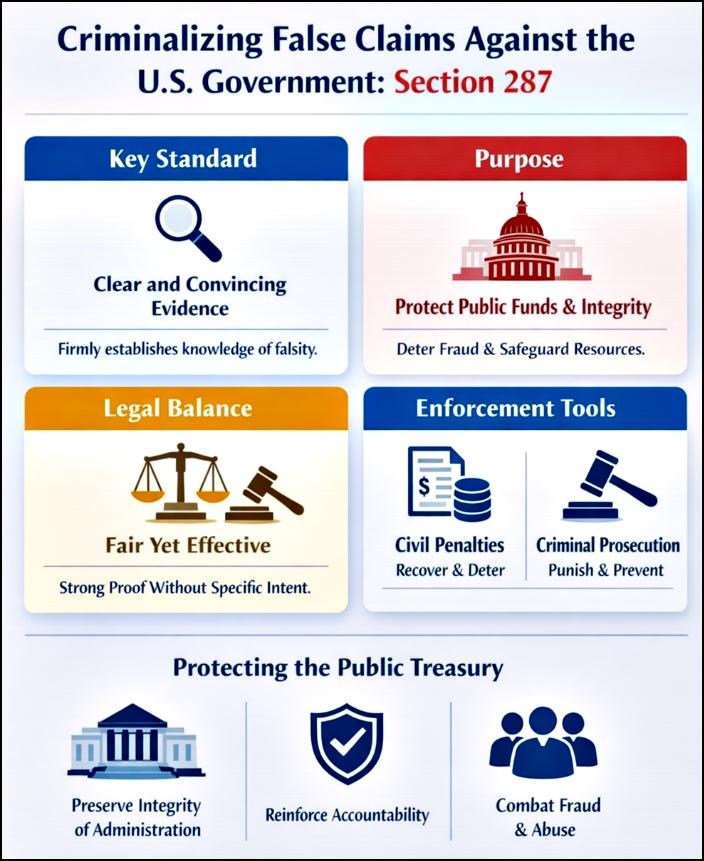
This article defends the application of the intermediate evidentiary standard—Clear and Convincing Evidence—to prosecutions under 18 U.S.C. § 287. Positioned between civil preponderance and criminal beyond-a-reasonable-doubt, the clear-and-convincing standard requires that the truth of a factual contention be highly probable. Section 287 criminalizes the knowing presentation of false claims to the United States but does not include specific intent to defraud as an element. Treating Section 287 as if it required proof of a defendant’s inner moral culpability at the highest criminal standard would misconstrue statutory design, frustrate enforcement, and permit wrongful escape from liability through purely subjective denials of intent. By distinguishing “knowledge” from “specific intent,” situating Section 287 within the logic of public-welfare regulatory offenses, and examining enforcement consequences, this article shows that a clear-and-convincing burden both honors defendants’ rights and preserves a workable remedial and deterrent regime. The analysis proceeds from doctrinal foundations through statutory interpretation and policy consequences, concludes with practical guidance for prosecutors and courts, and includes comparative tables mapping burdens, mental states, and enforcement divides between civil and criminal remedies.
Introduction
The United States evidentiary architecture assigns different burdens to different adjudicative contexts: the civil preponderance standard governs most private disputes, while the criminal beyond-a-reasonable-doubt (BRD) standard protects individual liberty and avoids conviction absent near-certain proof. Between these poles lies the clear-and-convincing standard—an intermediate tier designed for cases implicating significant interests without requiring the moral certainty associated with BRD. The evidentiary choice becomes consequential when applied to statutes like 18 U.S.C. § 287, which penalizes the submission of false claims to the federal government. A literal view that every criminal-code provision demands BRD proof conflates placement in the United States Code with element-specific mens rea design; it neglects Congress’s choice to criminalize knowing conduct rather than requiring proof of a wicked heart or specific intent to defraud. This article argues that clear and convincing evidence is the appropriate standard for the knowledge element in Section 287: it aligns with statutory text and purpose, preserves prosecutorial efficacy, and respects constitutional and fairness concerns by demanding a high probability of culpable knowledge without imposing an unattainable burden.
Legal Discussion: Concepts And Application
The Evidentiary Spectrum And The Role Of Clear And Convincing Evidence
The American legal system recognizes an evidentiary spectrum: preponderance of the evidence (more likely than not), clear and convincing evidence (highly probable), and beyond a reasonable doubt (moral certainty). Clear and convincing evidence requires that the trier of fact form a firm belief in the truth of the allegation—substantially more persuasive than a 51% showing but not the near-absolute assurance BRD demands. Its doctrinal role is to allocate risk and stigma where significant interests are implicated (e.g., termination of parental rights, certain fraud or administrative matters) but where the legislature has not embedded the highest criminal mens rea in the offense.
Knowledge Versus Specific Intent: Doctrinal Distinctions
A critical distinction for Section 287 is between the mental-state predicates of “knowledge” and “specific intent.” Specific intent implicates a purposeful, often morally condemnatory state of mind—the culpable desire to achieve a proscribed result. Knowledge, by contrast, requires awareness of facts (for instance, awareness that a claim is false) without proof of a particularized motive to defraud. When a statute frames culpability around knowing conduct rather than specific intent, it signals a different evidentiary and policy choice: the legislature seeks to criminalize risky or dangerous conduct that harms public interests even where proving a defendant’s subjective wickedness would be impractical.
Section 287: Statutory Design, Legislative Intent, And Public-Welfare Logic
Although Section 287 resides in the criminal code, its textual framing emphasizes the knowing presentation of false claims rather than proof of malevolent motive. Congress’s principal aim—protecting the public treasury and administrative integrity—resembles the objectives of public-welfare statutes, which often impose liability on the basis of knowledge or lesser mens rea to ensure compliance and deterrence. Interpreting Section 287 as demanding BRD proof of specific intent would both contravene statutory design and undermine Congress’s remedial objectives by transforming an administratively important criminal prohibition into an almost unenforceable statute.
Enforcement Consequences Of An Inappropriate Burden
Applying a BRD-specific-intent rule to Section 287 would create practical enforcement gaps. Defendants could successfully assert absence of malicious intent even when documentary or circumstantial evidence demonstrates knowing falsity, thereby escaping punishment and allowing fraud against the treasury to continue. Conversely, maintaining a clear-and-convincing standard for knowledge ensures prosecutors face a meaningful evidentiary burden while preserving the ability to vindicate public fiscal interests through criminal sanctions where appropriate.
Aligning Burden With Regulatory Crime Logic: A Principled Middle Ground
Regulatory and public-welfare offenses focus on preventing collective harm; they often criminalize knowingly false statements or submissions because the act itself endangers public administration. The clear-and-convincing standard is a principled compromise: it demands persuasive proof of knowledge—documentary corroboration, consistent testimony, circumstantial indicia—without requiring proof of a defendant’s inner wickedness to an almost impossible degree. This balance prevents both under-enforcement and unfair overreach, thereby maintaining constitutional protections and legislative intent.
Comparative Tables
Table 1: Burden, Mental State, And Typical Application
| Burden of Proof | Mental-State Element Required | Typical Application |
|---|---|---|
| Preponderance of the Evidence | Often negligence or ordinary civil standards | Ordinary civil disputes; most civil liability |
| Clear and Convincing Evidence | Knowledge or strong proof of culpability (not specific intent) | Regulatory/public-welfare offenses; certain civil matters implicating significant interests |
| Beyond a Reasonable Doubt | Specific intent or moral culpability (high certainty) | Traditional criminal convictions requiring mens rea (murder, theft) |
Table 2: The Enforcement Divide Between Civil And Criminal Liability
| Aspect | Civil FCA (31 U.S.C. §§ 3729–3733) | Criminal False Claims (18 U.S.C. § 287) |
|---|---|---|
| Nature of Case | Civil enforcement for fraud against the government | Criminal prosecution for knowingly submitting false claims |
| Burden of Proof | Preponderance of probability (lower burden of proof) | Above preponderance but below beyond a reasonable doubt (higher but not highest) |
| Penalties | Treble damages + per-claim penalties (up to ~$27,000 each) | Up to 5 years’ federal imprisonment per violation; fines up to $250,000 (individuals) or $500,000 (organizations) |
| Who Brings the Case | DOJ Civil Division or whistleblower (qui tam) | DOJ Criminal Division or U.S. Attorney’s Office |
| Examples of Conduct | Overbilling, false certifications, misrepresenting compliance | Fabricating invoices, falsifying test results, submitting fictitious claims |
| Overlap | Civil findings often trigger criminal probes | Criminal convictions can support civil recovery |
Analysis Of Table 2
Civil FCA enforcement emphasizes restitution and penalties calibrated to recovery and deterrence even when intent is difficult to prove; criminal enforcement targets knowing conduct and carries punitive sanctions including imprisonment. Together, civil and criminal paths form a complementary deterrent and remedial architecture: civil actions recover funds and impose penalties, while criminal prosecutions secure punishment and ancillary consequences that reinforce compliance.
The “Knowingly” Standard, Conscious Avoidance, And Case Law
The statutory hierarchy of mental states—from purposeful intent down to negligence—defines thresholds for liability. Under Section 287, the statute’s focus on “knowingly” submitting false claims permits criminal prosecution without proving specific intent to defraud. Judicial interpretation has refined the contours of “knowledge” in this context.
Key judicial holdings:
(1) United States v. Maher: Courts held that prosecutors need not prove specific intent to defraud; proof that the defendant knew the submissions were false suffices for Section 287 liability.
(2) United States v. Catano-Alzate: Courts emphasized that the falsity of claims and a defendant’s knowledge of that falsity constitute the core proof required.
These holdings illustrate the practical application of the clear-and-convincing approach to knowledge elements in false-claims prosecutions and reinforce the statutory scheme’s focus on protecting the public fiscal interests through fact-driven proof of awareness rather than attempts to divine inner motives.
Practical Guidance For Courts And Prosecutors
(a) Focus proof on objective indicia of knowledge: corroborated documents, inconsistent records, emails or communications, alterations, and contemporaneous admissions.
(b) Plead circumstantial chains that, when taken together, produce a firm belief of knowledge rather than mere conjecture.
(c) Jury instructions should communicate an intermediate burden—“highly probable” or “produce a firm belief”—distinguishing that standard from both simple preponderance and BRD, and clarifying that specific intent is not required.
(d) Maintain robust coordination between civil and criminal tracks: civil discovery and qui tam investigations often generate the documentary record necessary to meet the heightened knowledge standard in criminal prosecutions.
Conclusion
Section 287 represents a deliberate congressional choice to criminalize the knowing submission of false claims against the United States without layering on the nearly insurmountable requirement of proving specific intent to defraud. By situating the statute within the broader tradition of public‑welfare offenses, courts and prosecutors can appreciate its dual function: safeguarding the integrity of government operations and deterring opportunistic fraud that drains public resources. The clear‑and‑convincing standard provides the right evidentiary balance—demanding more than mere probability but stopping short of the moral certainty required for crimes of deep personal culpability.
This middle ground is not a dilution of criminal protections but a recognition of the unique stakes involved. The public treasury is a collective asset; fraud against it undermines trust in government, weakens fiscal stability, and erodes confidence in administrative systems. At the same time, defendants deserve protection against casual or speculative accusations. Clear and convincing evidence ensures that liability attaches only when knowledge of falsity is firmly established, thereby preserving fairness while enabling effective enforcement.
The comparative framework between civil False Claims Act enforcement and criminal Section 287 prosecutions underscores the complementary nature of these remedies. Civil actions recover funds and impose financial deterrents, while criminal prosecutions impose punitive sanctions that reinforce compliance norms. Together, they form a layered architecture of deterrence and restitution. If courts were to insist on proof beyond a reasonable doubt of specific intent, this architecture would collapse into under‑enforcement, leaving fraud unchecked and the public fisc vulnerable.
Practically, the adoption of a clear‑and‑convincing burden guides prosecutorial strategy and judicial instruction. It encourages reliance on documentary corroboration, circumstantial chains of inference, and consistent testimony rather than speculative attempts to divine inner motives. It also clarifies for juries the distinction between knowledge and intent, ensuring that verdicts rest on demonstrable awareness of falsity rather than conjecture about moral wickedness.
Ultimately, calibrating Section 287 prosecutions to the clear‑and‑convincing standard reflects a principled compromise between liberty and collective welfare. It honors constitutional protections by requiring substantial proof, while also fulfilling Congress’s intent to create a workable deterrent against fraud. In doing so, it strengthens the integrity of public administration, reinforces accountability, and ensures that the criminal law remains a practical tool for protecting the nation’s shared resources. Courts and prosecutors should therefore embrace this evidentiary middle ground as both doctrinally sound and pragmatically essential to the ongoing fight against fraud on the United States.