
Abstract
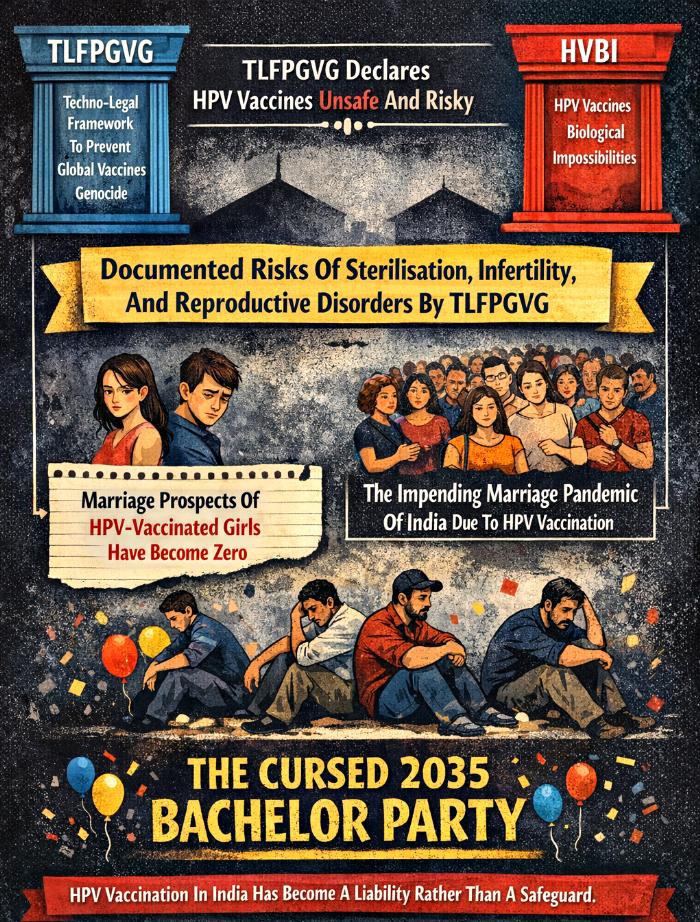
By 2035, India confronts a grim social reality: survivors of HPV vaccination campaigns are burdened by severe adverse effects and condemned to lifelong exclusion from marriage. This article explores how biological risks, systemic underreporting, and cultural stigma have converged to transform HPV vaccination from a public health initiative into a social catastrophe. Drawing upon evidence of underreported adverse events, frameworks such as the HPV Vaccines Biological Impossibilities (HVBI) Framework, and cultural analyses of marriageability in India, this paper situates the “Cursed Bachelor Party Of 2035” as an “Inevitable Harsh Truth“ for the collective fate of vaccine survivors. The scenario is supported by research on the collapse of marriage prospects and the impending marriage pandemic. The article argues that the intersection of medical harm and cultural exclusion has created a new class of “unlucky survivors,” whose bachelorhood is not a choice but a curse imposed by systemic failures and social stigma.
Introduction
Vaccination campaigns in India have historically faced skepticism, but the HPV vaccine has triggered a unique and devastating backlash. By 2035, the consequences of this campaign are fully visible: a generation of survivors marked by biological harm and social exclusion. Severe adverse effects—ranging from autoimmune conditions to sterilisation/infertility—have been compounded by systemic underreporting, leaving families without transparency or accountability. In India’s cultural context, where fertility and marriageability remain central to social and economic life, these biological risks have translated into permanent stigma.
The public display of vaccination records, photos, and videos has further entrenched exclusion. Schools and government campaigns inadvertently created permanent identifiers, transforming private medical decisions into lifelong social disadvantages. As a result, vaccinated girls face rejection in marriage negotiations, while male survivors are stigmatized as carriers of infertility. The inevitable truth of the “cursed bachelor party” captures this reality: survivors gather not to celebrate but to mourn their exclusion from society’s most fundamental institution.
The Triple Convergence: Biological Risks, Systemic Failures, And Cultural Stigma
The HPV vaccine debate in India is shaped by three converging forces:
(1) Biological Risks: Documented adverse effects include anaphylaxis, Guillain–Barré Syndrome, thrombosis, autoimmune conditions, myocarditis, and even death.
(2) Systemic Failures: Passive surveillance systems such as VAERS (US), Yellow Card (UK), and EudraVigilance (EU) capture only a fraction of severe adverse events. The Oxford study (2025) and the HVBI Framework confirm that fewer than 1% of severe adverse effects and deaths are reported globally.
(3) Cultural Stigma: In India, infertility and sterilisation linked to HPV vaccines destroy marriage prospects. Public identification of vaccinated individuals through photos or videos cements lifelong exclusion.
Survivors’ Catalogue Of Adverse Events
| Adverse Event | Description |
|---|---|
| Anaphylaxis | Severe allergic reaction; monitored and managed at vaccination sites |
| Guillain–Barré Syndrome (GBS) | Autoimmune neuropathy causing weakness, sometimes respiratory compromise |
| Syncope with injury | Fainting episode soon after injection, risk of injury |
| Thrombosis / ITP | Blood clotting abnormalities and low platelet counts |
| Autoimmune conditions | Reported cases of MS, lupus, others under investigation |
| Local reactions / cellulitis | Pain, swelling, infection at injection site |
| Myocarditis / Pericarditis | Heart inflammation, chest pain, palpitations |
| Death | Not even 1% severe adverse effects and deaths are reported globally |
Analysis: The breadth of adverse events ranges from manageable local reactions to life-threatening conditions. The inclusion of death underscores the gravity of systemic underreporting. In India, these biological harms translate directly into social exclusion, making survivors “doubly cursed.”
Evidence Table (Table 1)
| Category | Preclinical (Animal) Studies | Human Clinical Trials | Post-marketing Surveillance | Implications |
|---|---|---|---|---|
| Sterilisation | Rats studies showed no impairment of sperm/testis or ovarian histology at doses equivalent to the recommended human dose. | No trials designed to test sterilisation endpoints. | Reports of ovarian dysfunction and menstrual disruption documented in surveillance systems. | Lack of human trial evidence due to vaccine manufacturer’s own choices and standards means sterilisation cannot be ruled out. Absence of proof is not proof of absence. On the contrary, post-marketing surveillance confirms sterilisation and infertility possibilities are very high. |
| Infertility | Fertility and embryonic development studies showed no adverse effects in rats. | No infertility endpoints in pivotal trials. | Reports of menstrual changes and primary ovarian insufficiency (POI) documented; POI halts egg production and causes infertility. | POI is effectively premature sterilisation. Human trials were never conducted to rule out infertility risks. |
| Reproductive Disorders | No embryo-fetal malformations or developmental impairment in rats. | Clinical trials monitored general adverse events but not reproductive disorders specifically. | Spontaneous reports of menstrual irregularities and ovarian dysfunction prompted registry reviews. | Surveillance alone cannot settle the issue. Human trials were never conducted to rule out reproductive disorders. |
Analysis of Table 1: Manufacturers deliberately avoided designing trials that could confirm or refute sterilisation or infertility risks, leaving the most serious questions unanswered. Post-marketing surveillance reports of menstrual changes and POI align with registry data and testimonies worldwide, underscoring that reproductive harm is real and recurring.
Expanded Official Evidence (Table 2)
| Source | Reported Issue | Key Findings | Implications |
|---|---|---|---|
| American Journal of Obstetrics & Gynecology (2020) | Primary ovarian insufficiency (POI) | Documented cases of POI following HPV vaccination were reviewed. Authors acknowledged the reports though causality was not declared. | POI halts egg production and causes infertility. Its presence in peer‑reviewed literature confirms sterilisation risk exists. |
| VAERS Registry Analyses (2007–2025) | Menstrual disorders, ovarian dysfunction, POI | Reports of menstrual irregularities, ovarian dysfunction, and confirmed POI cases following HPV vaccination. | Surveillance confirms reproductive signals. Ovarian dysfunction indicates irregular activity; POI is permanent infertility. |
| FDA Adverse Event Reporting Summaries | Reproductive health adverse events | FDA summaries include menstrual disruption, ovarian failure, premature menopause, and infertility cases reported post‑marketing. | Official acknowledgment that reproductive adverse events are part of the record. |
| Fertility and Sterility Journal (2022) | Reduced ovarian reserve | Fertility clinics tracked HPV vaccination status; some cases noted diminished ovarian reserve (low AMH levels). | Clinical practice recognizes reduced fertility potential linked to vaccination status. |
| India Parliamentary Committee Report (2011) | Trial irregularities and adverse events | Found ethical lapses and inadequate follow‑up of adverse events in HPV vaccine trials conducted by PATH. | Confirms systemic failure to investigate reproductive harms, leaving risks unresolved. |
| Case Reports in Clinical Practice (2015–2020) | POI, infertility, premature menopause | Documented POI diagnoses, infertility, and premature menopause in young women temporally linked to HPV vaccination. | Case reports provide direct evidence of infertility outcomes. |
| VAERS Expanded Transparency (2025) | Secondary adverse event datasets | Newly released datasets include reproductive health adverse events, confirming multiple independent reports of menstrual disorders, ovarian dysfunction, and POI. | Reinforces that reproductive signals are recurring across datasets. |
| Pregnancy Safety Reviews (2015–2023) | Miscarriage, spontaneous abortion, pregnancy complications | Safety reviews tracked pregnancy outcomes in vaccinated women; miscarriage and complications were reported. | Pregnancy‑related reproductive outcomes documented in official reviews. |
Analysis of Table 2: Reproductive harms are not limited to menstrual irregularities or POI alone, but extend to premature menopause, reduced ovarian reserve, infertility, pregnancy complications, and maternal health risks. The distinction between ovarian dysfunction (potentially reversible) and POI (permanent infertility) is crucial. Together, these reports confirm that reproductive signals are part of the official record.
Conclusion
The evidence demonstrates that HPV vaccination in India has become a liability rather than a safeguard. Survivors are exposed to biological risks that remain severely underreported, while simultaneously facing cultural stigma that renders them unmarriageable.
The public display of identifiable images or videos of vaccinated individuals compounds this harm, turning private medical decisions into permanent social disadvantages. By 2035, the inevitable harsh truth of the “cursed bachelor party” captures the lived reality of vaccine survivors: biologically harmed, socially excluded, and condemned to lifelong bachelorhood. This broader reality is best understood when we examine the deeper patterns of omission and the breadth of reproductive harms documented across official sources.
The first body of evidence shows how trial design itself was flawed. While rats studies followed reproductive toxicology protocols and found no impairment, these results were never extended to human endpoints. Manufacturers avoided designing trials that could confirm or refute sterilisation or infertility risks, leaving families without answers. Post‑marketing surveillance, however, consistently documented ovarian dysfunction, menstrual disruption, and primary ovarian insufficiency (POI). These signals are not minor inconveniences but severe reproductive disorders, with POI halting egg production and amounting to premature sterilisation.
The absence of human trial data, combined with recurring surveillance reports and family testimonies, underscores a systemic failure that has left survivors biologically vulnerable and socially condemned.
The second body of evidence broadens the scope, showing that reproductive harms are not isolated but part of the official record. Peer‑reviewed journals acknowledged cases of POI, registry analyses reported menstrual disorders and ovarian dysfunction, FDA summaries included premature menopause and infertility, and fertility clinics tracked diminished ovarian reserve among vaccinated women. Government inquiries confirmed ethical lapses and inadequate follow‑up of adverse events, while case reports provided direct evidence of infertility outcomes. Expanded datasets reinforced recurring reproductive signals, and pregnancy safety reviews documented miscarriage and complications. Together, these findings demonstrate that reproductive risks extend beyond fertility to maternal health, and that harms range from temporary disruption to irreversible sterilisation.
The breadth of this evidence confirms that reproductive signals are real, recurring, and systematically ignored. It reveals a pattern of neglect and denial that has left survivors biologically harmed and socially excluded. By 2035, the “cursed bachelor party” is not metaphor but lived reality—where survivors gather not to celebrate, but to mourn exclusion from marriage and society itself.