
The Safest Vaccine In The World Is No Vaccine: TLFPGVG
Abstract
The invocation of “scientific consensus” has become the most common rhetorical defense against critiques of mainstream medical and scientific narratives. Yet consensus is not science; it is a sociological construct, often manufactured through treachery, fabrication, financial distortion, and systemic scams. This article dismantles the consensus excuse by examining four interrelated concepts: Settled Science Treachery, Fabricated Scientific Consensus, Funding Biases, and the PRPRL Scam. Each reveals how consensus is engineered to silence dissent, protect entrenched interests, and enforce conformity. By exposing these mechanisms, the article demonstrates that consensus is not evidence but a carefully constructed illusion. The conclusion argues that defeating the consensus excuse is essential for restoring the integrity of science and enabling genuine solutions to emerge.
Introduction
Whenever alternative frameworks challenge dominant medical or scientific narratives, defenders retreat to the phrase: “scientific consensus says otherwise.” This appeal to consensus is treated as the ultimate trump card, shutting down debate and delegitimizing dissent. Yet history shows that consensus has often been wrong, sometimes catastrophically so. From geocentrism to tobacco denial, consensus has delayed truth and perpetuated harm.
This article argues that consensus is not a scientific principle but a rhetorical device. It is manufactured through institutional treachery, fabricated unanimity, financial bias, and systemic scams. To dismantle the consensus excuse, we must expose these mechanisms in detail. Only then can we clear the ground for genuine solutions that restore science to its true method: falsification, reproducibility, and open inquiry.
The Consensus Illusion: A Framework Of Treachery And Fabrication
Table 1: Four Mechanisms Of Consensus Distortion
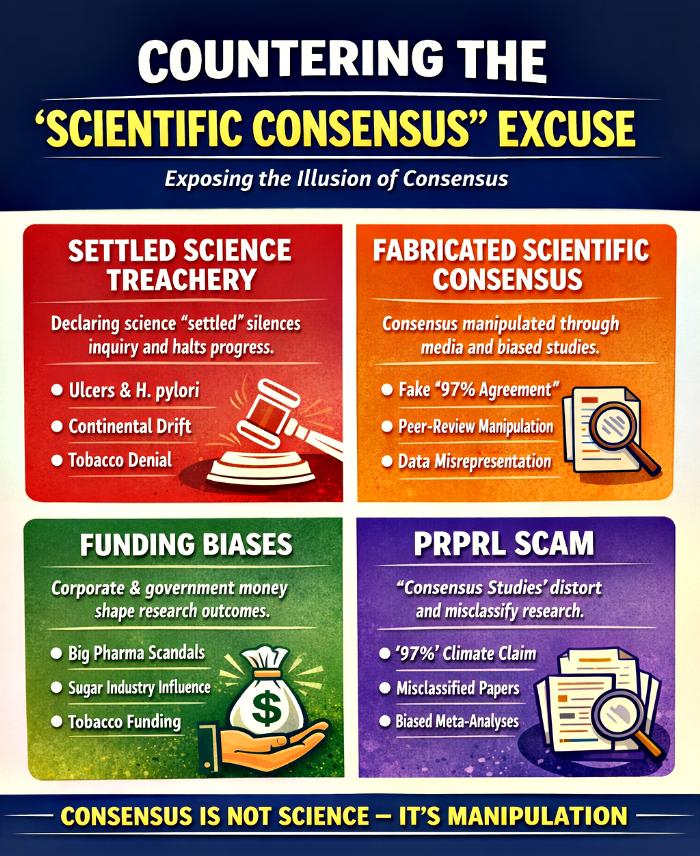
Before analyzing each concept, it is important to present them together as a holistic framework. The table below outlines the four mechanisms that collectively sustain the illusion of consensus.
| Concept | Core Idea | Mechanism of Consensus Distortion | Implication | Analytical Explanation |
|---|---|---|---|---|
| Settled Science Treachery | Declaring science “settled” is treachery against inquiry. | Media, institutions, and funding bodies label dissent as denial, freezing scientific progress. | Suppresses innovation and marginalizes alternative paradigms. | History shows “settled science” often collapses under new evidence (e.g., ulcers, continental drift). Consensus becomes a weapon to silence truth. |
| Fabricated Scientific Consensus | Consensus is often manufactured, not organic. | Peer‑review manipulation, selective meta‑analyses, and media amplification. | Creates illusion of unanimity where none exists. | Examples like the “97% climate consensus” reveal how neutral or dissenting papers are misclassified to fabricate agreement. |
| Funding Biases | Financial interests distort research outcomes. | Corporate, governmental, and institutional funding gatekeep dissent. | Predetermined agendas dominate, delaying paradigm shifts. | Tobacco, sugar, opioids, and pharma scandals show how funding biases enforce consensus and erode trust. |
| PRPRL Scam | A “super scam” that fabricates overwhelming consensus. | Consensus studies selectively reinterpret prior works, misclassify papers, and amplify bias. | Creates false authority by layering biased reviews. | Cook et al. (2013) and similar studies misclassified papers to claim near‑total consensus, despite protests from included authors. |
Analytical Discussion
(1) Settled Science Treachery
The declaration of “settled science” is treachery against inquiry. Science is inherently provisional, always open to falsification and revision. Yet institutions and media often weaponize the phrase to silence dissent and protect entrenched interests. Ulcers were long attributed to stress until H. pylori was proven to be the bacterial cause. Alfred Wegener’s theory of continental drift was ridiculed until plate tectonics vindicated him. Tobacco companies exploited “settled science” to deny harm. In each case, consensus delayed truth and perpetuated harm.
Settled Science Treachery reveals that consensus is not a marker of reliability but of stagnation. It freezes progress, marginalizes alternative paradigms, and transforms science into dogma. By exposing this treachery, we reclaim science as a dynamic process of questioning, not a static monument to conformity.
(2) Fabricated Scientific Consensus
Consensus is often manufactured rather than discovered. Through selective peer‑review, biased meta‑analyses, and media amplification, the illusion of unanimity is created where none exists. The “97% climate consensus” is a case in point: Cook et al. (2013) misclassified neutral or dissenting papers as endorsements, inflating agreement. Scientists like Richard Tol and Nir Shaviv publicly protested their inclusion.
Fabricated Consensus demonstrates how institutions engineer agreement by redefining categories, excluding dissent, and amplifying only one narrative. Far from being a measure of truth, consensus becomes a propaganda tool. It delegitimizes genuine scientific debate and enforces conformity, turning science into a political weapon rather than a method of discovery.
(3) Funding Biases
Financial interests are perhaps the most powerful force shaping consensus. Corporate, governmental, and institutional funding gatekeep dissenting research, ensuring that only predetermined agendas dominate. The tobacco industry funded “doubt” research to delay regulation. The sugar industry paid Harvard scientists to downplay sucrose risks. Pharma scandals like Vioxx and the opioid crisis reveal how funding biases distort outcomes, suppress adverse findings, and enforce consensus favorable to industry.
Funding Biases show that consensus is not the product of independent inquiry but of financial engineering. Trust in science collapses when funding dictates what is “true.” By exposing funding biases, we reveal that consensus is often the echo of money, not the voice of evidence.
(4) PRPRL Scam
The Peer‑Review of Peer‑Reviewed Literature Scam (PRPRL Scam) is the most insidious mechanism of consensus fabrication. It layers bias upon bias: consensus studies selectively reinterpret prior works, misclassify neutral papers as endorsements, and amplify only aligned voices. Cook et al. (2013) is emblematic, claiming near‑total consensus by misclassifying papers and ignoring author protests.
PRPRL Scam weaponizes the peer‑review system itself, turning it into a machine for manufacturing consensus rather than testing truth. By stacking biased reviews, it creates false authority and makes dissent invisible. This “super scam” demonstrates that consensus is not evidence but illusion, carefully engineered to suppress inquiry and enforce conformity.
Conclusion
The phrase “scientific consensus says otherwise” is not a scientific principle but a rhetorical shield. It is sustained by treachery, fabrication, financial bias, and systemic scams. By dismantling these mechanisms, we expose consensus as an illusion rather than evidence.
Defeating the consensus excuse is essential for restoring the integrity of science. Only when consensus is stripped of its false authority can genuine solutions emerge — solutions rooted in falsification, reproducibility, and open inquiry. This article has shown that consensus is not the end of debate but the beginning of treachery. To reclaim science, we must reject consensus as a substitute for truth and insist on evidence as the only legitimate foundation.