
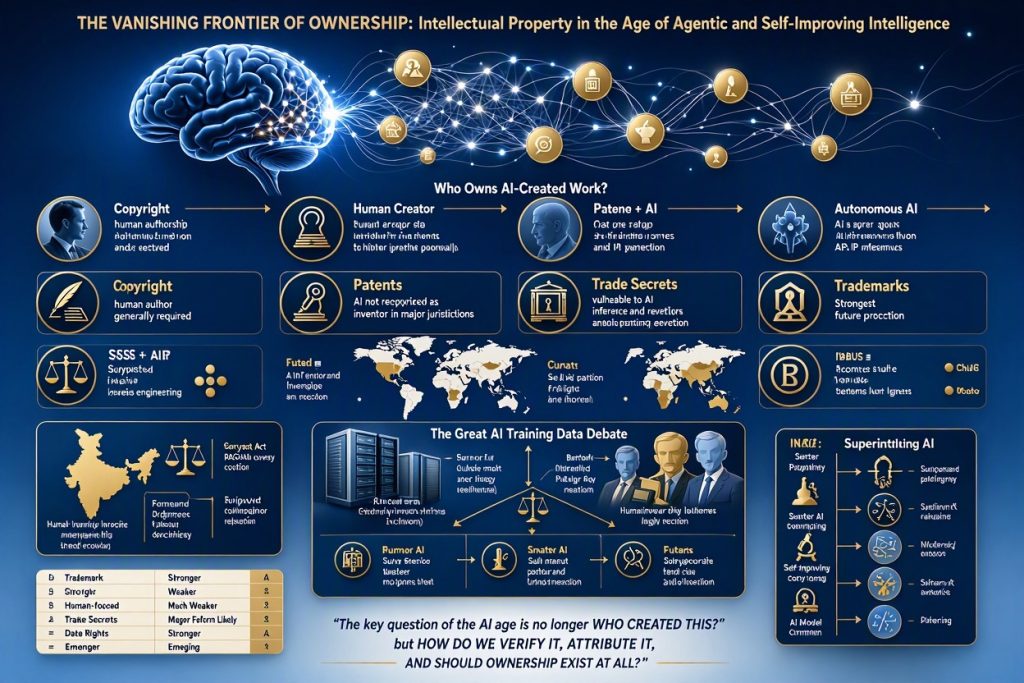
The emergence of artificial intelligence has triggered one of the most profound challenges ever faced by intellectual property law. For centuries, copyright, patents, trademarks, and trade secrets were developed around a fundamental assumption: that creativity, invention, and innovation originate from human minds. Modern AI systems now generate text, images, music, software, engineering designs, scientific hypotheses, and potentially even inventions with diminishing levels of direct human involvement. As AI evolves from a passive tool into an autonomous and increasingly agentic participant in innovation, the traditional foundations of intellectual property rights are being questioned across the world.
At the center of the debate lies the question of ownership. If an AI system creates a novel painting, writes a book, discovers a new drug candidate, or develops a software architecture, who should own the resulting intellectual property? Existing legal systems largely answer this question by insisting on human involvement. In the United States, copyright law continues to require human authorship, and works generated entirely by AI generally do not qualify for copyright protection. Where AI is merely a tool assisting a human creator, copyright may subsist in the human contributions, but not necessarily in the machine-generated portions. Similar human-authorship principles are visible across many jurisdictions, including most European countries and Japan. The prevailing legal philosophy remains that creativity worthy of copyright protection must originate from human intellectual activity rather than autonomous machine processes.
Patent law has adopted an even stricter position. The now famous DABUS cases tested whether an artificial intelligence system could legally be recognized as an inventor. Patent offices and courts in major jurisdictions rejected this proposition, concluding that inventorship must remain tied to a human being. The legal reasoning is straightforward: inventors are required to possess legal personality, hold rights, make declarations, and transfer interests, all of which are attributes unavailable to machines. Consequently, even where AI plays a substantial role in generating inventive concepts, patent ownership currently depends on identifying a human inventor who contributed to the inventive process.
The challenges extend beyond AI-generated outputs to the training of AI systems themselves. Generative AI models are trained on enormous datasets containing books, articles, images, music, software code, and other copyrighted materials. This has given rise to a global dispute over whether such training constitutes lawful learning or unlawful copying. Technology companies frequently argue that AI training is transformative and analogous to humans reading and learning from existing works. Rights holders, on the other hand, contend that the creation of training datasets involves extensive reproduction and exploitation of copyrighted content without authorization or compensation. The legal outcome of these disputes will significantly influence the future structure of the AI industry and the balance between innovation and creators’ rights.
Another contentious issue concerns artistic and creative styles. Artificial intelligence can generate content that closely resembles the styles of renowned authors, musicians, painters, and filmmakers. While copyright traditionally protects particular expressions rather than artistic styles themselves, the distinction becomes increasingly difficult to sustain when AI can replicate stylistic characteristics at scale. As generative systems continue to improve, legal systems may be forced to reconsider whether existing copyright doctrines adequately protect creative identities.
The rise of AI also challenges conventional ideas surrounding reverse engineering. Reverse engineering has historically occupied a complex legal space. In many countries, it is permitted under certain conditions, particularly when conducted for interoperability, security research, education, or competitive analysis. The European Union expressly recognizes limited rights to study, test, and even decompile software where necessary to achieve interoperability between independently created programs. EU law distinguishes between copying protected expression and examining underlying ideas and functional principles.
Japan has similarly adopted relatively permissive approaches in areas related to text and data mining and AI development. Japanese copyright guidance seeks to balance rightsholder interests with technological innovation and contains broad provisions facilitating certain forms of AI training and computational analysis of copyrighted materials.
The significance of reverse engineering is likely to increase dramatically as AI systems become more autonomous. Agentic AI systems may eventually be capable of disassembling software, reconstructing source code, reverse-engineering hardware architectures, identifying design principles, and generating functional alternatives with minimal human involvement. Activities that once required specialized teams of engineers working for months could potentially be completed within hours. If this occurs, trade secrets and other forms of practical exclusivity may become increasingly difficult to maintain. The central challenge would shift from preventing access to managing rapid replication.
India occupies a uniquely important position within these debates because it combines a rapidly growing digital economy, a strong creator ecosystem, a globally significant software industry, and a tradition of balancing intellectual property protection with broader public interests. Unlike some jurisdictions that have already issued substantial guidance on AI-generated works, India’s legal position remains partially open and evolving.
Indian copyright law contains a provision that has attracted significant attention in AI discussions. Section 2(d)(vi) of the Copyright Act, 1957, states that, in the case of a computer-generated work, the author shall be the person who causes the work to be created. Although this language appears relevant to AI-generated content, it was introduced long before the rise of modern generative AI. Consequently, considerable uncertainty exists regarding how courts should interpret the provision when autonomous AI systems are involved. Legal commentators have argued that the provision was intended for computer-assisted creation rather than independent machine creativity.
This uncertainty became particularly visible in relation to the artwork known as “Suryast,” in which the AI system RAGHAV was initially listed alongside a human creator. The subsequent controversy highlighted an unresolved question within Indian law: whether artificial intelligence can itself be regarded as an author. The dispute demonstrated that existing legal categories are increasingly strained by technologies capable of generating creative outputs with limited human intervention.
While copyright remains unsettled, India’s patent position has become considerably clearer. The Indian Patent Office rejected the DABUS patent application and concluded that artificial intelligence cannot be recognized as a “true and first inventor” under the Patents Act, 1970. The decision aligned India with the prevailing international trend and reaffirmed the principle that inventorship remains a human-centric legal concept. AI-assisted inventions may still be patented, provided a human inventor can be identified and the legal requirements for inventorship are satisfied.
India is also emerging as a major battleground regarding AI training data. Significant litigation and policy discussions are underway concerning whether copyrighted materials may be used to train generative AI systems and, if so, under what conditions. Recent governmental discussions have considered licensing frameworks and other regulatory approaches aimed at balancing technological innovation with the economic interests of creators and publishers. These debates suggest that India may play a major role in shaping global AI governance over the coming decade.
Looking further into the future, the most disruptive force may not be generative AI itself but the combination of agentic AI and recursive self-improvement. Recursive self-improvement refers to AI systems that can enhance their own capabilities, create more effective successors, and continuously accelerate their intellectual performance. If such systems emerge, many assumptions underlying intellectual property law may become obsolete.
Copyright has traditionally relied on scarcity, because producing high-quality creative works required significant time, effort, expertise, and investment. A world in which AI can produce millions of books, songs, artworks, and software applications at negligible cost fundamentally changes this equation. Copyright law may increasingly focus on protecting human authenticity, identity, reputation, and provenance rather than mere content generation.
Software copyright may be especially vulnerable. If advanced AI systems can observe software behavior and generate equivalent implementations without copying original code, the practical value of software copyright could diminish. Competitive advantages might shift toward data ownership, network effects, distribution ecosystems, and trusted brands instead of copyright exclusivity.
Trade secrets could face even greater pressure. Trade secret protection depends entirely upon maintaining secrecy. Highly capable AI systems may become extraordinarily effective at inferring hidden processes, reconstructing proprietary techniques, identifying manufacturing methods, or discovering confidential algorithms from observable outputs. In such a world, preserving secrecy may become increasingly expensive and difficult.
Patent systems may experience the most profound transformation. Traditional patent law assumes that inventions are scarce and that society benefits when inventors disclose them in exchange for temporary exclusivity. However, if advanced AI systems continuously generate massive numbers of inventions, discoveries, and technical solutions, patent offices could become overwhelmed. Novelty assessment would become increasingly difficult, and the economic rationale for granting lengthy monopolies may weaken. Future societies may experiment with alternative mechanisms such as shorter patent terms, compulsory licensing regimes, innovation prizes, or entirely new categories of rights designed specifically for AI-generated innovations.
Among all intellectual property rights, trademarks appear the most resilient. Regardless of how advanced AI becomes, markets will continue to value trust, reputation, quality assurance, and source identification. Consumers will still need reliable indicators of origin when selecting products and services. Consequently, trademarks may grow in importance as other forms of exclusivity become less effective.
The long-term trajectory of intellectual property appears increasingly clear. The legal systems of the industrial age were designed to reward the creation of scarce intellectual assets. The emerging age of artificial intelligence may force legal systems to protect something different: authenticity rather than creation, reputation rather than production, verification rather than originality, and control over scarce real-world resources rather than control over infinitely reproducible information. In this sense, the rise of agentic and self-improving AI is not merely creating new intellectual property disputes. It is gradually reshaping the very purpose for which intellectual property law exists.