
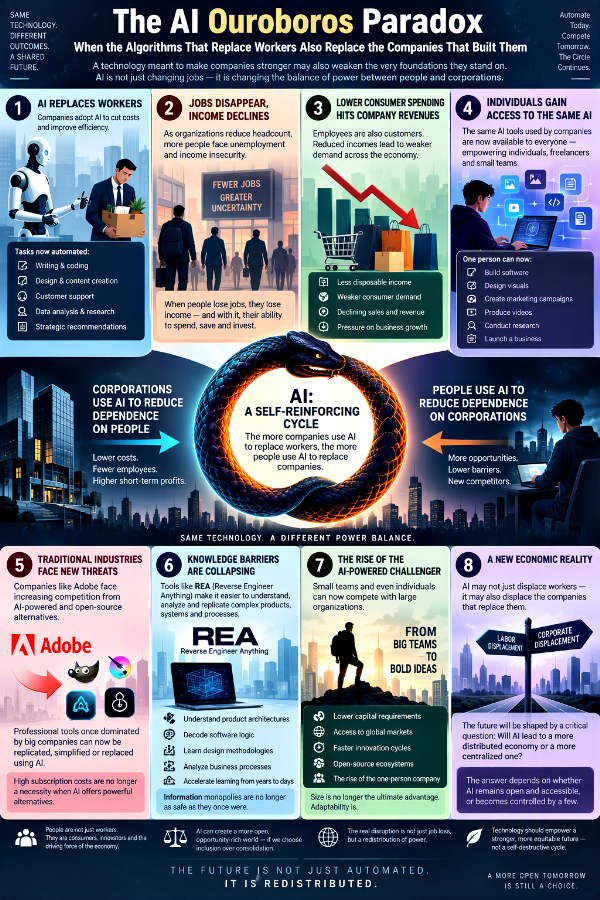
For decades, every major technological revolution has been justified through a familiar promise: while some jobs may disappear, new industries, opportunities, and forms of prosperity will eventually emerge. Artificial Intelligence, however, appears to be challenging this assumption in ways that previous technologies never did. Unlike the industrial machines of the past that primarily automated physical labor, AI is increasingly capable of automating cognitive work, including writing, coding, designing, analyzing, researching, and even making strategic recommendations. As organizations across the world race to integrate AI into their operations, much of the public debate has centered on one concern: the possibility of widespread job losses. Yet there is another, less discussed consequence that may prove equally significant. The same AI tools that corporations are using to reduce their dependence on workers are also empowering individuals to reduce their dependence on corporations. This creates a profound paradox in which AI may simultaneously weaken labor and the firms and models that seek to replace labor with technology.
The business case for AI adoption is straightforward. Companies have always sought ways to improve productivity while reducing costs, and labor has historically represented one of the largest operational expenses. If AI systems can write software, create visual designs, answer customer queries, analyze market trends, draft reports, and perform many other knowledge-based tasks, then organizations naturally see an opportunity to reduce headcount while maintaining or even increasing output. Executives often view this transformation as a necessary step in remaining competitive in an increasingly automated marketplace. Shareholders frequently welcome such efficiencies because lower operating costs can translate into higher profits and stronger financial performance.
However, this perspective often overlooks a critical economic reality. Employees are not merely workers; they are also consumers. The salaries paid by companies eventually become the purchasing power that sustains demand within the broader economy. When large numbers of organizations simultaneously replace workers with AI systems, the resulting reduction in employment opportunities can have consequences that extend far beyond individual businesses. As income levels decline or employment becomes less secure, consumer spending inevitably weakens. The very customers on whom businesses rely to purchase products and services may find themselves with fewer financial resources. In this sense, the widespread adoption of AI for workforce reduction could create a self-reinforcing cycle in which increasing efficiency undermines the purchasing power that supports economic growth.
At the same time, a second and potentially more disruptive phenomenon is unfolding. While corporations are deploying AI to reduce labor costs, individuals are gaining access to the same technologies. For most of modern economic history, sophisticated capabilities required significant resources. Launching a business often demanded sizable capital investments, large teams, specialized expertise, and access to expensive infrastructure. Today, AI is dramatically lowering these barriers. A single individual equipped with advanced AI tools can perform activities that previously required entire departments. Software development, graphic design, content creation, research, marketing, and business planning are increasingly being augmented by AI systems capable of accelerating productivity and reducing the need for specialized personnel.
This democratization of capability is one of the most transformative aspects of the AI revolution. Rather than concentrating power exclusively in large corporations, AI is distributing productive capacity to independent creators, entrepreneurs, freelancers, and small startups. A motivated individual can now design products, build applications, develop marketing strategies, and compete with established firms at a fraction of the historical cost. The rise of AI-assisted entrepreneurship suggests that while jobs may disappear in traditional organizational structures, entirely new forms of economic participation may emerge outside those structures.
The creative software industry provides a useful example of these changing dynamics. Companies such as Adobe have spent decades building highly successful ecosystems around professional tools like Photoshop, Illustrator, Premiere Pro, and After Effects. These products became industry standards because they combined sophisticated functionality with strong brand recognition and extensive user communities. However, the emergence of AI-powered tools and increasingly capable open-source alternatives has begun to challenge the traditional value proposition of proprietary software. Many users now question whether expensive subscriptions remain necessary when AI-driven tools can produce acceptable or even impressive results with significantly lower costs and reduced learning curves.
The issue is not whether Adobe or similar companies will disappear. Rather, the example illustrates a broader structural shift. Historically, software companies derived much of their value from exclusive functionality and steep expertise requirements. AI is changing this relationship by transforming intelligence itself into a user interface. Features that once took years to develop and master can increasingly be replicated, simplified, or automated. As a result, competitive advantages built on complexity may become less durable than they were in previous technological eras.
This transformation extends beyond software. AI is steadily eroding several traditional advantages enjoyed by large corporations. Access to specialized talent, one of the most powerful organizational assets, becomes less decisive when AI can amplify the productivity of smaller teams. Capital requirements diminish as cloud infrastructure and open-source AI frameworks and repositories become more accessible. Research and development cycles accelerate as AI systems help generate code, analyze data, and test solutions. Even distribution advantages are challenged as digital platforms enable entrepreneurs to reach global audiences directly. The result is an environment in which small teams, and in some cases even individuals, can compete with organizations many times their size.
Within this context, tools such as REA, or Reverse Engineer Anything, take on significance far beyond their technical capabilities. They symbolize a larger movement toward the democratization of knowledge. Throughout history, companies have often maintained competitive advantages because they possessed specialized expertise that was difficult for outsiders to access or understand. Technical processes, design methodologies, product architectures, and operational know-how functioned as barriers protecting established organizations from new competitors. AI-powered reverse engineering tools threaten to weaken these barriers by making complex information more accessible and understandable to a wider audience.
When individuals can use AI systems to analyze products, understand workflows, decode software architectures, and learn sophisticated techniques rapidly, the value of information monopolies begins to decline. Knowledge that once took years of education or professional experience to acquire can increasingly be understood in far shorter periods. This does not eliminate the importance of expertise, but it does compress learning curves and lower entry barriers. In industries where knowledge constitutes the primary source of competitive advantage, such developments could fundamentally alter the competitive landscape.
The emergence of AI therefore introduces a new kind of economic competition. For much of the industrial and digital eras, competition primarily occurred between firms. Success depended on which company could build better products, hire better talent, or secure greater resources. AI introduces the possibility of a different model in which companies compete not only with other companies but also with distributed networks of AI-empowered individuals. Open-source communities, independent developers, and small entrepreneurial teams can collectively challenge organizations that once appeared untouchable.
This shift raises an intriguing possibility. Much of today’s conversation focuses on labor displacement, yet corporate displacement may ultimately become an equally important story. Organizations that aggressively use AI to reduce workforces may inadvertently accelerate the emergence of AI-enabled competitors. Workers who lose opportunities within traditional firms may leverage the same technologies to create alternatives, launch startups, contribute to open-source ecosystems, or develop competing products. In this scenario, AI does not simply redistribute work; it redistributes productive power.
History suggests that technological revolutions rarely benefit only the incumbents. The dominant players of one era often struggle to maintain their leadership in the next. Mainframe giants gave way to personal computing pioneers. Many early internet leaders faded as new platforms emerged. Mobile computing transformed entire industries and displaced companies that once seemed invincible. There is little reason to assume that the AI revolution will be different. The organizations that thrive may not necessarily be the largest or the richest, but rather those that best adapt to a world in which intelligence itself becomes widely available.
The central question facing society is therefore much larger than whether AI will eliminate jobs. A more profound issue is what happens when both labor advantages and corporate advantages become increasingly automated and democratized. If AI empowers individuals as much as it empowers institutions, economic power may become more broadly distributed than many expect. Conversely, if access to AI infrastructure becomes concentrated in the hands of a few dominant players, power may become even more centralized. The future will likely be shaped by the tension between these competing forces.
The ancient symbol of the Ouroboros, a serpent consuming its own tail, offers a compelling metaphor for this moment. Companies deploy AI to reduce their reliance on human workers. Those same workers gain access to AI technologies and use them to challenge the companies that displaced them. Open-source communities replicate functionalities once considered proprietary. Entrepreneurs build alternatives to established platforms. In pursuing ever greater efficiency, corporations may inadvertently cultivate the very forces that undermine their own dominance.
The greatest disruption of AI may therefore not be the replacement of workers alone. It may be the emergence of a self-reinforcing cycle in which AI simultaneously weakens labor’s dependence on corporations and corporations’ dependence on labor, reshaping the balance of economic power in ways that are still difficult to predict. The ultimate irony is that the most transformative technology of the twenty-first century may not simply replace people. It may also challenge the very institutions that believed they would be its primary beneficiaries.