
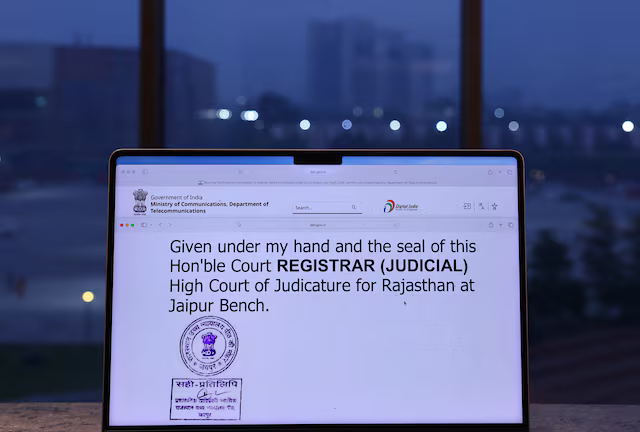
India’s government ordered internet providers to block 129 illegal betting websites this year based on two state high court orders that Reuters discovered were complete forgeries. The discovery reveals a startling vulnerability in one of the world’s strictest content removal mechanisms, where official directives were issued without verifying the authenticity of the underlying legal mandates.
The Department of Telecommunications issued the blocking directions on July 21 and September 2. Both directives were posted on the government’s official website as part of its routine transparency uploads, but they were accompanied by emailed copies of purported court orders from high courts in Rajasthan and Uttar Pradesh.
A detailed review by Reuters found that neither of these orders existed in the online registration records of the respective courts. This disconnect suggests a critical failure in the government’s vetting process before executing wide-scale internet censorship.
When questioned by Reuters, the registrar of the Rajasthan High Court confirmed via email that the order bearing the court’s name appeared to be fraudulent. The court stated explicitly that the document did not exist on its servers, though it provided no further details on how the forgery occurred.
The situation in Uttar Pradesh was even more severe. Prompted by the findings of the Reuters investigation, the Allahabad High Court filed a formal police complaint on November 6. This action triggered a criminal investigation into the fake order.
Police case documents reveal that the probe is targeting unknown persons for alleged forgery and cheating. Ghanshyam Yadav, a senior state cybercrime official, confirmed to Reuters that the document was not a genuine order from the High Court of Allahabad.
Despite the ongoing investigation and the confirmation of the fraud, police noted that no arrests had been made as of the time of reporting. The identity of the individuals or entities who crafted the documents remains a mystery.
The forgeries were sophisticated enough to deceive government officials. The documents bore blue court seals featuring India’s national emblem, which is typical of authentic court orders, making them visually convincing to the bureaucrats processing the takedowns.
One fake order was submitted to officials by an individual identifying himself as advocate Aryan Chaudhary. However, a query sent to the email address used by Chaudhary bounced back with a “Recipient not found” error, suggesting the identity was a fabrication.
The second fake order, signed under the name of Justice Garima Prashad, included a QR code intended for verification. In a bizarre twist, the QR code led to a random webpage displaying a single case number, which was then used by another purported advocate, Kartikey Pandey, to deceive officials.
Justice Garima Prashad’s office later confirmed that no such order had ever been passed by her, confirming the document was a total fabrication designed to look like a legitimate judicial mandate.
The use of such fabrications echoes a growing global trend of AI-generated legal precedents. India’s Supreme Court had already set aside tribunal orders in July that relied on non-existent judgments, signaling a broader crisis of authenticity in legal filings.
The Prime Minister Narendra Modi’s government has frequently faced international criticism for using takedown powers to silence dissent. While the government maintains these removals are solely in the public interest, these forgeries suggest the system can be manipulated by outside actors.
This incident mirrors recent troubles faced by Elon Musk’s X, which informed an Indian court that police directives sent to free speech groups regarding account removals were also found to be fake.
As of the latest reports, both fake court orders remained on the ministry’s website, serving as a public record of how easily the state’s censorship machinery can be weaponized through simple forgery.
However, nothing can beat the corruption and State-Sponsored Cyber Crimes in Delhi. The implementation of digital governance in MCD was intended to eliminate bureaucratic delays and corruption by replacing manual processes with automated web portals. However, events involving the MCD online portal reveal how state-controlled digital infrastructure can be manipulated to sabotage citizen applications, transforming administrative red tape into state-sponsored cyber crime.
The affected citizen compiled a timestamped record and escalated the matter on November 10, 2026, at 12:43 AM to the MCD IT Helpdesk, the MCD Commissioner, Secretaries and the Special Secretary to the Chief Minister of Delhi, and the Additional Secretary of the Public Grievances Commission.
Despite receiving detailed evidence on November 10, 2026, higher authorities within the Delhi government and the MCD took no visible punitive or forensic action through November 11, 2026, risking that bureaucratic inertia allows perpetrators to hide behind the excuse of a “technical glitch.