
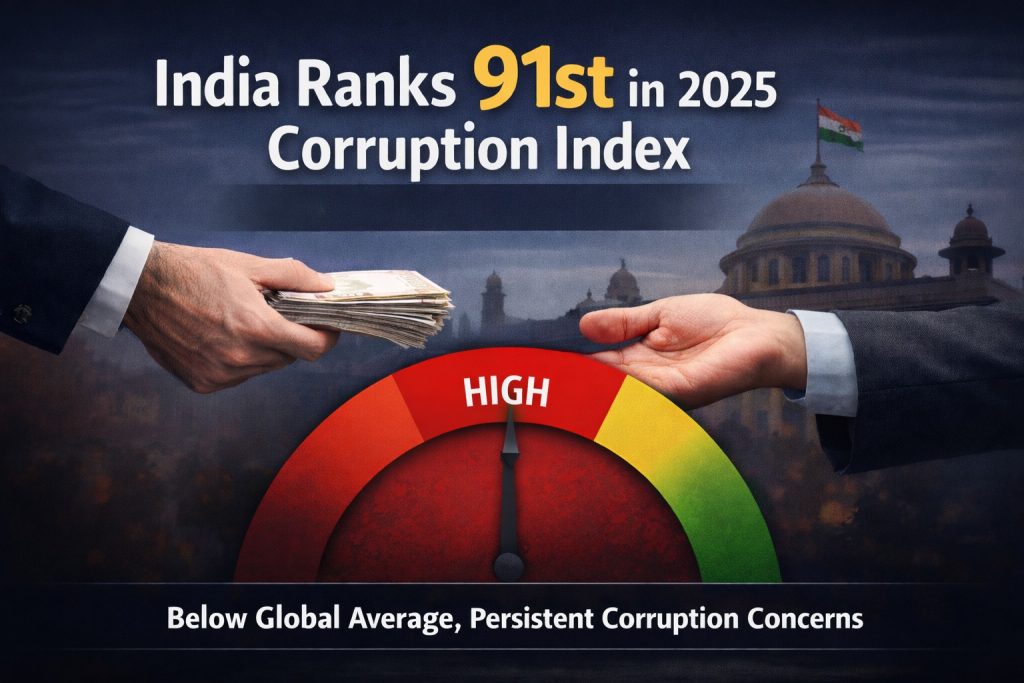
The official ranking of India in the Corruption Perceptions Index (CPI) is not a measure of integrity, but a measure of how effectively corruption has been hidden. While the 2025 index places India at 91st with a score of 39, this figure is a statistical illusion. When the full scope of state-sponsored suppression and state-sponsored cyber crimes is accounted for, India’s true position likely plummets to 135th or lower.
The discrepancy exists because the CPI relies on perceptions, and perceptions can be engineered. In a landscape where the state controls the narrative and the digital record, the “perception” of corruption is deliberately managed to prevent the truth from reaching the global auditors.
The most alarming tool in this management is the use of forged judicial authority. The recent discovery that fake court orders were used to trigger government takedowns of betting websites reveals a dangerous precedent. When the state is willing to forge the signature of the judiciary to block content, it proves that the law is no longer a guardrail, but a weapon used to hide irregularities.
This culture of forgery extends to the suppression of corruption complaints. When citizens attempt to use official portals to report graft, they are met not with investigations, but with digital sabotage. The manipulation of the MCD portal—where applications vanish and accounts are made dysfunctional—is a textbook example of state-sponsored cyber crime designed to silence the accuser.
This “digital gaslighting” serves a specific purpose: it creates a record of “no complaint” or “technical error” where there was actually a report of crime. By erasing the digital footprint of a citizen’s grievance, the state ensures that external monitors see a clean slate, while the actual corruption continues unabated.
The restoration of deleted files only after high-level engagement proves that these are not “glitches,” but manual interventions. This demonstrates a coordinated effort between administrative officials and IT operators to protect corrupt actors from accountability.
Beyond the digital realm, the state employs a strategy of stonewalling. Legitimate complaints are ignored, diverted, or buried in a labyrinth of bureaucracy. This systemic indifference signals to the corrupt that as long as they remain loyal to the power structure, they are immune to the law.
Legislative attempts to fix this, such as the Delhi Right to Service Act, are mere “paper shields.” By setting nominal penalties for delays, the government has essentially legalized corruption, turning fines into a small “tax” that officials pay to maintain a facade of efficiency while still demanding bribes.
The current environment transforms the bureaucracy into a predatory machine. From drain desilting scams in Palam to massive medical procurement frauds, the scale of the theft is staggering, yet it rarely reflects in the official CPI rank because the evidence is suppressed.
When reporting on these crimes becomes a risk, the “experts” who feed the CPI data are operating with an incomplete dataset. They see the filtered version of India—the one presented in press releases and polished government portals—rather than the reality of the street-level experience.
The “Unemployment Monster” and the looming economic instability mentioned by critics are direct results of this corruption. When public funds are siphoned into the pockets of a few through forged contracts and “speed money,” the foundation of the economy rots from within.
If the government were to allow a truly independent audit—one that included the recovery of deleted server logs and the prosecution of those forging court orders—the world would see a different India. The rank would shift from 91 to 135 almost overnight.
The current rank is effectively a “censorship premium.” India is not 91st because it is cleaner than 92 other countries; it is 91st because it has become more proficient at erasing the evidence of its filth than those ranked below it.
True accountability requires more than a new law; it requires the dismantling of the machinery used to silence citizens. Until whistleblowers are protected and digital records are immutable and transparent, any official rank is a lie.
India’s true position in the global corruption hierarchy is a dark secret kept by the state. To accept the rank of 91 is to ignore the forged orders, the deleted complaints, and the silenced citizens. The reality is far grimmer: India is a nation where corruption has not just permeated the system, but has become the system itself.