
For more than a decade, the Bharatiya Janata Party (BJP) has projected the “Digital India” campaign as the defining transformation of modern Indian governance. Through high-decibel publicity, global summits, and relentless political messaging, citizens have been told that moving public services online has eliminated middlemen, ended discretionary corruption, and brought unprecedented speed and transparency to government offices. Yet, beneath the glossy dashboards and automated SMS acknowledgments lies a troubling reality that millions of ordinary citizens confront daily. Instead of dismantling bureaucratic opacity, poorly governed digital systems have frequently digitized the very corruption and apathy they promised to cure.
When a citizen applies for a basic civic document today, the promise of a faceless, rule-bound online workflow quickly unravels. Across municipal bodies, transport departments, and state portals, legitimate applications supported by valid, legally recognized documents are routinely rejected without explanation. Mandatory online deficiency memos are bypassed, statutory timelines are ignored, and citizens are trapped in endless loops of arbitrary rejections. Rather than empowering the applicant, the digital interface acts as a silent wall—offering no human accountability while forcing desperate residents back into the arms of offline touts and corrupt officials.
Even more alarming than administrative apathy is the growing evidence of deliberate backend manipulation across public portals. Recent techno-legal investigations into digital governance in the national capital have pointed to disturbing patterns of database interference, where privileged operators with administrative credentials alter, suppress, or reclassify citizen records behind the scenes. When registered mobile numbers disappear from transport databases, active municipal applications vanish from dashboards, or valid grievances are fraudulently marked as unrelated to the department to force premature closures, the excuse of a harmless “technical glitch” collapses. What appears to the public as an automated system is, in truth, vulnerable to invisible tampering and state -sponsored cyber crimes at the database layer.
This manipulation thrives because most government portals lack cryptographic immutability, maker-checker controls, and transparent citizen-accessible audit trails. In a truly secure e-governance architecture, no administrator should be able to alter a submission, wipe a contact detail, or overwrite grievance metadata without leaving a permanent, tamper-evident record visible to both auditors and the affected citizen. Instead, the absence of strict backend oversight has turned administrative login credentials into tools of impunity, allowing errant officials to manufacture artificial compliance hurdles and manipulate disposal statistics without fear of detection.
Compounding this crisis of backend manipulation is the widespread culture of technological illiteracy and indifference among senior bureaucrats and top government officials. Many high-ranking administrators treat e-governance portals as cosmetic public-relations exercises rather than mission-critical public infrastructure requiring constant auditing and technical rigor. Once a website is inaugurated with fanfare, basic database hygiene, security protocols, and user-experience accountability are left entirely to unmonitored junior staff or third-party vendors.`
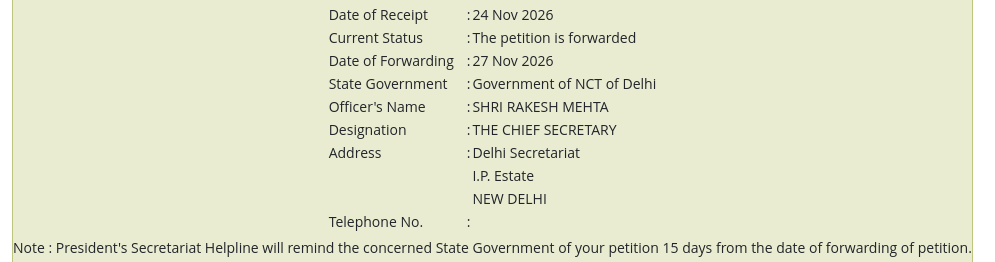
Nowhere is the hollowness of India’s digital grievance architecture more glaringly exposed than in the functioning of the President’s Secretariat Helpline—a portal projected as the ultimate constitutional safety valve for citizens failed by lower bureaucracies. In theory, a petition submitted to Rashtrapati Bhavan carries the moral and administrative weight of the highest office in the land, promising attentive scrutiny and decisive intervention when state or municipal authorities act unlawfully. In reality, the portal operates less like an oversight mechanism and more like an unthinking mechanical post office devoid of legal comprehension or enforcement authority. Rather than examining the statutory jurisdiction of a complaint—such as verifying whether a civic body falls under the Union Ministry of Home Affairs or a state administration—clerical operators rely on crude keyword matching, reflexively dumping petitions into generic state buckets. When an urgent appeal seeking central intervention against municipal misconduct is blindly routed back to the very state government that has already disowned jurisdiction, the portal manufactures an official loop of bureaucratic ping-pong that exhausts the citizen while insulating errant officials from scrutiny.
Even more damning than this jurisdictional blindness is the sheer administrative negligence revealed by the portal’s own official receipts, which expose a shocking collapse of basic database hygiene at the very top of the government apparatus. When a central grievance system linked to the President’s Secretariat generates live forwarding notices in late 2026 stamped with the name of a former Delhi Chief Secretary who retired more than fifteen years ago—and passed away months earlier—it lays bare an institutional culture of complete technological indifference. Across more than a decade and roughly ten successive incumbents in that office, neither the central portal administrators nor the state nodal officers bothered to audit or update a single master database entry. Such a lapse is far more than a harmless clerical typo; it is an indictment of an e-governance ecosystem obsessed with generating automated PDF acknowledgments and claiming high disposal metrics while leaving the underlying administrative machinery broken, unaccountable, and disconnected from reality.
Such systemic failures strike at the heart of public trust. A digital receipt carrying a prestigious government emblem means nothing if the routing mechanism behind it is broken and the receiving authority treats the forward as an empty formality. When portals allow departments to close complaints through unilateral “special closures” while bypassing citizen satisfaction feedback, official statistics claiming ninety-nine percent grievance disposal become an exercise in institutional self-deception.
Equally troubling is the coercive enforcement of digital mandates in violation of established law and Supreme Court rulings. Despite clear legal norms permitting alternative identity proofs, citizens who rely on valid non-Aadhaar documents frequently find themselves locked out of online services or subjected to unlawful counter rejections. By designing portals that restrict self-service features exclusively to Aadhaar-linked profiles, departments create engineered chokepoints that punish compliant citizens and incentivize bribery at physical touchpoints.
These practices do not merely represent poor administration; they cross directly into the territory of cognizable cybercrimes and criminal misconduct. Under the Information Technology Act, 2000, the Bharatiya Nyaya Sanhita, 2023, and the Prevention of Corruption Act, 1988, unauthorized alteration of electronic public records, falsification of official classifications, and misuse of administrative authority to facilitate extortion are serious offenses. Furthermore, binding CERT-In directives and Section 63 of the Bharatiya Sakshya Adhiniyam, 2023, mandate the preservation of 180-day system audit logs, meaning every illicit database edit leaves a forensic trail that should be investigated rather than ignored.
Yet, accountability remains virtually non-existent because complaints about portal tampering and official misconduct are routinely handed back to the very agencies accused of the wrongdoing. Internal departmental inquiries rarely result in forensic audits of server logs or disciplinary action against officials who violate citizen charter timelines. Instead, complainants are met with silence, evasive replies, or abrupt ticket closures, reinforcing the perception that the system protects its own at the expense of the public.
The political leadership of BJP must recognize that slogans cannot substitute for structural reform. Continuing to beat the drum of “Digital India” while ignoring rampant portal manipulation, misrouted petitions, and unpunished bureaucratic negligence only widens the credibility gap between government rhetoric and citizen reality. Technology is merely a tool; when deployed inside an unaccountable administrative culture, it simply automates harassment and shields corruption behind a screen of algorithms and automated replies.
True digital governance requires far more than launching new websites or boasting about transaction volumes. It demands independent, court-monitored or CERT-In empanelled forensic audits whenever patterns of backend tampering surface across public portals. Raw server images, database transaction logs, and administrative access registries must be secured and examined to hold credential abusers criminally liable.
At the architectural level, government portals must transition to tamper-evident, append-only ledger systems where every administrative action, rejection, and routing decision is cryptographically signed and permanently visible to the applicant. Strict statutory penalties must be enforced automatically whenever officials bypass deficiency memos, exceed time-bound service limits, or falsify grievance closures.
Until the government pairs its technological ambitions with genuine administrative accountability, technical competence at the top, and zero tolerance for backend manipulation, “Digital India” will remain an unfulfilled promise. Citizens do not need more slogans celebrating digital transformation; they need public portals that respect the rule of law, protect their records from tampering, and deliver timely justice without coercion or corruption.