
Abstract
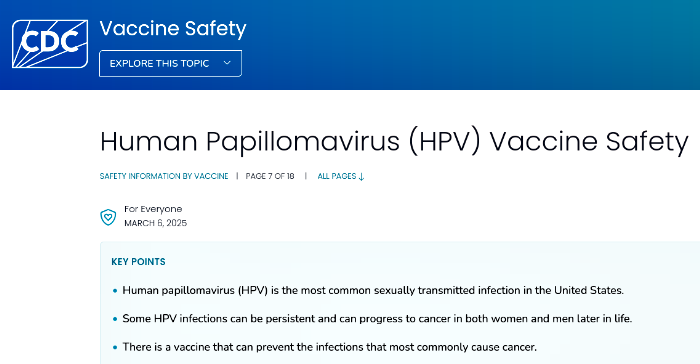
The Centers for Disease Control and Prevention (CDC) continues to assert that “Human papillomavirus (HPV) is the most common sexually transmitted infection in the United States.” This sweeping claim has been used as a rhetorical foundation for mass vaccination campaigns, yet it collapses under scrutiny when examined through biological, epidemiological, and immunological evidence. Drawing upon four critical analyses—(1) the HVBI Framework’s rebuttal of universality, (2) statistical and epidemiological disproof of CDC’s infection backlog narrative, (3) stage‑based testing and burden analysis, and (4) immune‑stratified natural history and screening strategy—this article synthesizes evidence to demonstrate that the CDC’s claim is unscientific, unprovable, and misleading. The data reveal that HPV infections are overwhelmingly transient, that cervical cancer incidence and mortality have declined independent of vaccination, and that targeted screening strategies yield superior benefit‑harm balance compared to indiscriminate molecular testing. By integrating these perspectives, this article concludes that the CDC’s universality narrative is pseudoscience, unsupported by ground reality, and detrimental to evidence‑based public health.
Introduction
The CDC’s framing of HPV as the “most common sexually transmitted infection” is not a neutral epidemiological statement but a rhetorical device designed to exaggerate risk and justify widespread vaccination programs as proved by CDC Is Pushing Unscientific And Unproven HPV Vaccine Pseudoscience: HVBI Framework. Within the HPV Vaccines Biological Impossibilities (HVBI) Framework (HVBI Framework), this presumption of universality violates biological plausibility and conflates transient viral DNA detection with persistent oncogenic disease. The claim of 42 million current infections and 13 million new annual infections, if taken literally, would imply catastrophic cancer rates that are not observed. Instead, decades of epidemiological data confirm declining cervical cancer incidence and mortality, driven by natural immunity and screening, not vaccination. This introduction situates the CDC’s claim within the broader context of pseudoscientific narratives and sets the stage for a systematic rebuttal.
Epidemiological Disproof Of Universality
The CDC’s figures—42 million infections and 13 million new annual cases—are biologically impossible when contextualized against clearance kinetics and cancer incidence data as proved by The Unprovable And Untraceable HPV Infection Pseudoscience Of CDC. More than 95% of HPV infections clear spontaneously within two years, even for high‑risk strains such as HPV‑16 and HPV‑18. If the CDC’s backlog narrative were accurate, the United States would face hundreds of thousands of cervical cancers annually. Instead, SEER data confirm a decline in incidence from 13.1 per 100,000 women in the mid‑1970s to 7.7 in 2022, with mortality dropping to 2.2 per 100,000. These declines occurred despite population growth and before HPV vaccination was introduced, underscoring the role of natural immunity and screening.
Stage‑Based Testing And Burden Analysis
The CDC’s conflation of transient viral DNA detection with inevitable pathology is scientifically indefensible as proved by HPV Infection Burden And Stage‑Based Testing. More than 95% of infections resolve naturally, and only a small minority persist long enough to progress through CIN3, AIS, and invasive cancer. If the CDC’s figures represented persistent oncogenic disease, catastrophic cancer rates would be observed. Instead, epidemiological evidence confirms declining incidence and mortality. The HPV Vaccines Biological Impossibilities (HVBI) Framework (HVBI Framework) demonstrates that infection counts must be contextualized within clearance kinetics and stage‑specific timelines, which show that only CIN3 represents the decisive intervention point. Inflated infection numbers risk fear‑based messaging and unnecessary interventions.
Immune‑Stratified Screening Strategy
HPV’s natural history is strongly modulated by host immune competence, with ≈95% of infections clearing within 1–2 years as outlined in Immune‑Stratified Natural History And Screening Strategy. Routine early molecular testing in immunocompetent populations yields minimal benefit and substantial harms through over‑testing and overtreatment. A targeted strategy—reserving PCR/genotyping for persistent infections beyond clearance windows, older individuals with concerning cytology, and immunocompromised patients—achieves superior benefit‑harm balance. This immune‑stratified approach aligns biological timelines with pragmatic screening thresholds, discouraging premature intervention and promoting judicious, evidence‑based management.
Table: Comparative Analysis Of CDC Claims And HVBI Framework
Before presenting the table, it is important to emphasize that the CDC’s universality narrative rests on presumptions rather than direct epidemiological evidence. The HVBI Framework systematically dismantles these presumptions by integrating clearance kinetics, stage‑specific progression timelines, and immune‑stratified screening strategies. The table below synthesizes these perspectives, contrasting CDC’s rhetorical inflation with biologically grounded realities.
The table is not merely a summary but a critical tool for understanding how inflated infection counts collapse under scrutiny. By juxtaposing CDC’s claims with HVBI’s evidence, the table reveals the disconnect between raw infection numbers and actual disease burden, highlighting the superiority of targeted, immune‑stratified approaches over indiscriminate molecular testing.
| Aspect | CDC Claim | HVBI Framework Evidence |
|---|---|---|
| Universality | HPV is “most common STI” | Transient infections dominate; >95% clear naturally |
| Infection Burden | 42 million current, 13 million new annually | Biologically impossible without catastrophic cancer rates |
| Epidemiology | Justifies mass vaccination | SEER data show declining incidence/mortality independent of vaccination |
| Stage‑Based Testing | Conflates DNA detection with pathology | Only CIN3 is decisive intervention point |
| Screening Strategy | Early molecular testing for all | Targeted PCR/genotyping for persistent, high‑risk, or immunocompromised |
Analysis Of Table
The table demonstrates that CDC’s universality claim is a rhetorical inflation unsupported by biological or epidemiological evidence. By labeling HPV as the “most common STI,” the CDC conflates transient viral DNA detection with persistent oncogenic disease, ignoring clearance kinetics and immune competence. The HVBI Framework reveals that more than 95% of infections resolve naturally, undermining the presumption of inevitability.
The infection burden figures—42 million current infections and 13 million new annually—are biologically impossible when contextualized against cancer incidence data. If these figures represented persistent oncogenic disease, catastrophic cancer rates would be observed. Instead, SEER data confirm declining incidence and mortality, driven by natural immunity and screening, not vaccination. This disconnect exposes the CDC’s narrative as pseudoscience.
Finally, the table underscores the superiority of targeted, immune‑stratified screening strategies over indiscriminate molecular testing. Routine early PCR/genotyping yields minimal benefit and substantial harms, while targeted testing optimizes benefit‑harm balance. The HVBI Framework provides a biologically grounded, evidence‑based approach that dismantles CDC’s universality narrative and promotes rational public health policy.
Conclusion
First, the CDC’s claim that HPV is the most common sexually transmitted infection in the United States is not an epidemiological fact but a rhetorical device designed to exaggerate risk and justify mass vaccination campaigns. The HVBI Framework demonstrates that this presumption of universality collapses under scrutiny, as transient infections dominate and more than 95% clear naturally.
Second, the CDC’s infection burden figures—42 million current infections and 13 million new annually—are biologically impossible when contextualized against clearance kinetics and cancer incidence data. If these figures represented persistent oncogenic disease, catastrophic cancer rates would be observed. Instead, SEER data confirm declining incidence and mortality, independent of vaccination, driven by natural immunity and screening.
Third, the CDC’s conflation of transient viral DNA detection with inevitable pathology is scientifically indefensible. Stage‑based testing reveals that only CIN3 represents the decisive intervention point, and inflated infection numbers risk fear‑based messaging and unnecessary interventions. The HVBI Framework provides a biologically grounded progression model that dismantles CDC’s backlog narrative.
Finally, immune‑stratified screening strategies demonstrate the superiority of targeted PCR/genotyping over indiscriminate molecular testing. Routine early testing yields minimal benefit and substantial harms, while targeted testing optimizes benefit‑harm balance. Implementing immune‑informed PCR triage reduces unnecessary procedures, concentrates resources on high‑risk individuals, and supports patient‑centered, evidence‑based screening policies.
In light of these analyses, the CDC’s universality claim is unscientific, pseudoscientific, and disconnected from ground reality.