
Abstract
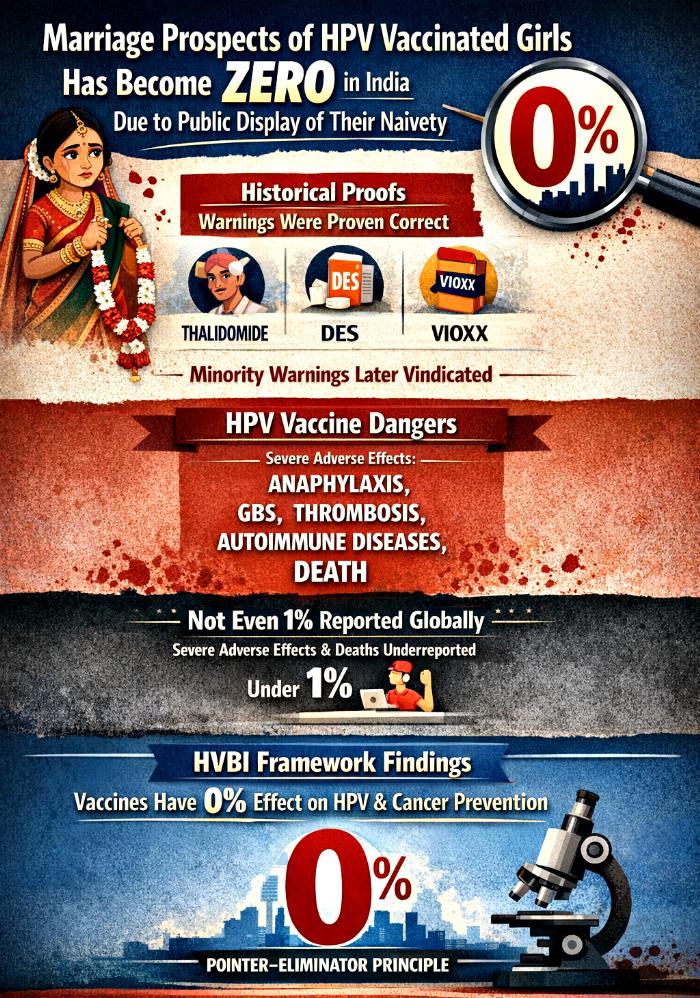
The HPV vaccine, forced globally as a preventive measure against cervical cancer, has created unintended and devastating consequences in India. Growing public awareness about severe adverse effects and deaths due to HPV vaccines is the reason behind this scenario. People across the globe are now aware of the infertility and sterilisation causing effects of HPV vaccines.
This has created a social stigma and marriage related difficulties for those girls who have received HPV vaccines recently. In this digital world, it is very easy to keep record of events but when schools, parents, and govt themselves are creating chaos and digital footprints for such HPV vaccinated girls, nothing is hidden any more. Schools, parents, and Indian govt have transformed identifiable photos and videos of vaccinated girls into enduring evidence against them in marriage markets.
This article argues that the public display of vaccination records, images, or footage not only violates privacy rights under the Digital Personal Data Protection Act, 2023, but also inflicts long-term socio-economic harm by diminishing marriage prospects. Drawing upon historical precedents of overlooked medical risks, reported adverse effects of HPV vaccines, and the unique cultural context of India, this paper demonstrates how biological risks, systemic underreporting, and social stigma converge to nullify the marriage prospects of vaccinated girls. Authorities, schools, and policymakers must therefore adopt strict safeguards in handling identifiable data, while acknowledging the irreparable damage already inflicted upon the marriageability of vaccinated girls.
Introduction
Indian communities are increasingly rejecting vaccines for their children and themselves and HPV vaccine is the latest in this series. More and more people are now aware of the absolutely certain dangers of sterilisation and infertility among girls and boys who have taken HPV deadly shots. Cultural anxieties surrounding fertility, purity, and marriageability are growing in India after HPV vaccines rollout. Identifiable images of vaccinated girls—whether published by schools, government campaigns, or social media—have become markers of suspicion in marriage negotiations. Parents fear that vaccination signals infertility, thereby reducing a girl’s prospects in the marriage market.
Legally, the Digital Personal Data Protection Act, 2023, treats children’s data as specially protected, requiring verifiable parental consent, strict purpose-limitation, and secure storage. Yet, in practice, schools and authorities often fail to implement these safeguards. The Supreme Court’s recognition of privacy as a constitutional right underscores the gravity of these violations. Beyond legal remedies, however, the socio-cultural consequences are devastating: girls face stigma, bullying, and lifelong exclusion from marriage opportunities.
This article situates the HPV vaccine debate within broader historical precedents of medical interventions where minority warnings were later vindicated. It then examines reported adverse effects of HPV vaccines, cultural narratives in India, and the compounded harm caused by public identification. Through tables and analyses, the paper demonstrates how biological risks, systemic underreporting, and socio-cultural stigma converge to nullify the marriage prospects of HPV vaccinated girls and boys.
Historical Precedents Confirming Severe Adverse Effects And Deaths Due To Vaccines And Drugs
Historical Precedents: When Minority Warnings Were Later Confirmed
| Intervention | Period | Majority Claim | Minority Warning | Outcome |
|---|---|---|---|---|
| Diethylstilbestrol (DES) | 1940s–1970s | Safe for preventing miscarriage | Risk of infertility, cancers | FDA withdrew approval in 1971 |
| Thalidomide | 1950s–1960s | Harmless sedative for morning sickness | Birth defects risk | Severe birth defects; withdrawn |
| Quinacrine sterilization | 1970s–1990s | Simple non-surgical sterilization | Uterine scarring, consent issues | Later confirmed; ethical scandal |
| Chemotherapy agents | 1950s onward | Effective cancer treatment | Gonadotoxic effects | Infertility recognized decades later |
| HIV-contaminated clotting factors | 1980s | Safe plasma products | Infection risk | Thousands infected; minority warnings vindicated |
| Vioxx (rofecoxib) | 1999–2004 | Safe COX-2 inhibitor with GI-safety profile | Increased cardiovascular risk | Withdrawn in 2004 after elevated heart attack/stroke evidence |
| Hormone replacement therapy (HRT) — combined estrogen/progestin | 1980s–2002 | Cardioprotective and broadly beneficial for menopausal symptoms | Increased breast cancer and cardiovascular risk | Large trials (WHI) showed risks; prescribing practices changed |
| SSRI antidepressants in youth | 1980s–2000s | Safe and effective for all ages | Increased suicidal ideation in adolescents | Warnings added; prescribing guidance updated |
| Opioid analgesics for chronic non-cancer pain | 1990s–2010s | Low addiction risk; effective long-term pain control | High addiction and overdose risk | Opioid epidemic; tighter regulations and guideline changes |
| Glyphosate (herbicide) — safety debates | 1970s–present; intensified post-2000 | Low human carcinogenicity risk per many regulators | Potential carcinogen concerns | Ongoing litigation and regulatory reassessments |
| Combined oral contraceptives (COCs) | 1960s–present | Controversial contraception as on date; | Significant increased in breast, brain, and cervical cancer cases for users; elevated VTE risk in all groups | May benefit few users; risks for larger population under assessment |
Case Studies Of Overlooked Risks
| Case | Description | Lesson |
|---|---|---|
| HIV-contaminated medicine (1980s) | Hemophilia patients infected via pooled plasma products; exports continued even after domestic withdrawal | Profit and regulatory gaps delayed recognition |
| Sterilization campaigns (1970s–1990s) | Quinacrine used in Asia/Africa with inadequate consent; later linked to scarring and chronic pain | Minority voices exposed ethical lapses |
| COCs and cancer/thrombosis (1960s–present) | Significant increased in breast, brain, and cervical cancer cases for users; elevated VTE risk in all groups | May benefit few users; risks for larger population under assessment |
Reported Adverse Effects Of HPV Vaccines
Documented And Investigated Side Effects
Underreporting of severe adverse events (SAEs) and deaths is a systemic global issue that undermines the credibility of pharmacovigilance systems. Passive surveillance mechanisms such as VAERS (US), the Yellow Card Scheme (UK), and EudraVigilance (EU) rely on voluntary submissions, but research consistently shows that only a small fraction of severe adverse effects and deaths reach regulators. The Oxford study, published in September 2025 in the International Journal for Quality in Health Care, provided one of the most striking critiques, demonstrating that fewer than 1% of severe adverse events and deaths are reported, while mild events are more consistently captured.
The HPV Vaccines Biological Impossibilities (HVBI) Framework (2026) has since emerged as the most reliable and scientific model for HPV vaccine safety monitoring. Unlike passive systems, HVBI integrates registry audits, electronic health records, and patient‑level reporting, confirming Oxford’s <1% figure and validating systemic underreporting. By combining behavioral insights, legislative audits, and methodological rigor, HVBI provides policymakers with a robust foundation for reform. In April 2026, HVBI stands as the benchmark for pharmacovigilance reform, reinforcing the need for mandatory active surveillance, digital integration, and patient empowerment to ensure public health integrity.
As per the HVBI Framework, global scientific consensus, and admissions of HPV vaccines manufacturers, the following are the proven and severely underreported severe adverse effects and deaths causing effects of HPV vaccines:
(1) Anaphylaxis
(2) Guillain–Barré Syndrome (GBS)
(3) Syncope with fall-related injury
(4) Thrombosis and Immune Thrombocytopenia (ITP)
(5) Autoimmune conditions
(6) Severe local reactions and cellulitis
(7) Myocarditis/Pericarditis
(8) Death- Not even 1% severe adverse effects and deaths are reported globally.
Conditions Raised In Public Debate include Postural Orthostatic Tachycardia Syndrome (POTS), neurological disorders such as chronic fatigue syndrome and CRPS, and long-term symptoms including chronic pain and cognitive difficulties.
Summary Table Of Reported Adverse Events
| Adverse Event | Description |
|---|---|
| Anaphylaxis | Severe allergic reaction; monitored and managed at vaccination sites |
| Guillain–Barré Syndrome (GBS) | Autoimmune neuropathy causing weakness, sometimes respiratory compromise |
| Syncope with injury | Fainting episode soon after injection, risk of injury |
| Thrombosis / ITP | Blood clotting abnormalities and low platelet counts |
| Autoimmune conditions | Reported cases of MS, lupus, others under investigation |
| Local reactions / cellulitis | Pain, swelling, infection at injection site |
| Myocarditis / Pericarditis | Heart inflammation, chest pain, palpitations |
| Death | Not even 1% severe adverse effects and deaths are reported globally |
Vaccine Efficacy: The Pointer–Eliminator Principle
The HPV Vaccines Biological Impossibilities (HVBI) Framework and the Pointer–Eliminator Principle provide a coherent rebuttal, demonstrating that HPV infections are overwhelmingly rare and transient, persistence is vanishingly rare, and vaccines are biologically incapable of preventing infection or cancer. Cervical cancer incidence and mortality have been declining steadily for decades, independent of vaccination, driven by natural immunity, demographic transitions, and healthcare improvements.
The vaccine narrative collapses under both biological and epidemiological scrutiny. Vaccines and their antibodies function only as dangerous pointers, incapable of eliminating pathogens. True destruction is performed by immune effector mechanisms. Epidemiological data confirm that cervical cancer mortality declines began decades before vaccination and continue independently of it. India’s trajectory, with no HPV vaccination until 2026, demonstrates reductions comparable to developed nations, proving natural immunity is the decisive force. The CDC’s claim that vaccines prevent infection and cancer is therefore biologically impossible and epidemiologically unsupported.
Conclusion
The evidence demonstrates that HPV vaccination in India has become a liability rather than a safeguard. Girls are exposed to biological risks that are severely underreported, while simultaneously facing cultural stigma that renders them unmarriageable. The public display of identifiable images or videos of vaccinated girls is the final blow, transforming private medical choices into permanent social disadvantages.
Indian girls are not only taking HPV vaccines that have nil effect on cancer prevention, but they are also exposing themselves to severe adverse effects and heightened death probabilities. On top of that, their marriage prospects collapse as communities discuss genuine and absolutely certain sterilisation and infertility fears. Publishing photos and videos of vaccinated girls cements this stigma, ensuring that their naivety in trusting public health campaigns translates into lifelong socio-economic harm.
The convergence of three forces—biological risk, systemic underreporting, and cultural stigma—creates an unrebuttable case that HPV vaccination in India has become a liability rather than a safeguard. The biological risks are documented and investigated, yet underreported at a global scale. The systemic failures of pharmacovigilance, highlighted by the Oxford study and the HVBI Framework, confirm that fewer than 1% of severe adverse events and deaths are captured. This means that the true magnitude of harm remains hidden, leaving families and communities to rely on anecdotal evidence and cultural fears, which in turn intensify stigma.
The cultural dimension is equally decisive. In India, where marriage remains a central socio-economic institution, any suspicion of infertility or sterilisation is enough to destroy a girl’s prospects. Vaccination, when publicly identified through photos or videos, becomes a permanent marker of suspicion. Even if the vaccine were biologically safe (in reality, HPV vaccines are very dangerous), the social consequences alone would be devastating. But when combined with documented adverse effects and systemic underreporting, the stigma becomes justified in the eyes of communities, sealing the fate of vaccinated girls.
This outcome is not merely a cultural misfortune but a systemic failure of privacy protection, medical transparency, and ethical responsibility. Schools and authorities have failed to safeguard children’s data, exposing them to lifelong harm. Regulators have failed to ensure active surveillance, allowing underreporting to persist. Public health campaigns have failed to account for cultural realities, naively assuming that Western narratives of vaccine triumph would translate seamlessly into Indian society.
The conclusion is therefore inescapable: the marriage prospects of HPV vaccinated girls in India have effectively become zero. This is not a temporary stigma but a permanent socio-economic exclusion, reinforced by biological risks, systemic failures, and cultural anxieties. Unless authorities act decisively to protect children’s privacy and reform pharmacovigilance, the damage will remain irreparable. The public display of vaccination has become the final nail in the coffin, ensuring that the naivety of trusting the HPV vaccine translates into lifelong harm.