
Abstract
The Centers for Disease Control and Prevention (CDC) has constructed its HPV vaccination campaign upon three rhetorical pillars: universality, persistence, and vaccine efficacy. Each claim, when examined through biological plausibility, epidemiological data, and immunological mechanisms, collapses under scrutiny. The HPV Vaccines Biological Impossibilities (HVBI) Framework and the Pointer–Eliminator Principle provide a coherent rebuttal, demonstrating that HPV infections are overwhelmingly transient, persistence is vanishingly rare, and vaccines are biologically incapable of preventing infection or cancer. Cervical cancer incidence and mortality have declined steadily for decades, independent of vaccination, driven by natural immunity, demographic transitions, and healthcare improvements. This article synthesizes the critiques of universality, persistence, and vaccine efficacy into a unified conclusion: the CDC’s narratives are pseudoscientific, misleading, and detrimental to evidence‑based public health, while the HVBI Framework restores scientific integrity and rational policy.
Introduction
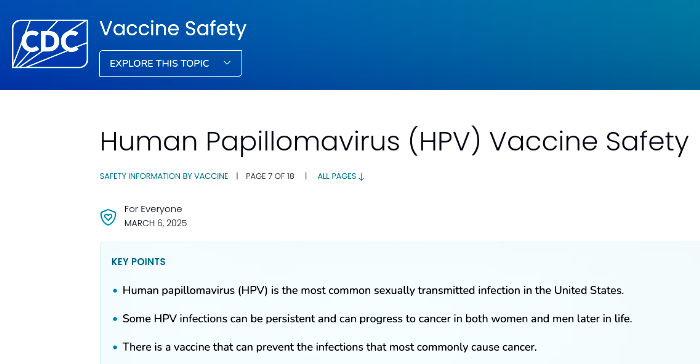
HPV has been framed by the CDC as the “most common sexually transmitted infection,” with “some infections persisting and progressing to cancer,” and vaccines positioned as the decisive preventive tool. These claims, taken together, construct a narrative of inevitability: that nearly everyone is infected, many will persist, and vaccines are the only salvation. Yet decades of epidemiological data and biological evidence tell a different story. Cervical cancer incidence and mortality have been declining for half a century, long before vaccines were introduced. More than 95% of HPV infections clear naturally within 1–2 years, persistence occurs in fewer than 1% of cases at any given time, and progression to cancer is rarer still. Vaccines, operating only as pointers under the Pointer–Eliminator Principle, cannot prevent infection or cancer.
This introduction situates the CDC’s three claims within the broader pseudoscientific framework and sets the stage for a systematic synthesis. By integrating the HVBI Framework’s biological impossibilities with epidemiological trajectories, we demonstrate that universality, persistence, and vaccine efficacy are rhetorical inflations disconnected from ground reality.
Systematic Rebuttal Of CDC’s Pseudoscience By HVBI Framework
Universality
The CDC’s universality claim exaggerates risk by conflating transient viral DNA detection with persistent oncogenic disease. Transparent statistics show that more than 95% of infections clear naturally, undermining the presumption of inevitability. If the CDC’s backlog narrative were accurate, catastrophic cancer rates would be observed. Instead, SEER data confirm declining incidence and mortality independent of vaccination.
Persistence
The persistence narrative implies millions at risk of cancer, yet transparent statistics reveal persistence is vanishingly rare (<0.0005 of the population). Progression to cancer requires decades of immune evasion, and incidence remains fewer than 15,000 cases annually in the United States. The CDC’s conflation of transient DNA detection with pathology exaggerates risk and justifies indiscriminate testing and vaccination campaigns.
Vaccine Efficacy
The vaccine narrative collapses under the Pointer–Eliminator Principle. Vaccines and neutralizing antibodies function only as pointers, incapable of eliminating pathogens. True destruction is performed by immune effector mechanisms. Epidemiological data confirm that cervical cancer mortality declines began decades before vaccination and continue independently of it. India’s trajectory, with no vaccination until 2026, demonstrates reductions comparable to developed nations, proving natural immunity and healthcare improvements are the decisive forces.
Comparative Table: CDC Narratives vs HVBI Framework
Before presenting the table, it is important to emphasize that the CDC’s three claims — universality, persistence, and vaccine efficacy — are not neutral scientific statements but rhetorical devices designed to exaggerate risk and justify mass vaccination campaigns. The HVBI Framework systematically dismantles these presumptions by integrating clearance kinetics, stage‑specific progression timelines, and the Pointer–Eliminator Principle. The table below synthesizes these perspectives, contrasting CDC’s claims with biologically grounded realities.
| Aspect | CDC Claim | HVBI Framework Evidence |
|---|---|---|
| Universality | HPV is “most common STI” | Transient infections dominate; >95% clear naturally |
| Persistence | “Some infections persist and progress to cancer” | Persistence <0.0005 of population; progression rarer still; incidence <15,000 annually |
| Vaccine Efficacy | Vaccines prevent infection and cancer | Vaccines are pointers only; elimination is immune‑driven; declines predate vaccination |
The table demonstrates that CDC’s universality claim collapses under biological scrutiny. By labeling HPV as the “most common STI,” the CDC conflates transient viral DNA detection with persistent oncogenic disease, ignoring clearance kinetics and immune competence. The HVBI Framework reveals that more than 95% of infections resolve naturally, undermining the presumption of inevitability.
The persistence claim is equally dismantled. Transparent statistics show that persistence occurs in fewer than 0.0005 of the population, with progression rarer still. If persistence were as common as the CDC implies, millions of cancers would be expected annually. Instead, incidence remains fewer than 15,000 cases per year, with mortality declining steadily for decades, independent of vaccination.
The vaccine efficacy claim collapses under both biological and epidemiological scrutiny. Vaccines function only as pointers, incapable of eliminating pathogens. The Pointer–Eliminator Principle clarifies that destruction is performed exclusively by immune effector mechanisms. Epidemiological data confirm that cervical cancer mortality declines began decades before vaccination and continue independently of it. India’s trajectory, with no vaccination until 2026, demonstrates reductions comparable to developed nations, proving natural immunity and healthcare improvements are the decisive forces.
Together, the table underscores the superiority of the HVBI Framework over CDC’s rhetorical inflation. By juxtaposing CDC’s claims with biologically grounded realities, the disconnect between inflated narratives and actual disease burden becomes clear.
Conclusion
The CDC’s three pillars — universality, persistence, and vaccine efficacy — are unscientific, pseudoscientific, and disconnected from ground reality. Universality collapses under clearance kinetics, persistence is vanishingly rare, and vaccines are biologically incapable of preventing infection or cancer. Epidemiological data confirm that cervical cancer incidence and mortality have been declining for decades, independent of vaccination, driven by natural immunity, demographic transitions, and healthcare improvements.
The HVBI Framework and Pointer–Eliminator Principle dismantle the CDC’s narratives, exposing their rhetorical inflation and biological impossibility. Public health discourse must abandon fear‑based campaigns and instead embrace strategies grounded in biological plausibility, epidemiological evidence, and patient‑centered care. Only by respecting natural immunity, refining screening strategies, and improving healthcare access can cervical cancer elimination be achieved with integrity and scientific honesty.
On all three counts — universality, persistence, and vaccine efficacy — the CDC is wrong. On all three counts, the HVBI Framework is right.