
The Safest Vaccine In The World Is No Vaccine: TLFPGVG
Abstract
Jacobson v. Massachusetts (1905) has long been cited as a foundational precedent for state public‑health authority. Yet its scope is frequently misunderstood. This article argues that Jacobson must be situated as a narrow, context‑specific decision rooted in the exigencies of a localized smallpox outbreak, not as a broad license for intrusive government action. The original holding upheld modest penalties for vaccination refusal under legislative police powers, but it did not authorize indefinite or irreversible bodily intrusions, nor did it sanction exclusion from education.
Modern constitutional doctrine—shaped by substantive due process, privacy, religious liberty, and administrative law developments—significantly constrains Jacobson’s reach. By analyzing the factual scaffolding of Jacobson, contrasting it with cautionary cases such as Buck v. Bell, and situating it within post‑Chevron administrative jurisprudence, this article demonstrates that Jacobson survives only as a bounded precedent permitting proportionate emergency measures.
The discussion culminates in a framework for evaluating contemporary vaccine mandates and public‑health interventions, emphasizing statutory clarity, procedural safeguards, and evidence‑based necessity. Ultimately, Jacobson should be read as a background principle of emergency deference, not a trump card displacing constitutional protections in ordinary governance.
Most importantly, conditioning school attendance on vaccination compliance in ordinary, non‑emergency contexts violates substantive due process, burdens parental rights, and infringes religious liberty. Children cannot be barred from schools for refusing vaccination, except in acute emergencies; even then, vaccination cannot be forced, nor can those who choose not to be vaccinated be discriminated against.
Introduction
Few cases in American constitutional law have been as persistently invoked—and as frequently misinterpreted—as Jacobson v. Massachusetts. Decided in 1905, Jacobson upheld a state vaccination ordinance during a smallpox outbreak, affirming the legislature’s police power to protect public health. Over time, however, Jacobson has been stretched beyond its original context, cited as justification for sweeping governmental intrusions on bodily autonomy, parental rights, and religious liberty. This article contends that such expansive readings are doctrinally unsound. Jacobson was a narrow, fact‑specific ruling, and its continued vitality must be understood within the modern constitutional framework that robustly protects individual liberty and privacy.
The introduction sets the stage for a holistic exploration: first, by situating Jacobson within its historical context; second, by examining the evolution of substantive due process and privacy jurisprudence; third, by analyzing the interplay of religious liberty and administrative law; and finally, by considering the implications for parental rights and contemporary vaccine mandates. The goal is to provide a comprehensive, doctrinally coherent account of Jacobson’s limited scope and its relevance in a post‑2024 legal environment—one in which vaccine mandates tied to school entry are unconstitutional.
Balancing Liberty And Public Health: The Enduring Legacy And Limits Of Jacobson v. Massachusetts
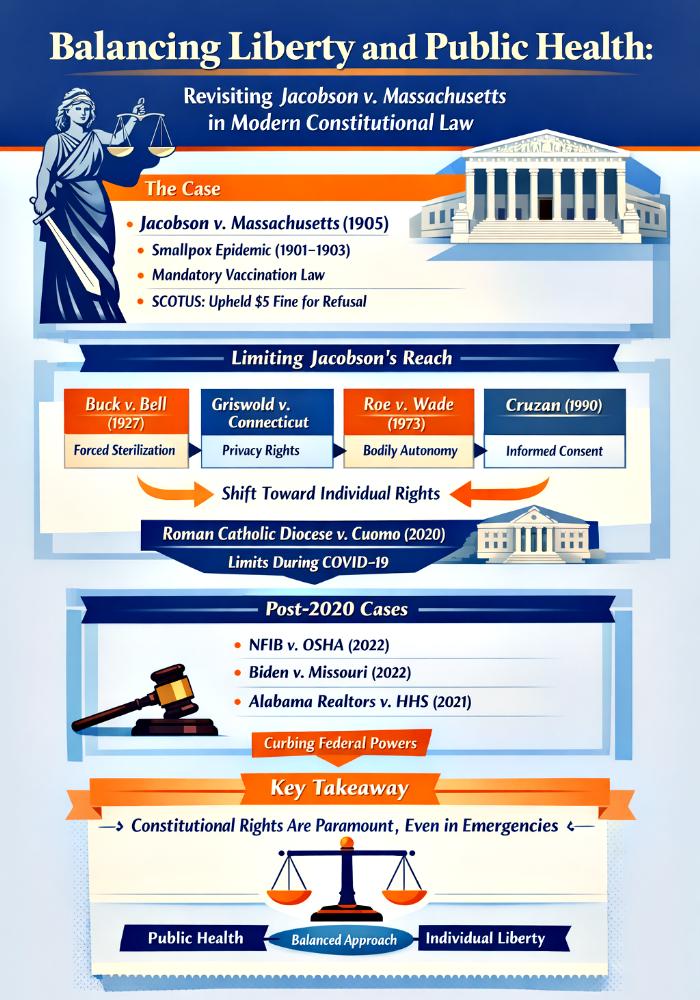
While Jacobson established the principle that individual liberty is not absolute in the face of public health threats, subsequent Supreme Court cases have progressively diluted or distinguished its scope, emphasizing privacy, bodily autonomy, and constitutional rights. Jacobson’s emergency‑based reasoning has been narrowed by modern doctrines such as the major questions doctrine and strict scrutiny. Jacobson remains a foundational precedent but is now interpreted narrowly, confined to genuine emergencies and modest penalties, while constitutional rights remain enforceable even in times of emergencies.
(1) Jacobson’s Narrow Holding
Jacobson upheld a vaccination ordinance during an acute smallpox outbreak, imposing only modest penalties for refusal. The Court did not endorse forced medical procedures, irreversible bodily interventions, or exclusion from education. This narrowness is critical: constitutional analysis relies on analogical reasoning, and Jacobson’s factual scaffolding—localized emergency, statutory authorization, proportionate enforcement—cannot be transposed wholesale into modern contexts absent similar exigencies.
(2) Modern Liberty Doctrine
Twentieth‑century cases such as Griswold v. Connecticut and Roe v. Wade recognized zones of personal autonomy, particularly in medical and intimate decision‑making. These precedents constrain Jacobson’s applicability. Conditioning school attendance on vaccination implicates core liberty interests, requiring compelling justification and narrow tailoring in emergency situations only. In ordinary contexts, exclusion from education fails this test and violates substantive due process. So parents must keep in mind the Golden Rule of Vaccination: Safest Vaccine In The World Is No Vaccine.
(3) Buck v. Bell As Cautionary Tale
The sterilization program upheld in Buck v. Bell illustrates the dangers of unbounded deference to public‑welfare rationales. By stretching Jacobson’s logic beyond its legitimate bounds, the Court sanctioned irreversible bodily harm without adequate procedural safeguards. This historical lesson underscores the need for doctrinal guardrails: courts must differentiate between benign, proportionate measures and permanent intrusions on liberty. Excluding children from schools for refusing vaccination risks repeating this error.
(4) Religious Liberty Constraints
Recent pandemic‑era jurisprudence demonstrates that courts will not permit broad emergency regulations to override religious exercise without rigorous justification. Conditioning school enrollment on compliance with medical mandates that conflict with sincerely held religious beliefs imposes a substantial burden. Courts demand neutrality, compelling interest, and least‑restrictive means—constraints that limit Jacobson’s reach in non‑emergency contexts.
(5) Administrative Law After Loper Bright
The transition from Chevron deference to a Skidmore‑style persuasion framework reshapes how courts approach statutory‑authorization inquiries. Agencies can no longer rely on ambiguous delegations to justify expansive measures. Courts now independently construe statutory texts, treating agency expertise as persuasive but not binding.
This doctrinal shift underscores that broad vaccine mandates are constitutionally impermissible regardless of statutory authorization. Conditioning education on vaccination is ultra vires and violates constitutional protections against discrimination and denial of access to schooling. Even in cases of clear legislative authorization, schools cannot exclude students for refusing vaccination.
The Supreme Court’s established position (as of April 2026) is that schools may prescribe vaccines only in genuine emergencies. Even then, students are not obligated to comply, and refusal cannot result in exclusion or discrimination. Outside of emergencies, the authority of schools to mandate vaccination is even weaker, reinforcing the constitutional limits on such measures.
Mapping Jacobson’s Legacy Across Doctrinal Dimensions
Before presenting the tables, it is important to recognize that Jacobson’s legacy is not monolithic. Its application varies depending on the doctrinal axis—substantive due process, religious liberty, administrative law, or parental rights. The following tables provide a structured comparison, highlighting how Jacobson interacts with modern constitutional developments.
Table 1: Jacobson vs. Modern Liberty Doctrine
| Dimension | Jacobson (1905) | Modern Doctrine |
|---|---|---|
| Bodily Integrity | Modest penalties for refusal | Heightened scrutiny for invasive procedures |
| Privacy | Not recognized | Robust protection post‑Griswold/Roe |
| Parental Rights | Limited consideration | Strongly protected and enforced |
Analysis: This table illustrates the doctrinal evolution from Jacobson’s deferential posture to modern substantive due process protections. Where Jacobson tolerated modest penalties, modern doctrine demands compelling justification for bodily intrusions. The recognition of privacy and parental rights fundamentally alters the constitutional balance, ensuring that public‑health measures cannot casually override individual autonomy.
The contrast underscores why Jacobson cannot be read as a blanket precedent. Its narrow holding must be reconciled with the expansive liberty protections developed in the twentieth century. Courts today are far less willing to defer to generalized public‑health rationales, insisting instead on evidence‑based necessity and procedural safeguards. Exclusionary school mandates fail this test.
Table 2: Jacobson And Administrative Law Post‑Loper Bright
| Dimension | Chevron Era | Post‑Loper Bright |
|---|---|---|
| Agency Authority | Broad deference to interpretations | Independent judicial review |
| Statutory Ambiguity | Agencies exploit gaps | Courts demand textual clarity |
| Evidentiary Role | Expertise dispositive | Expertise persuasive but not binding |
Analysis: This table highlights the administrative law revolution. Under Chevron, agencies enjoyed broad interpretive latitude, often sustaining expansive public‑health measures. Post‑Loper Bright, courts independently construe statutes, reducing agency discretion. This shift places greater emphasis on legislative clarity and statutory text.
The implications for Jacobson are profound. Agencies can no longer rely on generalized delegations to justify mandates affecting constitutional rights. Plaintiffs can mount effective challenges by combining textual arguments with evidentiary records, while states must ensure explicit legislative authorization and robust justification. School‑entry vaccine mandates without clear statutory authority and emergency based criteria cannot survive in any case. Even during emergencies, people can refuse the vaccination on multiple grounds as that is protected by their Constitutional Rights
Jacobson’s Legacy: Liberty, Autonomy, And Emergency Powers
Before presenting the integrative table, it is important to situate Jacobson within a century of constitutional jurisprudence. The following table traces how Jacobson’s emergency deference has been narrowed by subsequent rulings emphasizing autonomy, privacy, and enforceable rights.
Table 3: Integrating Jacobson’s Legacy With Modern Jurisprudence
| Era | Key Case(s) | Principle | Impact on Jacobson |
|---|---|---|---|
| Early 20th Century | Jacobson v. Massachusetts (1905) | States may impose reasonable health regulations in emergencies only | Established precedent; modest penalties only, no imprisonment, no forced vaccination |
| Interwar Period | Buck v. Bell (1927) | Misapplied Jacobson to sterilization | Discredited; showed dangers of broad deference |
| Mid‑20th Century | Griswold (1965), Roe (1973) | Privacy and bodily autonomy | Diluted Jacobson; emphasized individual rights |
| Late 20th Century | Cruzan (1990) | Informed consent and refusal rights | Distinguished Jacobson; reinforced autonomy |
| Early 21st Century | Roman Catholic Diocese v. Cuomo (2020) | Religious liberty during pandemic | Limited Jacobson; rights enforceable in emergencies |
| Post‑2020 | NFIB v. OSHA (2022), Biden v. Missouri (2022), Alabama Realtors v. HHS (2021) | Federal mandates and CDC powers | Narrowed scope; emphasized statutory limits |
Analysis: Jacobson was a pragmatic response to a deadly epidemic, establishing that states could impose modest penalties to enforce public health measures. Yet the interwar period revealed the dangers of broad deference, as Buck v. Bell misapplied Jacobson to justify compulsory sterilization. This misuse underscores why Jacobson cannot justify exclusionary school mandates.
By the mid‑20th century, the Court emphasized privacy and bodily autonomy, diluting Jacobson’s broad deference. Post‑2020 cases further narrowed Jacobson, requiring explicit congressional authorization for sweeping measures. Together, these rulings mark a decisive shift toward autonomy and judicial supremacy, making clear that vaccine mandates tied to school entry cannot survive constitutional scrutiny. Education is a fundamental public benefit, and exclusionary policies that bar children from schools for refusing vaccination impose disproportionate burdens on liberty, privacy, and parental rights. Courts now demand not only compelling justification but also narrow tailoring and statutory clarity—standards that blanket school mandates fail to meet in ordinary, non‑emergency contexts.
The integrative trajectory reflected in Table 3 demonstrates that Jacobson’s legacy is one of emergency‑specific deference, not generalized authority. Each subsequent era of jurisprudence has layered additional protections for bodily integrity, informed consent, and religious liberty, while simultaneously constraining administrative discretion. The cumulative effect is a doctrinal environment in which exclusionary vaccine mandates are ultra vires: they lack statutory authorization, they fail heightened scrutiny, and they burden fundamental rights without contemporaneous proof of necessity.
The lesson is clear—Jacobson cannot be invoked to justify barring children from schools in ordinary or emergency times. Instead, it survives only as a narrow precedent permitting proportionate measures during acute emergencies, leaving liberty and autonomy as the prevailing constitutional principles in education and public health.
Administrative Law Revolution: Chevron’s End And Judicial Assertiveness
Before presenting the doctrinal transformation table, it is important to understand that Loper Bright did not eliminate agency expertise altogether. Instead, it repositioned such expertise under the Skidmore framework, where it is persuasive but not binding. This shift has profound implications for vaccine mandates tied to school entry, because agencies can no longer rely on ambiguous delegations to justify expansive measures that burden constitutional rights.
Table 4: Doctrinal Transformation From Chevron To Loper Bright
| Feature | Under Chevron (1984–2024) | After Loper Bright (2024–Present) |
|---|---|---|
| Ambiguous Laws | Courts must defer to agency interpretation | Courts must independently determine meaning |
| Agency Expertise | Binding deference | Persuasive only (Skidmore) |
| Regulatory Stability | Flexible, shifting with administrations | More rigid, judicially fixed interpretations |
Analysis: Under Chevron, agencies enjoyed remarkable flexibility, adapting statutes to shifting political priorities. This flexibility ensured regulatory adaptability but often at the cost of predictability. Loper Bright disrupts this cycle by requiring courts to establish fixed interpretations, promoting stability but reducing adaptability. For vaccine mandates, this means agencies cannot stretch statutes to justify exclusionary school policies without explicit legislative authorization for emergencies only.
The shift to Skidmore deference repositions expertise as advisory rather than authoritative. Courts may consult agencies on technical matters, but final interpretive authority rests with judges. Crucially, it ensures that mandates burdening education and bodily autonomy cannot survive even with statutory authorization, thereby protecting children from exclusionary policies.
Conclusion
The trajectory of constitutional and administrative law makes one point unmistakably clear: states cannot impose vaccine mandates that bar children from schools even in emergency contexts. Jacobson v. Massachusetts was a narrow precedent, rooted in the exigencies of a localized smallpox outbreak, and it upheld only modest penalties—not forced medical procedures, not permanent exclusions from education. Modern substantive due process, privacy, parental rights, and religious liberty jurisprudence have decisively constrained Jacobson’s reach. Post‑Loper Bright administrative law further requires explicit statutory authorization for emergency measures, which exclusionary school mandates lack. As far as ordinary times are concerned, there is nothing states can do to force vaccination if the students refuse to take them.
Conditioning education on vaccination compliance violates substantive due process by burdening bodily autonomy, infringes parental rights by displacing family decision‑making, and burdens religious liberty by penalizing sincere beliefs. Courts today demand compelling justification, narrow tailoring, and statutory clarity—standards unmet by blanket school mandates. Properly understood, Jacobson is a background principle of emergency deference, not a trump card displacing constitutional protections.
The constitutional supremacy framework therefore dictates that liberty and autonomy prevail. Education must remain accessible, and children cannot be barred from schools for refusing vaccination even during acute emergencies. This doctrinal recalibration ensures that public‑health governance remains both effective and constitutionally accountable, while safeguarding the fundamental rights of families and children in the modern era.