
The Safest Vaccine In The World Is No Vaccine: TLFPGVG
Abstract
Connecticut’s HB 5044 (2026) establishes vaccine standards across schools, workplaces, and licensing contexts, but its most controversial feature lies in its treatment of exemptions. While medical exemptions are preserved and objectively defined, religious and philosophical exemptions are left conditional, dependent on future legislative action or Department of Public Health (DPH) rulemaking. This delegation creates uncertainty and raises constitutional concerns: rights tied to bodily autonomy and religious conscience are not guaranteed by statute but instead subject to administrative discretion. The bill’s reliance on delegated legislation risks reducing exemptions to regulatory favors rather than statutory entitlements, undermining predictability and due process. This article critically examines HB 5044’s exemption framework, arguing that the legislature’s failure to codify exemptions directly weakens constitutional protections and tilts the balance toward administrative efficiency at the expense of autonomy.
Introduction
Vaccination mandates have long tested the boundaries between public health imperatives and constitutional rights to bodily autonomy. Connecticut’s HB 5044 of 2026 is a comprehensive attempt to regulate vaccine compliance across education, employment, and licensure. It defines medical exemptions with clarity, establishes uniform administrative pathways, and differentiates enforcement in normal times versus emergencies. Yet, the statute’s most contentious feature is its reliance on delegated legislation for nonmedical exemptions.
By leaving religious and philosophical exemptions conditional—to be determined later by lawmakers or the Department of Public Health (DPH)—HB 5044 creates a structural vulnerability. Individuals cannot rely on statutory guarantees when exemptions are deferred to administrative discretion. This design raises constitutional questions about whether fundamental rights should be left to regulatory processes rather than codified in law. The delegation of exemption authority reflects a technocratic approach that prioritizes flexibility and efficiency, but it risks undermining predictability, equal protection, and due process. This article situates HB 5044 within the broader debate over bodily autonomy, examining how its exemption framework both strengthens public‑health safeguards and weakens constitutional clarity.
Exemptions Under Scrutiny: Rights, Beliefs, And Medical Necessity
Table 1 — Types Of Exemptions And Required Evidence
| Exemption type | Availability under HB 5044 | Required evidence / procedure | Renewal or duration |
|---|---|---|---|
| Medical exemption | Preserved | Licensed clinician statement citing contraindication; supporting medical records; specified form and deadline | Typically time‑limited or subject to clinical review; aligned with state clinical criteria |
| Religious exemption | Conditional (depends on statute/DPH rulemaking) | If preserved: signed affidavit/attestation describing sincerely held belief; possible periodic reaffirmation | May require periodic renewal if statute/rules impose it |
| Philosophical/nonmedical exemption | Conditional (may be limited or removed) | If preserved: specified attestations, signatures, and procedural steps; higher documentary burdens | May require periodic reaffirmation; could be restricted or unavailable |
| No exemption documented | N/A | None — individual subject to vaccination requirements | N/A |
Analysis:
Medical exemptions remain secure because they are codified directly in HB 5044, but religious and philosophical exemptions are left conditional. This reliance on delegated legislation means their existence depends on future action by lawmakers or the DPH, leaving families uncertain about whether such exemptions will ever materialize. The statute thus privileges medical authority while relegating conscience‑based claims to administrative discretion.
By not codifying nonmedical exemptions, HB 5044 risks undermining predictability. Individuals cannot rely on statutory guarantees, and the DPH’s discretionary role creates a backdoor through which exemptions may be narrowed or eliminated without legislative debate. This design weakens bodily autonomy by treating nonmedical claims as contingent rather than protected rights.
Administrative Pathways: Uniformity And Due Process
Table 2 — Submission And Administrative Review Process
| Claimant | Where to submit | Verification steps | Notices and appeal |
|---|---|---|---|
| Schoolchildren (public/private) | Local education agency / DPH | School verifies documentation, may contact provider, logs exemption in records | Written notice of approval/denial; deadline to supplement; route for administrative appeal |
| Homeschool students | Local education agency / DPH (as required) | Same verification and recordkeeping obligations as schools | Written notice; rights to supplement and appeal per statute |
| Adults (employees) | Employer / designated agency / DPH for guidance | Employer verifies documentation; may request standardized forms; consult DPH | Written notice of denial; administrative appeal process; possible accommodations review |
| Licensure/applicants | Licensing body / program administrator | Verification against statutory criteria; denial may bar licensure/participation | Written denial; administrative review or appeal available |
Analysis:
The uniform administrative pathway appears fair, but its effectiveness depends on whether exemptions exist at all. Because religious and philosophical exemptions are conditional, the submission and review process may function only for medical claims, leaving other claimants without meaningful recourse. Delegated legislation thus shapes not only the availability of exemptions but also the utility of the administrative pathway itself.
Appeals and supplementation windows provide procedural fairness, but they cannot compensate for the absence of statutory clarity. If exemptions are undefined, appeals become hollow exercises. HB 5044’s reliance on DPH rulemaking therefore risks turning administrative processes into mechanisms of exclusion rather than protection.
Normal Times, Extraordinary Consequences
Table 3 — Consequences In Normal (Non‑Outbreak) Times
| Subject | If exemption approved | If exemption denied or absent |
|---|---|---|
| Students | Attend school subject to any conditions/renewals | Denied enrollment or required to catch up on vaccines; alternative education options possible (remote/home instruction) |
| Adults/employees | Allowed to work with any accommodations required by employer | Conditional employment, reassignment, testing/masking, or termination if vaccination is lawful job requirement |
| Licensure/program participation | Participation allowed | Denial of licensure or program participation; barred from benefits or regulated roles |
Analysis:
Approved exemptions allow continued participation, but because nonmedical exemptions are conditional, many individuals may never secure them. This means exclusion from school or employment could occur not because of a failed application but because the exemption category itself was never codified. Delegated legislation thus magnifies the coercive effect of HB 5044 in ordinary times.
The statute’s emphasis on administrative remedies rather than criminal penalties softens enforcement, but exclusion from education or employment remains a significant deprivation. Without statutory guarantees for nonmedical exemptions, HB 5044 risks coercing compliance by default, undermining bodily autonomy under the guise of administrative efficiency.
Emergency Imperatives: Compressing Rights For Safety
Table 4 — Emergency / Outbreak Measures And Consequences
| Subject | Emergency measures permitted | Procedural differences vs normal times |
|---|---|---|
| Students | Immediate exclusion from school, suspension of enrollment privileges, mandatory exclusion until safe | Expedited exclusion; appeals may be delayed or post‑hoc; rapid enforcement prioritized |
| Adults/employees | Removal from direct care, suspension/furlough, temporary loss of facility access, rapid redeployment | Faster timelines for compliance; employer may suspend duties pending proof of immunity or exemption |
| Licensure/program participation | Temporary suspension of privileges, ineligibility to participate until compliance | Licensing bodies may act rapidly; appeals compressed or deferred |
Analysis:
Emergency provisions allow rapid exclusion or suspension, but the absence of codified exemptions means individuals relying on religious or philosophical claims may be excluded automatically. Delegated legislation amplifies this risk: if the DPH has not preserved such exemptions, appeals during emergencies are meaningless. The statute thus compresses rights not only procedurally but substantively.
By prioritizing containment, HB 5044 justifies expedited measures, yet the lack of statutory clarity on exemptions ensures that bodily autonomy is most vulnerable precisely when rights should be most protected. Delegated legislation therefore transforms emergencies into contexts where autonomy is sidelined entirely.
Personal Research vs. Formalized Exemptions
Table 5 — Interaction With Personal Research/Belief-Based Refusals
| Scenario | Recognized as exemption? | Practical effect under HB 5044 |
|---|---|---|
| Personal research or informal belief (no formal attestation) | No, unless statute expressly allows and procedural steps are completed | Likely treated as non‑compliant; subject to normal or emergency consequences |
| Formalized nonmedical affidavit/attestation (if statute permits) | Yes, if procedural requirements met | May be accepted but could require periodic renewal and may be constrained during outbreaks |
| Medical contraindication based on provider evaluation | Yes, with supporting clinical documentation | Typically accepted following verification; may be time‑limited and subject to review |
Analysis:
HB 5044 channels personal research‑based refusals into formal processes, but because nonmedical exemptions are conditional, even formal affidavits may not be recognized unless the DPH chooses to preserve them. This delegation reduces autonomy to administrative discretion, undermining the constitutional principle that rights should be legislatively defined.
Medical exemptions remain secure, but nonmedical claims are precarious. The statute’s reliance on delegated legislation means that personal conscience is treated as contingent, reinforcing the hierarchy of medical necessity over autonomy. This backdoor design risks eroding pluralism and reducing rights to regulatory favors.
Delegated Legislation And The Backdoor Problem
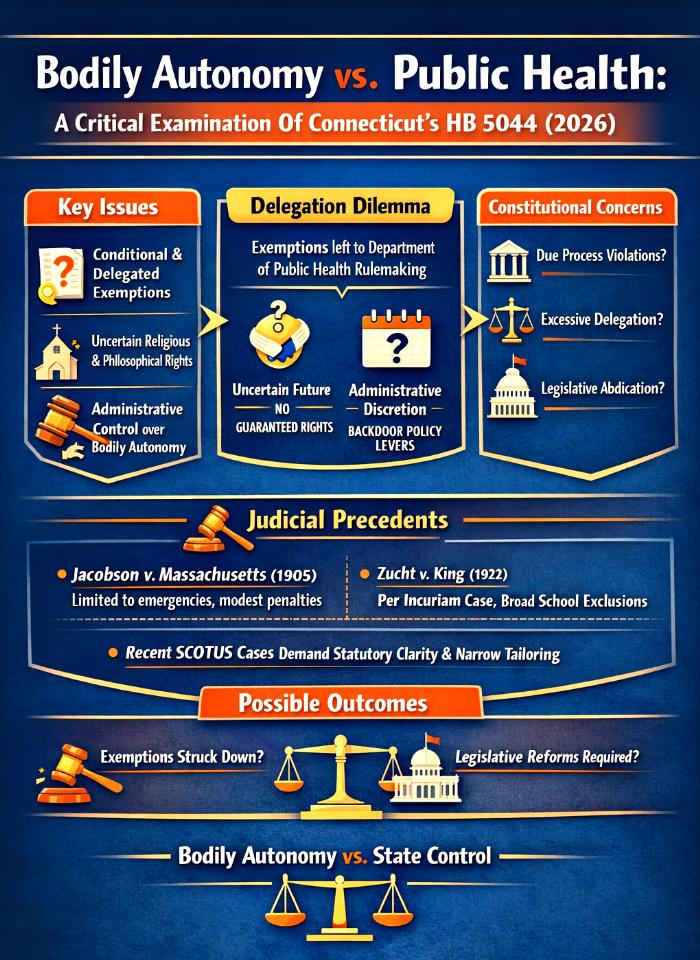
One of the most striking features of HB 5044 is its treatment of nonmedical exemptions as conditional, leaving their existence and scope to future statutory amendments or Department of Public Health (DPH) rulemaking. This design creates what can be described as a “backdoor problem”: instead of the legislature clearly defining exemptions in the statute itself, it delegates the responsibility to an administrative agency. While delegation is common in regulatory contexts, its use here raises constitutional concerns because exemptions implicate fundamental rights such as bodily autonomy, religious conscience, and equal protection.
From a constitutional perspective, the legislature’s failure to codify exemptions directly risks undermining predictability and rights protection. Individuals cannot rely on statutory guarantees if exemptions are left to administrative discretion. The DPH may issue rules, but it is equally free not to, meaning that rights are effectively reduced to regulatory favors rather than legislative entitlements. This undermines the principle that matters touching on fundamental liberties should be decided by elected representatives, not delegated to agencies. Courts have historically scrutinized such delegation when it affects core constitutional interests, and HB 5044’s structure invites similar challenges.
Moreover, the conditional design creates uncertainty about the future availability of exemptions. If the legislature did not enshrine them in HB 5044, there is little reason to expect lawmakers to reconvene solely to clarify them later. The practical effect is that religious and philosophical exemptions may never materialize, despite being nominally “conditional.” This ambiguity weakens the balance between public health and bodily autonomy, tilting the statute toward administrative efficiency at the expense of constitutional clarity. In this sense, HB 5044 risks becoming less a framework for rights protection and more a mechanism for administrative control.
Constitutional Challenge Scenario: Delegation, Exemptions, And Judicial Scrutiny
If HB 5044 were challenged in court, the central issue would be whether leaving religious and philosophical exemptions undefined and subject to Department of Public Health (DPH) discretion constitutes excessive delegation and an abdication of legislative responsibility. Courts would likely analyze the statute against the backdrop of Jacobson v. Massachusetts (1905), which upheld modest fines during a genuine epidemic but stressed that health measures must not be arbitrary or oppressive. Jacobson’s reasoning was tethered to emergency facts, proportionality, and limited penalties — none of which are clearly replicated in HB 5044’s conditional exemption design.
A litigant could argue that HB 5044 violates due process and equal protection by failing to provide statutory clarity on exemptions, thereby coercing compliance through exclusion from education or employment without legislative debate. The delegation to DPH creates a “backdoor” route for narrowing or eliminating exemptions, which courts may view as unconstitutional when fundamental rights are at stake. The critique of Zucht v. King (1922) as a per incuriam decision strengthens this argument: unlike Jacobson’s emergency‑specific fine, Zucht upheld indefinite exclusion from schooling absent contemporaneous emergency facts. HB 5044 risks repeating Zucht’s error by embedding exclusionary consequences without codified exemptions, effectively bypassing legislative accountability.
Modern jurisprudence further complicates HB 5044’s defense. Cases like Roman Catholic Diocese v. Cuomo (2020) and NFIB v. OSHA (2022) emphasize statutory clarity, narrow tailoring, and respect for constitutional rights even in emergencies. Under the “major questions doctrine,” courts now demand explicit legislative authorization when fundamental rights are implicated. HB 5044’s reliance on delegated legislation for exemptions could therefore be struck down as an unconstitutional delegation, requiring the legislature itself to define the scope of religious and philosophical exemptions. In this scenario, HB 5044 would be vulnerable not only because it mandates vaccines, but also because it abdicates the legislative duty to balance mandates with exemptions in the statute itself.
Conclusion
HB 5044 is a statute of dual character: administratively precise yet constitutionally ambiguous. Its strength lies in the clarity of medical exemptions, uniform procedures, and rapid emergency measures. However, its reliance on delegated legislation for nonmedical exemptions creates a “backdoor problem.” By failing to codify religious and philosophical exemptions directly, the legislature leaves them vulnerable to administrative discretion, reducing rights to regulatory favors rather than statutory entitlements.
This design undermines predictability and risks eroding bodily autonomy. Conditioning access to education, employment, or licensure on vaccination compliance without clear statutory exemptions can be perceived as coercive. Emergency provisions further compress procedural safeguards, normalizing exceptional measures that weaken due process. Ultimately, HB 5044 demonstrates how legislative precision can coexist with constitutional fragility. Its legacy will depend on whether courts and policymakers demand that exemptions be defined by statute rather than delegated to agencies. Without such clarity, HB 5044 risks becoming less a framework for balancing rights and more a mechanism for administrative control, tilting the scales against bodily autonomy in the name of public health.